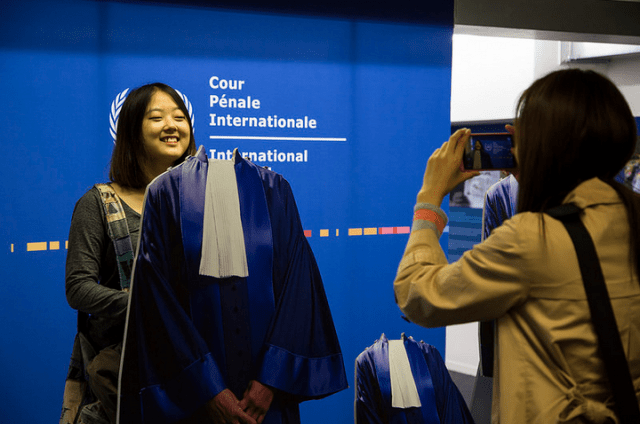
Visitors at the International Criminal Court (Photo: ICC)
The International Criminal Court (ICC) is doing a lot of things right and, almost 15 years since its establishment, it is also doing many things better than it used to. But one area it continues to struggle with is its communications strategies. This is an area of its work that is only growing in importance. Indeed, it is arguable that the ICC’s greatest challenge going forward isn’t singularly legal or solely political; rather, it is the fight over the perception of its work. From the ongoing cases in Kenya to the Court’s relationship with global powers and African states, all of these are being fought on the battleground of public perception. With its limited and squeezed budget, the Court simply cannot compete with states or individuals that have millions, even billions, of dollars at their disposal. But smart public relations strategies can have an equalizing force that belies their low cost. As a result, for a struggling institution, establishing and harnessing smart, creative and effective communication strategies should be of immense importance.
It remains unclear why the ICC seems reluctant to do much about its communications work. Perhaps it’s bureaucratic ineptitude. Perhaps it is a lack of leadership or staff. Perhaps it is a resource issue. Perhaps it is all of the above or perhaps it is none. But, in the spirit of being helpful rather than merely critical, here are seven easy and cost-effective things the Court could do to boost its public relations profile and thus its standing in the world. Importantly, this is not simply about the ICC’s ‘outreach’ which I take to encompass the Court’s activities aimed at affected communities and constituencies. This is about thinking of the Court as what it truly is: an international institution in a turbulent world of politics. Doing so means acknowledging and accepting the importance of public diplomacy and public relations.
1. Get a New Website. Seriously: New Website.
At this point, it is beyond inexcusable that the ICC still has the same website. It is hard, if not impossible, to think of a good enough or sufficient reason why the same website is still in place. It has been two and half years since some observers, including myself, began criticizing the Court’s web presence. And it has been and two years since the company the ICC outsourced the new website to offered glimpses of an ‘alpha’ version of the site (which was, it must be noted, a phenomenal improvement on the current edition). Still, we see no change.
Currently, basic information, let alone relevant court documents, is impossible to find on the website. There is virtually nothing user-friendly about it. The font is tiny, the photos are minuscule, and there’s something just so 1998 about it. As a teacher, I would find it irresponsible to send a student to the ICC’s website to learn about the Court. But more importantly, it turns away more potentially interested people than it attracts.
If justice needs to be seen to be done, the website is the logical portal for achieving that aim. The website must be priority number one and whatever stands in the way of rolling it out, must be overcome. Getting a website might be a bit costly but the Court has already invested in it and, more importantly, it is worth every penny. I hope that rumours of a new site being rolled out shortly are true. It is beyond overdue.
2. Focus Groups
As I mentioned above, it has been almost 15 years since the ICC became a functioning reality. But it seems increasingly difficult to know what the Court’s story really is today. What is the ICC truly about and for whom? To find that out, the Court should explore the use of focus groups amongst its various relevant constituencies.
One of the greatest dangers in marketing is believing that everyone loves your product as much as you do. It’s almost certainly never the case. Instead, good public relations is based on understanding what a brand is – a set of ideas about a product that truly resonates with a targeted audience. Focus groups could help the ICC figure out what its brand, as a justice producer, is. That brand, and the handful of ideas its based on, could then be plugged into sophisticated – but relatively inexpensive – communications strategies.
This is another policy that might come at some financial cost but it doesn’t necessarily have to. To do this kind of work, the ICC could partner with regional civil society organizations or academic institutions that would, I have no doubt, chomp at the bit to do such research.
3. Stream Key Trial Moments on Various Social Media and News Sites.
Another frustration for ICC observers pertains to viewing key trial moments (e.g. opening statements or verdicts) online. There have been times when the site has simply shut down due to having ‘too much’ traffic. At other times, it is only possible to view the courtroom in a tiny little square on the computer screen.
One way to resolve this, and to make the Court’s work more accessible in the meantime, is to stream these key moments on social media and news sites. There is no reason why the ICC should not have simultaneous streams on Facebook or Reddit as well as local news sites and their international counterparts like the New York Times and Guardian that would almost surely be happy for the free traffic. This would cost the ICC nothing.
4. Engage Meaningfully on Social Media
The ICC has a potentially vast and loyal following. We know this because the Court is in the news daily and because groups like Save Darfur or Invisible Children make documentaries that chime with parts of the ICC’s mission and which capture global attention. Whether one agrees with their message or not, these organizations understand the importance and value of social media. The Court, however, has a very superficial and sterile presence on social media. While its recently increased use of photographs is a welcome effort in allowing people to see developments at the ICC, rather than grasping that social media is primarily about engagement, the Court’s web presence is a repository of “this is what happened at the ICC today” news with links to the Court’s website. More can and should be done to turn the ICC’s social media presence into a strength of its public relations and outreach efforts.
Continue reading →