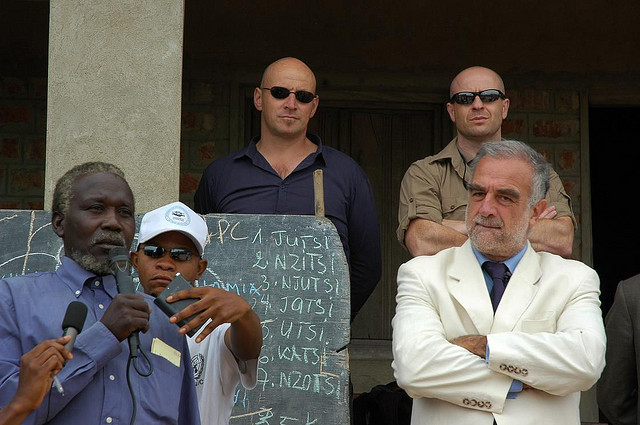
Former ICC Chief Prosecutor Luis Moreno-Ocampo in Ituri District, DRC (Photo: ICC)
It is no secret. The last few months and years have not been kind to the International Criminal Court (ICC). Fairly or not, the Court has been the target of a growing chorus of criticisms which insist that it unfairly targets African states and embodies the latest line of neocolonial tools imposed on weak states by the powerful West. In Libya, the ICC was left desperate and empty-handed in what was supposed to be its most recent legitimating exercise: i.e. intervening against the regime of Muammar Gaddafi. The Kenya cases – the first investigations opened by the Prosecutor’s office itself (rather than by referral from the UN Security Council or an ICC member-state) – are hanging by the thinnest of threads. Some of the Court’s biggest fish – like Joseph Kony and Omar al-Bashir, and the targets many expect should be in the Court – like Bashar al-Assad, seem more than comfortable evading justice. For adherents of the ICC, it isn’t a pretty picture.
One result of all of this calamity in the realm of international criminal justice has been a re-calibration of the expectations of what the ICC can – and cannot – deliver. This has happened not just within the halls of NGOs, academic institutions and political institutions like the UN but more subtly, within the Court itself.
Most notably, there appears to be a softening of the lofty rhetoric that the ICC can “end impunity” for war crimes, crimes against humanity and genocide. Instead, there is a nuanced but important shift towards maintaining that the ICC can contribute to ending impunity – not by prosecuting bad guys in The Hague – but by helping states prosecute perpetrators themselves.
As readers will know, a foundational premise of the ICC is that it acts in a complementary fashion to national jurisdictions. This is embodied within the Court’s principle of complementarity wherein the ICC can only investigate or prosecute crimes when the relevant state is unable or unwilling to do so itself. The Court’s first Prosecutor, Luis Moreno-Ocampo, famously exclaimed that the ultimate success of the ICC would be a world where there were no cases being prosecuted in The Hague because states were able and willing to prosecute international crimes themselves.

The judges of the ICD in charge of the Kwoyelo case (Justice and Reconciliation Project)
As the ICC has been unable to demonstrate that the majority of its warrants would be enforced, that it could have uncontroversially positive effects on the conflict and post-conflict situations in which it intervenes, and that it had the capacity to deter crimes or “end impunity”, the importance of the Court’s role in encouraging states to prosecute crimes themselves has achieved a new level of relevance.
Again, this is a nuanced shift. Complementarity has always been a core element of the ICC’s mandate. So-called “positive complementarity”, wherein the ICC galvanizes domestic interest and capacity to prosecute crimes, was placed centrally in the Office of the Prosecutor’s 2009-2012 prosecutorial strategy. But what we are witnessing now is a move from an expression of complementarity as a principle that differentiated the ICC from previous tribunals (especially the Rwanda and Former Yugoslavia tribunals) and a lofty end-goal, to entrenching complementarity as a current, primary and strategic goal of the the Court. Continue reading