Proponents of international criminal justice seem to be searching in vain for perfect justice in Syria. Iva Vukusic joins JiC for this timely post exploring the options for justice in Syria. Iva is an analyst and researcher based in The Hague. She previously worked for the Research and Documentation Centre and Special War Crimes Department of the Prosecutor’s office in Sarajevo.
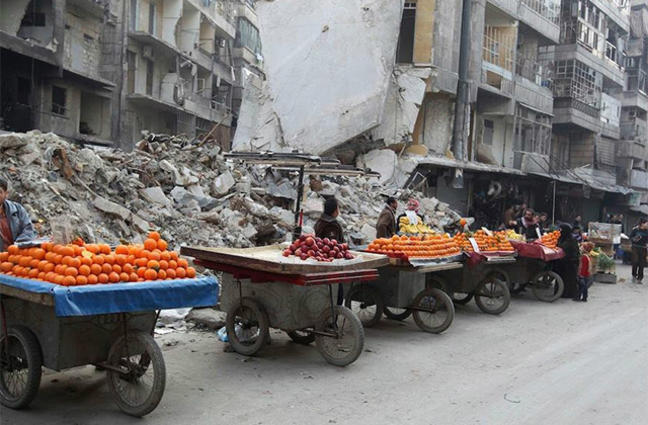
Fruit vendors in Aleppo, Syria, in February 2014 (Photo: Jalal Al-Mamo / Reuters)
Since March 2011, estimates suggest that 200,000 people have died in Syria but the crisis shows no signs of winding down and the future is uncertain. In these circumstances, planning a response to mass human rights violations and war crimes is difficult. But many believe Syria will need justice in order to move towards some sort of recovery. A referral of Syria to the International Criminal Court (ICC) is off the table for the time being so other options are being explored: an ad hoc tribunal or a hybrid institution being those most widely debated. Domestic prosecutions will potentially be possible in a more distant future and universal jurisdiction may provide justice in isolated cases.
So far, debates about justice have largely focused on the ICC. In 2013, the UN Commission of Inquiry concluded it is the appropriate venue to pursue the fight against impunity. Government forces, non-state armed groups and trans-border networks like ISIS all stand accused of crimes against humanity and war crimes but given the Security Council deadlock, other options are increasingly the subject of conversation between states, policy makers, NGOs, activists and the academic community. Even if the ICC got involved, it would not be able to address the immense number of violations as it would likely focus on a handful of perpetrators. Even those, it would probably have difficulty arresting. Other mechanisms, judicial and other, thus have to be discussed and the Syrians need to be included.
Advocates of an ad hoc or hybrid tribunal stress benefits like the capacity to work through a more substantial caseload and the ability to focus all institutional attention on one conflict. Some concrete suggestions have already been made with draft statutes. The ICTY has, for example, been rather successful but it had support from the EU through pressure exerted on states that wanted to join the Union. Critics, on the other hand, ask why establish a separate institution when a functioning ICC exists and if another institution would undermine the Court. In response, it can be said that the ICC may be functioning but it does not have jurisdiction, so in order to respond to the need for justice, exploring other options is legitimate. However, the issue should not be framed as a competition in which the ICC is being somehow ‘protected’ by sacrificing justice or a situation in which another institution somehow ‘threatens’ the Court. The need for justice is vast and there is plenty to do for a variety of institutions if they work in concert. Practical questions of jurisdiction would arise if the ICC worked alongside another court, so there is a need to anticipate potential problems that could arise with these scenarios.
Another issue with regards to the hybrid tribunal option is that such institutions require close collaboration with the state in question. What would that mean for Syria? This issue highlights the fact that all options now seem to center on the assumption of Assad’s regime falling. Much of the efforts go into documenting crimes by the regime (and much less on opposition groups where the hierarchy and command structures appear to be less clear and in flux). What if the regime doesn’t fall? What justice, if any, can we envisage in that scenario? With the recent gains of ISIS and the developments in Iraq, a regional dimension to the conflict is emerging. The longer the conflict goes on, the more complicated it becomes and whatever option will be implemented, prosecutors will have an incredibly difficult task in deciding on strategy and case selection. The work load is immense and the resources will be scarce. Outreach will be important in explaining to victims why some cases have been taken up while others remain unaddressed.

A woman carrying her belongings returns to her home in central Homs (Photo: European Pressphoto Agency)
Many will ask the question of cost and if it makes sense to pour so much money into justice (and we know from previous experiences that justice cannot be done on the cheap) when so many other needs exist: rebuilding infrastructure, schools, hospitals and roads. Surely, there will be limitations for funds. But it should not be framed as a choice between justice and reconstruction. All of these investments need to be made if Syria is to be turned into a functioning, stable state. Choices such as these are always hard in situations of competing priorities. But that does not mean compromises cannot be sought.
If a new court is established, institutional design and procedures will be discussed: are self-representation or in absentia trials possible? What about victim participation? To what extent would Syrian law be taken into account? How can the court be brought closer to the public and their ownership of the process ensured? Experiences with other courts will be crucial in this regard. Continue reading