Peace versus Justice in Syria

The venue of the Geneva II  peace talks (Photo: PressTV)

The venue of the Geneva II peace talks (Photo: PressTV)

As talks between the Syrian government and Syrian opposition stumble in the opening phases of the so-called Geneva II negotiations, a hot topic is whether those parties responsible for atrocity crimes in Syria can and should be prosecuted.

Of course, this debate has been ongoing since the beginning of the Syria’s civil war. Early on, Western governments funded a team of investigators to collect evidence of alleged war crimes and crimes against humanity, a process that has apparently continued to this day. At the same time, there have been numerous calls by organizations and states for the situation in Syria to be referred to the International Criminal Court (ICC). Because Syria is not a member-state of the ICC, doing so would require a resolution from the United Nations Security Council. Last September, the possibility of referring Syria to the Court was shot down by the Council. According to Carsten Stahn, the potential referral “was sacrificed for the purpose of facilitating a diplomatic compromise over the enforcement regime.”

For a host of reasons (and not just the tired argument that Russia will block any referral), an investigation of crimes in Syria by the ICC isn’t going to happen any time soon. Not even the use of chemical weapons against civilians was enough to alter the stalemate over justice and accountability. Making things particularly tricky is that there is evidence that both sides of the conflict have committed crimes within the jurisdiction of the ICC. Yet (and perhaps as a result), amongst those political actors with leverage, there appears to be little-to-no appetite for accountability in Syria. This is evidenced by the lack of interest in middle-ground options such as a conditional referral, a referral-deferral or the creation of an ad hoc tribunal.

Of course, any suggestion that international criminal justice should be pursued in the context of ongoing hostilities in Syria leads us to the familiar “peace versus justice” debate. Within this debate, there are broadly two camps: one which views international criminal justice as a necessary and useful tool which can deter crimes, marginalize perpetrators and even be conducive to peace negotiations; and a second camp which sees judicial interventions as deleterious to peace talks and claims that it creates disincentives for warring parties to negotiate and leads to increased levels of violence.

To date, those who have engaged in the debate have largely recycled the claims and arguments from one camp or the other and applied them to new and emerging contexts. Thus any potential prosecution of Bashar al-Assad is either necessary to any sustainable peace in Syria or constitutes a naive and dangerous proposition which could prolong violence in the country.

United Nations-Arab League special envoy for Syria Lakhdar Brahimi, US Secretary of State John Kerry and Russian Foreign minister Sergey Lavrov (Photo: Getty Images)

United Nations-Arab League special envoy for Syria Lakhdar Brahimi, US Secretary of State John Kerry and Russian Foreign minister Sergey Lavrov (Photo: Getty Images)

If the Geneva peace talks ultimately fail, it obviously won’t be because of the ICC but a host of other factors. But if the ICC does intervene and the peace talks also fail, critics will point their accusatory fingers at the Court, ascribe responsibility for the failure of negotiations to the Prosecutor and neglect the very factors that would have led to the talks failing irrespective of an ICC intervention. The moving parts would be brushed aside because, within the dominant lenses of the “peace versus justice” debate, the ICC can only help or a hinder to peace. It remains too rarely conceded that the Courts effects are mixed and, even more rarely, that they might be negligible. Continue reading

Posted in Peace Negotiations, Syria | Tagged , | 3 Comments

The ICC in Afghanistan: Peace, Justice and Accountability

Djeyhoun Ostowar joins JiC for this fascinating glimpse into some of the key issues and dilemmas that frame any potential intervention by the International Criminal Court into Afghanistan. Djeyhoun is a PhD student at the War Studies Department of King’s College London where his research focuses on the nexus of peace and justice in Bosnia and Afghanistan, in particular assessing the timing and sequencing of different peace building and transitional justice mechanisms.

(Photo: UNAMA)

(Photo: UNAMA)

Debates on justice in Afghanistan have generally neglected the role of the International Criminal Court (ICC). International and national attention has focused on domestic opportunities for justice. Following the notorious silence on accountability in the initial phases of the post-Taliban transition, the work of the civil society, in particular the Afghanistan Independent Human Rights Commission (AIHRC), inspired some hope that justice for heinous crimes committed during the different stages of the unyielding conflict in Afghanistan (1978 – ) could still be achieved. However, the comprehensive and ambitious Transitional Justice Action Plan that was signed by President Karzai in 2005 failed dramatically and was eventually discarded altogether in 2010.

With the disappointment over transitional justice options in Afghanistan, the passing of an amnesty law in the Afghan parliament in 2007, and the now imminent drawdown of military and political engagement of the international community in the country after 2014, the ICC has become one of the very few serious options still available in the face of impunity for past crimes and a lack of serious accountability measures for ongoing violations in Afghanistan. Afghanistan is currently only at the preliminary investigation stage at the ICC but at some point in the near future it will have to be decided whether formal investigations should start (the country has been in the preliminary examinations for more than 6 years – the longest period so far). There are many issues that can be raised in connection to the potential operation of the ICC in Afghanistan but the key question is how the ICC could affect the prospects for peace and stability in the country.

The ICC in Afghanistan: Obstacles Abound

Any potential involvement of the ICC in Afghanistan faces many challenges/ It is therefore important to be realistic about what the ICC can achieve in terms of justice and accountability in this country. There is not only the obvious temporal limitation of addressing only the crimes that were committed from 1 may 2003 (the date of the start of the ICC jurisdiction on the territory of Afghanistan) – thereby leaving various incidents and abuses prior to this date beyond the consideration of the court – but also a number of other concrete practical and legal obstacles. There is a basic question of who will be responsible for and likely to follow through the commitment of detecting, apprehending and extraditing potential ICC indictees.

As it stands, the prospects are not particularly encouraging. Neither the Afghan government, despite its ratification of the Rome Statute, nor the government of the main international intervening force, the US, has shown openness to the idea of delivering own citizens at an international court. There is no need to explain that the chances that the Taliban and affiliated armed groups will ever cooperate with an international court are almost nonexistent.

Furthermore, there are serious legal challenges associated with the endeavour. Washington still does not recognize the jurisdiction of the ICC and even has a controversial law dubbed ‘The Hague Invasion Act‘, under which the American forces could unilaterally invade the Netherlands to free American war crime detainees. There is no historical precedence on this yet so the validity and practical value of the Act has not been tested. But as pointed out by Kevin Jon Heller in a post on the topic, the US and Afghanistan also have a ‘bilateral immunity’ agreement, signed in September 2002. This agreement imposes direct legal constraints on the Afghan government’s ability to surrender US citizens to the ICC, independently from the rather slim chance of a hypothetical situation where the Afghan government would seek to apprehend an American citizen in order to extradite him/her to the Court (imagining a top Taliban detainee being delivered to the ICC by Kabul instead of being prosecuted at home is only slightly more imaginable).

The ICC, and perhaps the International Court of Justice (ICJ), in case of a legal dispute between the US and Afghanistan, would have to grapple with this limitation as a separate question. In addition to the problems mentioned above, there are a multitude of other legal and practical challenges associated with investigating specific crimes in a situation of ongoing conflict, identifying direct suspects when some of them may not longer be on the territory of Afghanistan, and dealing with such issues as ‘command responsibility’ and ‘proportionality’ in military operations.

An Afghan soldier in Wardak Province, Afghanistan (Photo: Mauricio Lima / The New York Times)

An Afghan soldier in Wardak Province, Afghanistan (Photo: Mauricio Lima / The New York Times)

Hope Remains

While the above mentioned challenges should not be ignored nor be underestimated, they do not provide sufficient reason to give up the ICC option. Some see an ICC intervention as potentially detrimental. Rahim Kanani warned against “the inevitable political ramifications” in case an official investigation by the ICC would start. He explained: “If a case is officially opened, the Prosecutor must deal with both allegations against the Taliban and the NATO troops. While the former yields no grief, the latter will surely cause a stir”. However, an immediate question here would be: is there any situation where the ICC has opened investigations that was completely uncontroversial politically? Political stir and controversy are not in themselves sufficient justification for opposing the involvement of the ICC. Similarly, the challenge of realizing apprehensions and extraditions is not particular to the case of Afghanistan. In the situations of Northern Uganda and Sudan, for example, this problem was apparent, with the ICC not being able to count on sufficient cooperation in terms of arresting and delivering the indictees. Other issues, such as legal obstacles related to jurisdiction, the bilateral immunity agreement, command responsibility are all real challenges. However, as in any similar situation, these questions should be left for the ICC – or another appropriate legal authority – to adjudicate. Continue reading

Posted in Afghanistan, International Criminal Court (ICC), International Criminal Justice | Tagged | 1 Comment

Iraq’s Long Shadow of Injustice Haunts Britain

(Photo: PressTV)

(Photo: PressTV)

Earlier this week, I wrote a post on the filing of a complaint at the International Criminal Court (ICC) over alleged abuses committed by UK officials in Iraq. On Tuesday, I attended the official launch of the complaint at the Law Society in London and subsequently had the opportunity to write a more comprehensive article over at Foreign Policy. For those interested, here’s an excerpt:

It is often said that unresolved human rights violations cast a long and harrowing shadow. Atrocities and crimes committed in the past can come back to haunt even the most powerful states. For Britain, that restless shadow is the war in Iraq.

Earlier this week, two groups — the European Center for Constitutional and Human Rights (ECCHR) and Public Interest Lawyers (PIL) — lodged a formal complaint at the International Criminal Court (ICC), demanding that the ICC investigate British political and military officials for their alleged role in the commission of war crimes in Iraq. The filing maintains that senior figures within the British government bare the greatest responsibility for systematic torture and cruel, inhuman, and degrading treatment of Iraqi citizens between 2003 and 2008.

The complaint comprises a judiciously organized, comprehensive, 250-page dossier. Notably, it relies not only upon witness testimony but on documents and manuals revealed and produced by various commissions, inquiries, and British ministries. Its focus is on Britain’s Ministry of Defense and officials such as General Sir Peter Wall, former Defense Secretary Geoff Hoon and former Defense Minister Adam Ingram. Those hoping to see former Prime Minister Tony Blair targeted will be disappointed; his name does not appear once in the filing.

While the ICC is frequently criticized for its myopic focus on sub-Saharan Africa, attention has shifted in recent years, rather dramatically, toward the Middle East and North Africa. The court has grabbed headlines for its actual and potential role in LibyaSyriaPalestine, and now Iraq.

Still, the complaint should not be confused as constituting a judicial intervention into Iraq. Rather, this week’s filing could represent the best opportunity to expose senior British officials to investigation by the ICC. This poses an unprecedented political and legal challenge for the court.

You can read the rest of the post here.

Posted in International Criminal Court (ICC), Iraq | 2 Comments

Rethinking Amnesty and Accountability

On 2 January 2014, Nepal’s Supreme Court ordered the Nepalese Government to amend a law to establish a truth commission with the power to recommend amnesty. The Court also instructed the government to establish a team comprising conflict experts, victims’ representatives, human rights law experts and other stakeholders to advise on how to make the amnesty provisions compliant with domestic and international law. In this guest-post, Louise Mallinder argues that The Belfast Guidelines on Amnesty and Accountability, recently published by an Expert Group of scholars and practitioners, could provide a valuable resource to inform these debates. Louise is a reader in international law and human rights at the Transitional Justice Institute, University of Ulster. 

(Photo: AP)

(Photo: AP)

Nepal’s decade-long civil war claimed the lives of over 13,000 persons. There were 1,300 enforced disappearances. The country’s transition from conflict and autocratic rule has been arduous. It began with signing of the Comprehensive Peace Agreement in 2006, in which the main political parties and the Maoist rebels committed themselves to investigating and taking “lawful action … against individuals responsible” for human rights violations, refraining from encouraging impunity, and providing reparations to victims. Still, since 2006, political instability has returned and the country has made limited progress in addressing the legacy of the conflict.

Draft legislation on a truth commission and a separate Disappearances Commission were subject to public consultation in 2011 but failed to be promulgated before parliament was dissolved in May 2012. In the absence of a functioning legislature, the Council of Ministers, representing the four major political parties, adopted the Ordinance on the Investigation of Disappeared Persons, Truth and Reconciliation Commission (unofficial translation) in August 2012. The President enacted the Ordinance in March 2013. It immediately faced criticism from victims’ organizations and human rights campaigners, including the OHCHR.

The Commission’s Powers to Recommend Amnesty and Prosecutions

The Ordinance provided that the Truth and Reconciliation Commission would be tasked with investigating disappearances, crimes against humanity and gross violations of human rights and recommending reparations for victims. It would also work to end the “state of impunity by bringing perpetrators” of serious violations “under the ambit of the law”.

More controversially, the Commission would be empowered to recommend that the Nepalese Government grant amnesty to individual offenders. The Ordinance did not explicitly propose amnesty be granted for gross violations of human rights, stipulating that amnesty could not be recommended for “serious crimes that lack sufficient reasons and grounds for granting amnesty”. However, it also did not define “serious crimes” nor clarify the grounds that could prevent serious crimes being amnestied.

For an offender to be eligible for amnesty, the Ordinance stipulated that he or she must

  • Inform the Commission of the facts relating to the full extent of his or her involvement in crimes during the armed conflict
  • Submit an individual written application for amnesty
  • Repent in writing their ‘misdeeds’ during the conflict “to the satisfaction of the victim”

The Commission would have robust investigative powers, but the Ordinance did not address how the Commission would determine if offenders had truthfully disclosed their criminal acts.

The Commission could also recommend to the Attorney General that perpetrators be subject to legal action under existing law. If the Attorney General decided to prosecute a case, the Ordinance stipulated that charges must be filed within 35 days. There is no requirement in the Ordinance that charges must be brought following a recommendation from the Commission. In deciding whether or not to recommend amnesty, the Commission had the option of consulting victims.

Government troops on a patrol in 2005 (Photo: Gurinder Osan / AP)

Government troops on a patrol in 2005 (Photo: Gurinder Osan / AP)

Supreme Court’s Decision on Amnesty

A coalition of victims’ organizations responded to the Ordinance by demanding that the Supreme Court repeal the sections relating to amnesty and amend the legislation to require prosecutions. In its January 2014 decision, the Court ordered a series of amendments. With respect to amnesty, it held that:

“The provision of amnesty in Section 23 of the Ordinance does not appear to have guaranteed not to recommend amnesty for [serious violations of human rights]. These crimes are made the subject of amnesty, and instead of making participation and consent of victims for the amnesty process primary, it has been made secondary. This makes it evident that this provision is against the victims’ fundamental right to justice including their right to life and liberty, right to information, right against torture, and against the accepted principles of justice. Therefore, this provision needs to be reviewed, reformed and amended accordingly.” (emphasis in original)

This raises two questions that must be addressed by the proposed Nepalese Expert Group and in the amendments to the legislation:

  • What legal prohibitions exist on the granting of amnesty for serious crimes?
  • What role should victims have in decisions to recommend or grant amnesty?

These questions are among the issues tackled in the Belfast Guidelines on Amnesty and Accountability.

The Approach of the Belfast Guidelines on Amnesty and Accountability

The Belfast Guidelines were produced by a group of independent, interdisciplinary scholars and practitioners around the world. The Guidelines aim to assist all those seeking to make or evaluate decisions on amnesties and accountability in the midst or in the wake of conflict or repression. Their recommendations draw on international legal sources, such as international treaties and customary international law; decisions
 by international criminal courts and human rights bodies; UN declarations, guidelines, resolutions and other standards; as well
as national amnesty processes and case law, and scholarly writings. Continue reading

Posted in Amnesty, Guest Posts, Nepal | Tagged , | 1 Comment

The ICC and Iraq: “A Pinochet Moment”?

Former UK PM Tony Blair in Iraq (Photo: PA)

Former UK PM Tony Blair in Iraq (Photo: PA)

A formal complaint has been lodged at the International Criminal Court (ICC) requesting that senior British military and political officials – including General Sir Peter Wall, former Defence Secretary Geoff Hoon and former Defence Minister Adam Ingram – be investigated for their alleged responsibility for war crimes committed during the war in Iraq. The complaint was filed by two groups: the European Centre for Constitutional Rights (ECCHR) and Public Interest Lawyers (PIL). The UK government has vociferously rejected any notion of the ICC investigating British officials, maintaining that enough is being done to ensure that any abuses by British troops are investigated and prosecuted.

This isn’t the first time that the ICC has been asked to investigate alleged atrocities committed by intervening powers in Iraq. The ICC’s Office of the Prosecutor has received hundreds of such requests. In 2006, former ICC Chief Prosecutor Luis Moreno-Ocampo dismissed the idea of an official investigation on the grounds that the alleged crimes were not of sufficient “gravity” to warrant further investigation or prosecution.

Some believe, however, that the Prosecutor was guided by a desire not to ruffle the feathers of Western states, particularly the US. A Wikileaks cable painted Moreno-Ocampo as being reluctant to investigate alleged crimes in Iraq:

Less clear are [Ocampo’s] views on Iraq,” the cable states. “Ocampo has said that he was looking at the actions of British forces in Iraq — which … led a British ICTY prosecutor nearly to fall off his chair.

Privately, Ocampo has said that he wishes to dispose of Iraq issues (ie. Not to investigate them.)”

Reports of the former Prosecutor’s recalcitrance fit well with the view that Moreno-Ocampo sought to mollify and accommodate US political interests with the ultimate aim of improving the tumultuous relationship between the world’s superpower and the fledgling new court. This is incisively explored in David Bosco‘s new book, Rough Justice: The International Criminal Court in a World of Power Politics.

Still, this apparent accommodation to Western powers has come at a significant cost to the ICC’s legitimacy and reputation. For many, this is particularly evident in the growing perception of the Court as an institution applying uneven justice and only targeting weak states. This issue was eloquently covered in a recent article by Professor William Schabas, entitled The Banality of International Justice.

338793_troopsSchabas, who is also involved in the Iraq filing, has drawn parallels between the request to investigate alleged abuses by British forces in Iraq and the perception of the ICC as being a biased Court. In describing the PIL and ECCHR’s filing, Schabas declared:

“What this application does is throw down the challenge to the court to show there are no double standards.”

A similar point was made by ECCHR Secretary General, Wolfgang Kaleck:

“The International Criminal Court in The Hague is the last resort for victims of torture and mistreatment to achieve justice. Double standards in international criminal justice must end. War crimes and other severe violations of human rights must be investigated and prosecuted, regardless of whether they are committed by the most powerful.”

Continue reading

Posted in International Criminal Court (ICC), Iraq | 5 Comments

A Snowball’s Chance in Cairo: The ICC To Intervene in Egypt?

A protestor cheers after a Muslim Brotherhood office was ransacked (Photo: Reuters)

A protestor cheers after a Muslim Brotherhood office was ransacked (Photo: Reuters)

A group of international lawyers and legal scholars representing the Muslim Brotherhood are pushing for the International Criminal Court (ICC) to investigate alleged crimes committed in Egypt. According to The Globe and Mail’s Paul Waldie, the Brotherhood’s legal team believe that violence committed by the Egyptian army constitutes crimes against humanity:

The legal battle is led by a team in London that includes one of Britain’s top international criminal lawyers, a former official with the United Nations and the former director of public prosecutions in Britain. The lawyers have not only filed a complaint with the ICC alleging widespread crimes against humanity by the military, but they also plan to file a series of lawsuits around the world targeting individual Egyptian army officers.

The most obvious obstacle to the ICC intervening in Egypt is the fact that the country is not currently a member-state of the Court, despite occasional proclamations that it would sign and ratify the Rome Statute. Thus, for the ICC to investigate any alleged crimes committed in Egypt, one of two things would have to occur: First, the UN Security Council could refer Egypt to the ICC. It goes without saying that that is not going to happen; such a referral is not on the Council’s radar. Second, the Egyptian government could voluntarily refer a particular event or time-period to the ICC, even if Egypt is a non-member state. There is precedence for this. Despite not being a member of the ICC, Ivory Coast accepted the Court’s jurisdiction in April 2003.

This second option represents what the legal team representing the Muslim Brotherhood believe should happen. And it is here where their efforts become particularly controversial and political. The team seems to be suggesting that the ousted former President and Muslim Brotherhood leader Mohammed Morsi, is the rightful leader of Egypt and, therefore, can refer violence in Egypt to the Court. This is a tenuous argument at best. While there are ongoing questions about the legitimacy and legality of the coup that deposed Morsi, there are few who would suggest that he remains the head of state of Egypt. According to Kevin Jon Heller, for example,

“…there is much question that the Brotherhood is no longer the government of Egypt. A number of states have condemned the Egyptian military’s actions … but none to my knowledge have refused to recognize the Mansour government. And just as importantly, representatives of the Mansour government have continued to represent Egypt at the UN.”

Morsi former US Secretary of State Hilary Clinton (Photo: Flickr)

Morsi former US Secretary of State Hilary Clinton (Photo: Flickr / Political Violence @ a Glance)

Thus, beyond an intellectual exercise, it would be hard, if not impossible, to argue that Morsi was the rightful President of Egypt who could request the ICC to investigate alleged crimes committed in the country.

But there is another issue to consider here: does the ICC have any interests in intervening in such a case? After all, the filing has been made and at some point (likely in the distant future), the Court’s Office of the Prosecutor will have make an official decision to open an investigation or not.  Continue reading

Posted in Egypt, International Criminal Court (ICC), Palestine, Palestine and the ICC | Tagged , | 4 Comments

Happy 2014 from JiC (Plus Predictions)!

fireworks-wallpapers-fireworks-blue-hd-pics-1Dear readers,

Happy New Years!

2013 brought a host of fascinating developments in the world of international criminal justice. With around a 100 posts, our regular contributors, guest-posters and I myself tried to cover as much as we could and provide thoughtful commentaries. We look forward to doing the same in 2014.

To ring in the new year, here are five predictions (some more plausible than others) for 2014:

– The ICC will open its first official investigation outside of the African continent. It will ruffle the feathers of Western powers, but the Court’s investigations will be restricted enough not to make them sweat.

– Joseph Kony will remain elusive. There may be reports of “surrender talks” or perhaps even his death but he will not be captured.

– Another Libyan will be indicted by the ICC and Libya will not have any issue with it. But, when 2015 rolls around, Saif al-Islam Gaddafi will still not have been tried and the ICC’s Office of the Prosecutor will not have any issue with it.

– Not only will the Court not intervene in Syria, but no resolution at the UN Security Council will be proposed to refer the situation there to the ICC.

– I will finish my PhD.

What are your predictions?

Thank you all, as always, for your readership and contributions. Here’s to another year of a little more justice and a little less conflict!

Mark

Posted in JiC News | 2 Comments

UPDATED – What a Mess: ICC Prosecutor Seeks Delay in Kenyatta Trial

(Simon Maina/AFP/Getty Images)

(Simon Maina/AFP/Getty Images)

Yet another twist in the trial of Kenyan President Uhuru Kenyatta. Yet another win for victory for critics of the International Criminal Court (ICC). And yet another delay in the pursuit of justice and accountability for Kenya’s 2007/08 post-election violence.

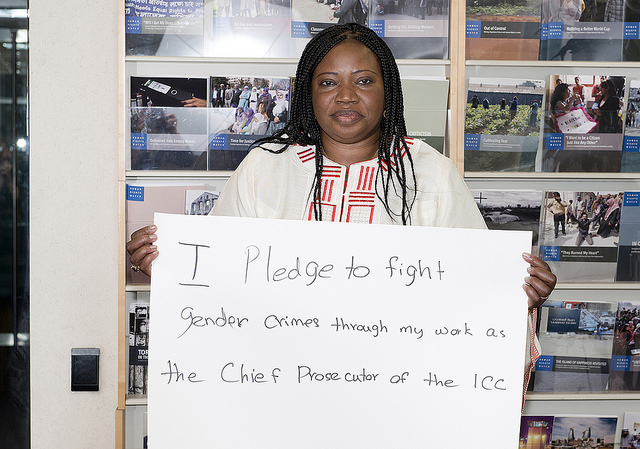
The Kenya trials have already been ravaged by incessant controversy, repeated delays and a nasty war of words between Kenya, its allies and the Court. Now, ICC Chief Prosecutor Fatou Bensouda has declared that the prosecution does not have enough evidence to proceed with Kenyatta’s prosecution and, as a result, is seeking an adjournment in the trial. The Prosecution’s reasoning is based on the fact that some of its key witnesses were no longer reliable and thus “the case against Mr. Kenyatta does not satisfy the high evidentiary standards required at trial.”

From the outset of her statement, the Prosecutor sought to make it clear that her decision was based on legal reasoning and not external political pressure:

My decision is based solely on the specific facts of this case devoid of extraneous considerations. As Prosecutor, I have consistently stated my actions and decisions are at all times strictly guided by the evidence in accordance with the Rome Statute legal framework. This recent decision is no different. It is my professional duty to react, and to take the necessary decisions when the state of the evidence changes, as it has in this case.

In truth, it won’t really matter whether the decision was legally based or not. On the back of the Assembly of States Parties conference where states agreed to accommodate Kenyatta’s request to avoid being present at trial, as well as  significant pressure on the Court to ease-up on Kenyatta and his deputy, William Ruto, this decision will ultimately be perceived as political. And to a large degree it is a response to political developments – especially if the Prosecution is correct and its host of problems with evidence in the Kenya cases stems from Kenyatta allies intimidating and tampering with witnesses.

Bensouda also stated that this was not the end of her efforts to bring justice for post-election violence in Kenya:

“To the people of Kenya, my decision to apply for an adjournment today was not taken lightly and I have explained fully to the Judges the reasons for my exceptional decision. I have and will continue to do all that I can to realise justice for the victims of the 2007-2008 post-election violence.”

Will we ever see Kenyatta in an ICC courtroom again? (Photo: ICC)

Will we ever see Kenyatta in an ICC courtroom again? (Photo: ICC)

Curiously, Bensouda’s statement does not say that pursuing justice in Kenya requires prosecuting Kenyatta. Indeed, the most bizarre thing about the Prosecutor’s decision is that it appears to be a request for an indefinite delay to the trial (Update: this has now been clarified by the Prosecutor – see below). There is no indication as to when the Prosecution will be prepared to proceed with proceedings – or will even aim to be ready. Judges are likely to request the Prosecutor to be more specific about what type of time-frame she has in mind. After all it would likely be a breach of fair trial standards – not to mention justice – to have an open-ended threat that prosecution will continue at some undefined point in the future. The Prosecutor needs to be much more clear about what the plan is. If that’s not possible…  Continue reading

Posted in ICC Prosecutor, International Criminal Court (ICC), Kenya, Kenya and the ICC | 14 Comments

The ICC in the Central African Republic: The Death of Deterrence?

(Photo: Xavier Bourgois / AFP/ Getty Images)

(Photo: Xavier Bourgois / AFP/ Getty Images)

The Central African Republic (CAR) is “descending into chaos“. In the past few months, violence and instability in the country have proliferated. In November, the French Foreign Minister even used the ‘g-word’ to describe the situation in the CAR, declaring that “[t]he country is on the verge of genocide”. Jean Ging, of the UN’s Office for the Coordination of Humanitarian Affairs, similarly suggested that the country is sowing the “seeds of genocide“.

In response to the crisis, the international community has immersed itself knee-deep into another military and humanitarian intervention. Last week, the UN Security Council unanimously authorized France and African Union forces to use “all necessary measures” to protect civilians. The African Union and the UN Security Council have their work cut out for them. In endorsing international intervention into the CAR, the International Crisis Group stated:

Over nine months, the weak Central African Republic (CAR) state has collapsed, triggering a serious humanitarian crisis, with 400,000 displaced and nearly half the population in need of assistance. The transition government and the regional security force have failed to prevent a descent into chaos in urban areas, in particular Bangui, as well as in the countryside. After months of “wait-and-see” and following deadly clashes, the international community now realises it cannot afford another collapsed state in Africa. Unfortunately, the situation on the ground is deteriorating at a much faster pace than the international mobilisation, and Bangui is vulnerable to a total breakdown in law and order.

This week, the International Criminal Court’s chief prosecutor, Fatou Bensouda, waded in:

The Office of the Prosecutor expresses its concerns over the unfolding events in the Central African Republic (CAR), and in particular reports of serious on-going crimes.  The deteriorating security situation over the past several days has contributed to the escalation of unlawful killings, sexual violence, recruitment of child soldiers and other grave crimes, across the country.  The situation worsens daily and thousands of civilians are fleeing the violence.

(Photo: Alaian Amontchi / Reuters)

(Photo: Alaian Amontchi / Reuters)

Bensouda also threatened that those committing crimes under the Court’s jurisdiction risk being prosecuted:

War crimes, crimes against humanity and genocide fall under the subject matter jurisdiction of the International Criminal Court.  I hereby call upon all parties involved in the conflict, (including former Séléka elements and other militia groups, such as the anti-Balaka), to stop attacking civilians and committing crimes, or risk being investigated and prosecuted by my Office.

Bensouda’s comments should be understood as an attempt at shooting a warning shot across the bow of potential perpetrators in the CAR in order to deter potential crimes. Such warnings are a regular part of the Prosecutor’s modus operandi. In August the Prosecutor declared that “that crimes that may fall under the jurisdiction of the International Criminal Court continue to be committed in CAR, including attacks against civilians, murder, rape, and recruitment of child soldiers.” Similar statements have been made in the case of Mali and the Ivory Coast in an attempt to deter actors from committing crimes.

But here’s the thing: deterrence hasn’t worked in the Central African Republic – like at all. It has been almost ten years since the CAR government referred itself to the ICC. Former DRC President Jean-Pierre Bemba is on trial for his alleged responsibility for war crimes and crimes against humanity committed in the CAR. But the ICC’s intervention hasn’t prevented – or really had any effect – on the country’s slide into political violence and slaughter. Making matters worse, it is exactly the types of crimes that the ICC has focused on – sexual violence, mass displacement, executions of civilians and the use of child soldiers – that characterize the current violence in the CAR.  Continue reading

Posted in Central African Republic (CAR), Deterrence, ICC Prosecutor, International Criminal Court (ICC), International Criminal Justice | 3 Comments

What Mandela Teaches Us: Negotiating Between Good and Evil

(Photo: Reuters)

(Photo: Reuters)

The year 1997 marked the height of Libya’s isolation from the international community. The regime of Muammar Gaddafi was under strict sanctions from the United Nations, the European Union, and the United States, amongst others. For its alleged role in a vicious laundry list of transgressions, including the bombing of a German discotheque, Pan Am Flight 103 over Lockerbie, and UTA Flight 772, Libya was castigated as a sponsor of international terrorism. Its leader painted as the embodiment of evil and the “mad dog of the Middle East“.

By 1997, it had also been three years since Apartheid had ended. Nelson Mandela was the immensely popular and universally revered President of South Africa. The country was destined for a more just, fair and egalitarian future. For his role in South Africa’s peaceful transition from autocratic Apartheid to stable democracy, Mandela was considered a saint and joined a select group of individuals whose names would forever be associated with peace and justice.

In that same year, the two men met. According to a New York Times report of the event, Mandela embraced Gaddafi and defiantly criticized the West for its role in ostracizing the Libyan despot:

In Tripoli Mr. Mandela, 79, greeted Colonel Qaddafi with a hug and a kiss on each cheek, saying, “My brother leader, my brother leader, how nice to see you.”

Shortly afterward, he told reporters that he remained unimpressed by American opposition to his mission, adding: ”Those who say I should not be here are without morals. I am not going to join them in their lack of morality.”

Mandela’s visit was undoubtedly a boon for Gaddafi. Just a year earlier, in 1996, Gaddafi had ordered the slaughter of some 1,200 prisoners in the notorious Abu Salim prison massacre. Yet here was Mandela, a man so widely respected that he was largely beyond criticism – from the West or anyone – visiting Tripoli and hugging Gaddafi. For Mandela, the trip was apparently a payment of gratitude for Gaddafi’s support for the anti-Apartheid movement during Mandela’s long imprisonment.

The personal bonds between Mandela and Gaddafi went deep. One of Mandela’s grandsons was named after the deposed Libyan leader. Their political relationship was also close. Mandela was instrumental in brokering the 1999 breakthrough deal between Western states and Libya that brought the Lockerbie suspects to trial. Later, Mandela believed that Abdelbaset al-Megrahi had been wrongfully convicted of the crime, visited him in his Scottish prison, and welcomed his repatriation to Libya in 2009.

At the time of the Lockerbie deal, the South African President intimated that his personal relationship with Gaddafi had produced a political breakthrough and, more importantly, that diplomacy and negotiation must always remain an option:

“No-one can deny that the friendship and trust between South Africa and Libya played a significant part in arriving at this solution… It vindicates our view that talking to one another and searching for peaceful solutions remain the surest way to resolve differences and advance peace and progress in the world.” Continue reading

Posted in Apartheid, Justice, Libya, South Africa | Tagged | 6 Comments