The following is a guest-post by Rhodri C. Williams, a human rights consultant and commentator who recently began working on rule of law issues in Libya with the International Legal Assistance Consortium. Rhodri also writes at his fantastic TerraNullius blog. In this post, Rhodri examines the uneasy relationship between international criminal law and post-conflict reconciliation.
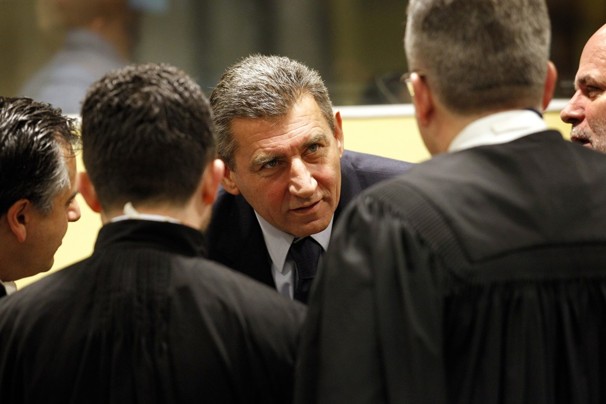
Ante Gotovina shortly after being told he and Mladen Markac had been acquitted (Photo: AP / Washington Post)
In April 2011, Trial Chamber I of the International Criminal Tribunal for the former Yugoslavia (ICTY) convicted two Croatian Generals, Ante Gotovina and Mladen Markač to lengthy jail terms for their role in planning and carrying out ‘Operation Storm’, a 1995 offensive that resulted in the flight of up to 250,000 Croatian Serbs from their homes in the Krajina region of Croatia. At the time, the conviction hardly came as a shock given that the Storm campaign was widely seen as one of the most large-scale episodes of ethnic cleansing among the many that the 1990s wars in the former Yugoslavia had to offer.
But last Friday, in what has been described as “one of the most comprehensive reversals of the tribunal’s 19-year history”, the Appeals Chamber eviscerated the Trial Chamber’s findings and ordered the immediate release of both defendants. The summary read out in court reflected the Appeals Chamber’s acceptance of both the defense’s key arguments: first that the shelling of four Serb-held towns at the outset of the offensive had not been unlawful, and second, that absent unlawful shelling, the Trial Chamber’s finding of a ‘joint criminal enterprise’ (JCE) to permanently remove the Serb population of the region could not stand in regard to the defendants.
As I’ve described at TerraNullius, at the time of the Trial Chamber decision, the finding of the existence of a JCE by the Trial Chamber tied the defendants to a range of discriminatory actions and policies that accompanied the offensive. Perhaps most notably in relation to the current situation of Krajina Serbs, thousands of whom remain displaced, such acts included both the destruction of private property and the ex lege cancellation of Croatian Serb refugees’ rights to ‘socially owned’ apartments they had often occupied for generations.
As set out in the summary of the decision, the rejection of a JCE removed this link, leaving insufficient evidence to tie the defendants to the policy of expelling Serbs found by the Trial Chamber:
…the Appeals Chamber, Judge Agius and Judge Pocar dissenting, considers that the Trial Chamber’s findings on the JCE’s core common purpose of forcibly removing Serb civilians from the Krajina rested primarily on the existence of unlawful artillery attacks against civilians and civilian objects in the Four Towns. While the Trial Chamber also considered evidence concerning the planning and aftermath of the artillery attacks to support its finding that a JCE existed, it explicitly considered this evidence in light of its conclusion that the attacks on the Four Towns were unlawful. Furthermore, the Trial Chamber did not find that either of the Appellants was directly implicated in Croatia’s adoption of discriminatory policies.

Gotovina and Markac upon their return to Croatia (Photo: Goran Mehkek / CROPIX)
This shock reversal has already begun to generate intense legal and political debate. The Prime Minister of Serbia, where most of the Krajina refugees found shelter, was quick to claim that that the ICTY does not function as a court but rather fulfills “pre-determined political tasks.” However, supporters of Generals Gotovina and Markač began to read the acquittal as a blanket vindication of Croatia’s conduct and aims during its 1991-95 war. As reported in the Guardian, for instance, Gotovina’s defence lawyer, Greg Kehoe, said the appeal verdict demonstrated that Operation Storm had been entirely legitimate under international law, “as a proper and just attempt to bring back that land into Croatia.”
By Friday evening, Gotovina and Markač had already returned from the Hague in the official Croatian government airplane and were met by the Prime Minister and a cheering crowd of 100,000 in the main square of the capital, Zagreb. Both Generals were quick to draw a line under the past, with Gotovina stating that the war “belongs in history” and Markač “happy that in the future every Croat in the world can say ‘we have our homeland and we freed it in a clean way.’” Croatian President Ivo Josipovic went further, arguing that the ruling was evidence that the “Croatian army wasn’t involved in any criminal activities.”
When the dust settles, the legal issues may turn out to be deceptively straightforward. It is certainly credible that the Trial Chamber went too far with its JCE finding and that the Appeals Chamber was right to tighten the focus to what criminal acts could be directly and unambiguously attributed to the defendants. On the other hand, this decision is demonstrative of the legal certainty-defying manner in which international law expands. After all, the same Appeals Chamber that last week swatted away an expansive JCE theory previously presided over an unprecedented – and not uncontroversial – expansion of the genocide definition in the 2004 Krstic judgment (involving the Srebrenica massacre in Bosnia; see the case-sheet here and a synthesis of the criticism here). Continue reading →






 Justice in Conflict