
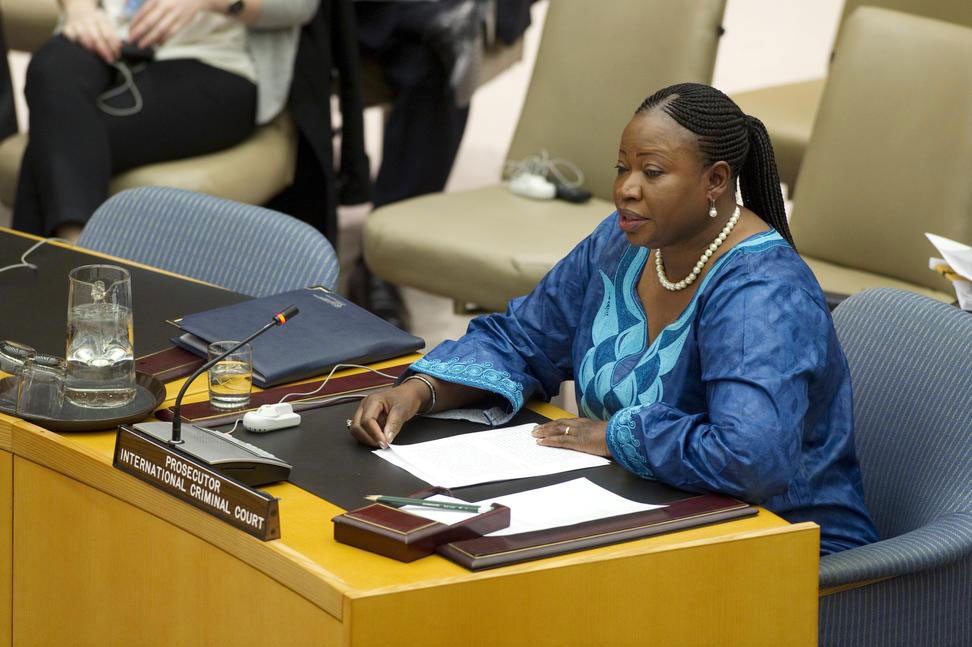
ICC Prosecutor Fatou Bensouda at the UN Security Council (Photo: Evan Schneider/UN)
In the wake of the military and judicial interventions in Libya, this blog has often criticized the relationship between the UN Security Council and the International Criminal Court (ICC). The criticisms are well-known to most readers and hinge on the premise that the UN Security Council’s referrals have placed the Court at the whims of the Council member’s political interests and thus threaten the Court’s independence, impartiality and legitimacy as a judicial institution.
While the practice and politics of UN Security Council referrals have received the lion’s share of attention in recent months, the reality is that every type of referral mechanism opens the ICC up a unique set of potential manipulations. Security Council referrals put the Court at risk of being instrumentalized by the narrow political interests of the Council’s members, especially the permanent five veto-wielding members. The Court’s experience with self-referrals, as in the case of Uganda or the Democratic Republic of Congo for example, has exposed the potential of the ICC to be leveraged by the referring government. As a result, the Court is often seen as pursuing one-sided justice against rebel groups while ignoring government perpetrated atrocities. While technically not a ‘referral’, opening cases proprio motu – through the ICC Prosecutor’s discretion – can also create problems as states argue that the Prosecutor does not have the political authority to intervene and that the Court lacks checks-and-balances in its mandate. Kenya is the best example where this has occurred.
In short, every mechanism available to bring a situation under investigation by the ICC is open to criticism. None is perfect and all are, to one degree or another, political. Yet what has frustrated many observers of the ICC is that the Court often appears unwilling to admit to, let alone critically address, the potential drawbacks of each type of referral. This unwillingness has been particularly worrying given ample evidence from past experiences which demonstrates that accepting referrals with open arms can undermine the public perception of the Court’s independence and legitimacy.
That being said, it is easy to only be critical of the ICC and its relationship with both states and the Security Council. While informed criticism is necessary, it is also important to consider possible solutions which could bolster the Court’s capacity to pursue international criminal justice. In this spirit, here is a proposal which could help the ICC to assess and address the political nature – and dangers – of referrals. Continue reading











 Justice in Conflict