The ICC in Mali: Just Another ICC Intervention in Africa?

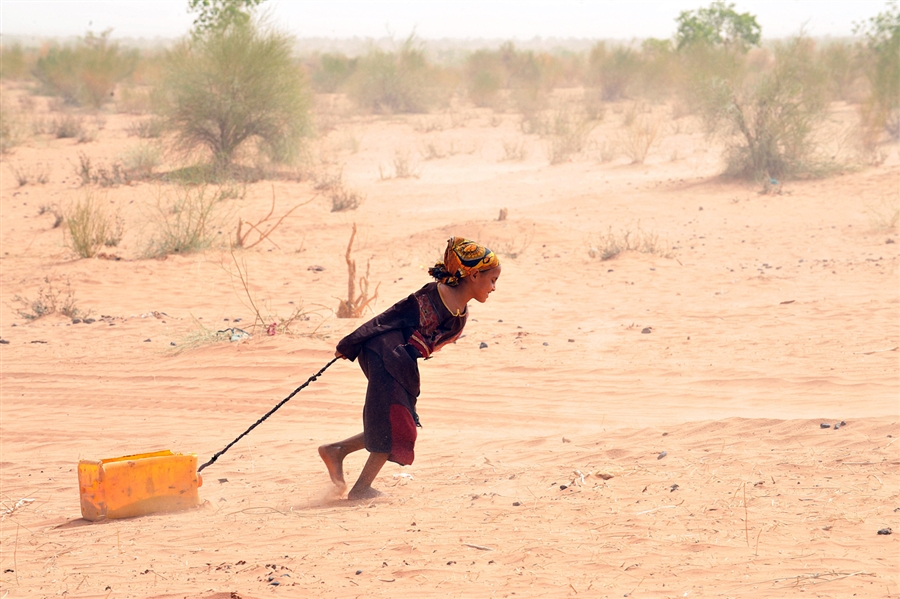
A Malian refugee in Southern Mauritania (Photo: Abdelhak Senna / AFP – Getty Images)

So there you have it: the first investigation opened by Fatou Bensouda, the ICC’s new Chief Prosecutor, will be in Africa. The ICC’s Office of the Prosecution (OTP) accepted a request by Malian government authorities for the Court to intervene and will now conduct a preliminary investigation of the situation, likely focusing on the north of the country. This shouldn’t come as a huge surprise to anyone following the ICC in recent weeks. Bensouda has made it very clear, from the get-go, that she would not hesitate to open a case in an African state.

It is important to remember, as William Schabas reminds us, that this is still only a preliminary investigation. Nevertheless, statements by Besouda hint at the fact that the investigation is much further along than many realize. Bensouda has already declared that she considers the destruction of cultural sites in Timbuktu to constitute a war crime and, in a statement yesterday, she indicated that the OTP has been monitoring the situation closely since violence broke out earlier this year. It would not surprise me if the OTP discretely requested Mali to give the Court jurisdiction through a self-referral.

So what does this mean for the ICC?

Another African Case: Adding Fuel to the Fire?

Both Kevin Jon Heller and Schabas have expressed their reservations about the ICC opening a new investigation in an African state. On the surface, these concerns are understandable. After all, the chorus of critics claiming that the Court is biased against Africa hasn’t waned much, if at all, with Bensouda’s appointment as Chief Prosecutor. Adding yet another investigation into an African state may be seen as adding fuel to the fire. I’m not so sure.

Opening an investigation into Mali may actually have positive consequences on the relationship between the ICC and African states. As I have argued elsewhere, the animosity between the African Union (and more specifically some of its member states) and the ICC has not been an extension of the number of cases the ICC has in Africa – although it is often framed as such for rhetorical purposes. The hostility stems from the increasingly close relationship between the ICC and the “great powers”, most notably those on the UN Security Council. In this context, it is important to remember that African states have most vociferously condemned the Court when it intervened as a result of Security Council referrals in Sudan and Libya (and to some extent in the Kenyan case where the ICC intervened on its own volition). Critically, the African Union has never significantly criticized the ICC following a self-referral by an African state, as was the case with Uganda, the Democratic Republic of Congo and the Central African Republic. This is, of course, a logical consequence of the fact that it would be very awkward for the African Union to criticize the Court for an investigation it conducts at the explicit behest of an African state.
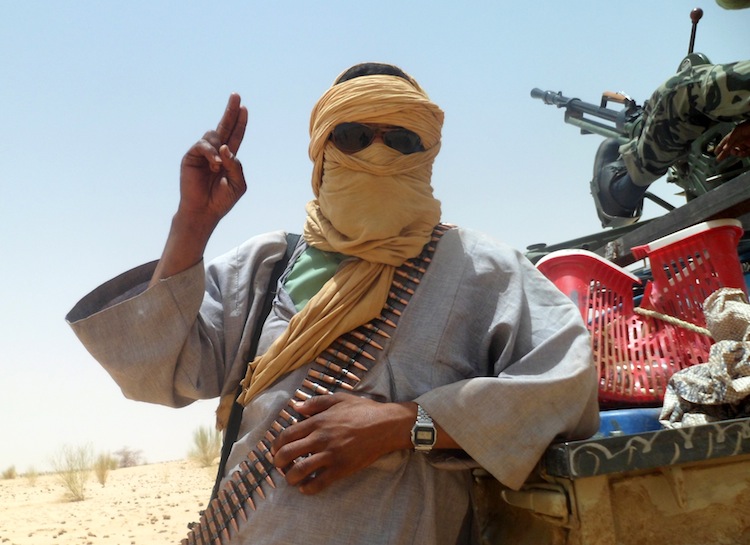
An Islamist rebel near Timbuktu (Photo: Ahmed Ouoba/AFP/Getty Images)

Mali’s self-referral could ultimately have a positive effect on the perception of the ICC as biased against Africa. Self-referrals are inherently cooperative, requiring both the state and the ICC to work together. For this reason, former ICC Prosecutor, Luis Moreno-Ocampo invented a strategy to pursue and encourage self-referrals in the first years of the Court’s existence. He believed that receiving such invitations to investigate would bolster the legitimacy of the ICC. Self-referrals, as experience shows, certainly make it more difficult for African leaders opposed to the ICC to decry the Court’s role on the continent. Mali’s self-referral may also make it easier for Bensouda and proponents of the ICC to undermine the argument that the Court has unfairly honed in on weak African states. Defenders of the Court can argue that it was Mali’s own decision to request the Court’s intervention and that the decision refutes any African consensus against the Court. Continue reading

Posted in African Union (AU), Fatou Bensouda, International Criminal Court (ICC), Mali | Tagged | 9 Comments

Will the African Union and ICC Mend Fences? New leadership, less bad blood

The African Union summit, held this past week in Ethiopia, could have important implications for the ICC’s relationship with African states. Despite such strong support among African states in the Rome Treaty negotiations for the ICC, the Court’s focus on African conflicts and elite perpetrators since then has prompted a mixed record of cooperation and support. So why might the AU and ICC mend fences?

New AU Commission Chairperson Dlamini-Zuma

Good Riddance to Ping!

The summit delegates elected South African diplomat Nkosazana Dlamini-Zuma as their new and first female chairperson of the African Union Commission. Dlamini-Zuma pledges to work toward a more united Africa and to tackle the continent’s hotspots, hoping to improve upon the AU’s poor responses to crises in Côte d’Ivoire and Libya and address current crises in Mali, Democratic Republic of the Congo, etc.

Dlamini-Zuma defeated incumbent chairperson, Jean Ping of Gabon, who has vilified the ICC and former Chief Prosecutor Moreno-Ocampo for unfairly targeting African states. Under Ping’s leadership the relationship between African states and the ICC became more polarized and divisive. In his term, AU delegates passed a resolution of non-cooperation with respect to the ICC’s arrest warrant for President Bashir and sided with the Kenyan government to seek a deferral of its ICC cases. Both efforts were rejected by the Court and the UN Security Council. With Ping out and Dlamini-Zuma in, the AU’s continued diplomatic support of this opposition to the ICC is in jeopardy.

Politics of ICC Support

Dlamini-Zuma is a South African diplomat and South Africa is a well-known supporter and defender of the International Criminal Court. She was Minister of Foreign Affairs (1999-2009) when South Africa ratified the Rome Statute in 2000, making it the 23rd State Party.  South Africa supported the Bashir arrest warrant and opposed the deferral of the Kenya cases.

Image from Human Rights Witness

African states are more divided and nuanced on the ICC than what is suggested by AU support for Sudan and Kenya. As Kurt Mills explains in his recent article in Human Rights Quarterly, “the AU position is a façade masking significant arguments and disagreements, as well as significant support for the ICC.”  There are those states, such as Botswana, Ghana, South Africa and States Parties that have self-referred their situations, who support the ICC. Whereas those that oppose the ICC’s targeting of Bashir and Kenyan elites argue for a deferral in the interests of stability and not for wholesale impunity. Moreover, the reason that the summit took place in Ethiopia was that its original host – Malawi – pledged to arrest President Bashir if he accepted the AU’s invitation to attend

Proposal for a Regional Criminal Court

In parallel to these specific disagreements, there is a growing general perception that the Court’s judicial interventions are neo-colonial in their intentions and effects and concern that targeting ruling political elites endangers stability. The alternative, as the AU recommended for both Sudan and Kenya, is to mete out accountability on African soil and in deference to domestic political and security contexts. This could come in the form of hybrid courts or a regional mechanism. A draft protocol was to be considered at the summit that proposed expanding the mandate of the African Court of Justice and Human Rights to have criminal jurisdiction over genocide, war crimes and crimes against humanity. African justice ministers already approved the measure. But it’s not clear whether a regional criminal court would mean greater contestation or complementarity of justice between Africa and the ICC.

Bensouda is Optimistic

On the other side of this relationship is new ICC Chief Prosecutor, Fatou Bensouda, who might engender a more positive relationship between the African Union and the ICC. African states lobbied hard for her election and she is likely to be less brash, reckless, and “political” as her predecessor. In a recent interview she stated that the African Union has shown “strong leadership” on international justice and she expects to have a good working relationship with the organization.

Certainly, developing patterns in the ICC’s selection of situations and the prosecutorial strategy for cases will affect the Court’s relationship with African states. The ICC also needs to diplomatically engage with political elites and institute deeper and broader outreach strategies with victim communities. The burden of cooperation and good diplomacy is not on African states alone.

Posted in African Union (AU), Fatou Bensouda, Kenya, Sudan | 5 Comments

Justice through Graffiti and Cartoons in Syria

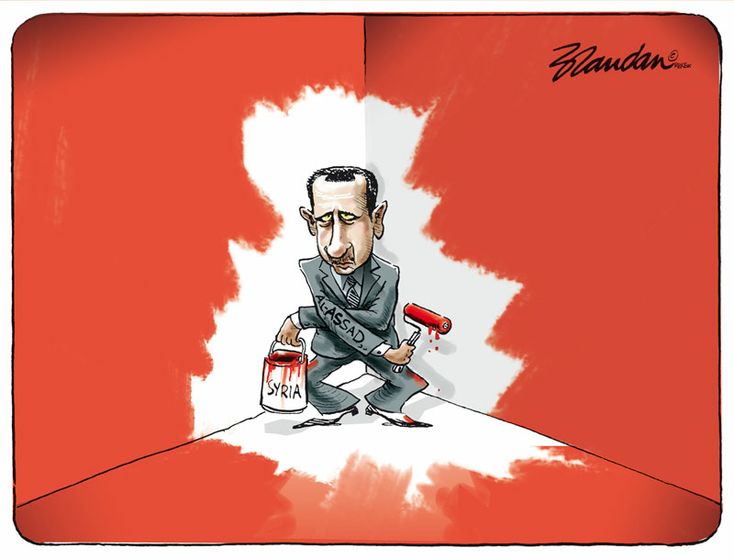
Syria cartoon, Assad

“No Exit Plan” (Cartoon: Brandan Reynolds)

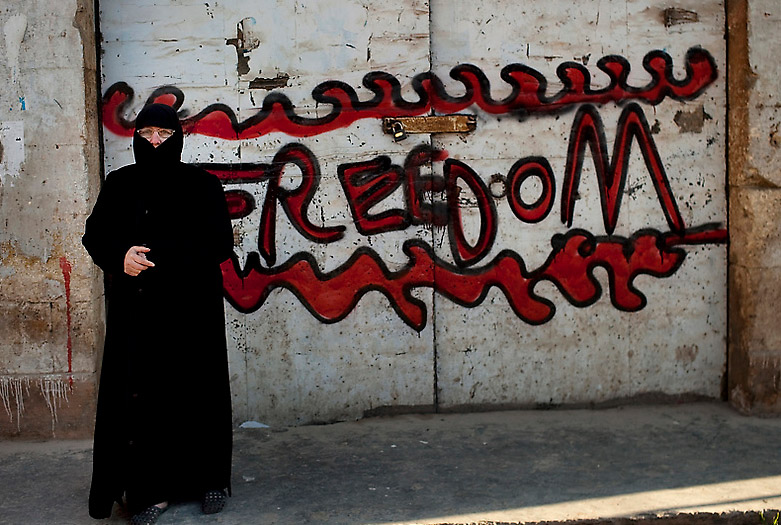
A fascinating and common trend amongst ‘Arab Spring’ states has been the use of imagery, particularly graffiti and cartoons, to denigrate bloodthirsty leaders, to express exasperation with repressive regimes, and to evoke hope for a different and altogether more peaceful life. Many images often focus on and ridicule particular features or statements of the tyrants they are aimed against. Others celebrate the fallen, or act as reminders of the grievances at the root of the uprisings. In many cases, cartoons and graffiti are also small attempts to achieve an inkling of justice, to declare that a transition is underway, to boldly express a yearning for freedom of expression and to create public spaces where people can be reminded that their hopes are shared.

Graffiti is particularly interesting. In Western states, graffiti is generally considered to be an act of vandalism, perpetrated by no-good, disenchanted youth. While certainly the case in some instances, there also are a lot of problems with this assumption. But what is quite striking is the divergent opinion given to the outside world. In those Arab states which have waged upheavals against their long-time oppressors, graffiti is rightfully being praised as a brave act of resistance. So, in one place graffiti is an act of disenfranchisement and misplaced rebellion, in the other an act of enfranchisement and freedom. Clearly, context matters.

In Syria, as in other Arab Spring states, graffiti is playing a key – if under-acknowledged – role in the conflict. As Rima Marrouch writes,

“Outside of the violence there’s another war: a graffiti battle to control images and slogans. Walls are the battlefields of influence between anti-government and pro-government supporters.”

The fight over messaging through graffiti has even spread to Lebanon. This is perhaps unsurprising. Some observers have suggested that it was the slogans and images depicted in anti-government graffiti that stirred and catalyzed Syria’s uprising.

Then there is the story of Nour Hatem Zahra, the 23-year-old protestor, known as “the spray man” who spread messages of dissent through graffiti across Damascus. He was tortured and eventually killed by Syrian security forces. Celebrated by many as a martyr, Zahra’s friends and supporters created a Facebook Page called “Freedom Graffiti Week” in his honour.

Despite the prevalence of cartoons and graffiti linked to the causes and dynamics of revolution, we still don’t know much about the aesthetics of the Arab Spring transitions. We have very little understanding of what it means to people to see their leaders vilified and humiliated through the use of graffiti or to be confronted by bold messages of resistance and hope sprayed across public edifices.

But it appears that the world is catching up. It is increasingly impossible to deny the place of these images in the life-cycle of uprisings and revolution. These mostly anonymous images and symbols are infectious and have real effects, becoming symbols of the revolution itself, a social medium that people can actually see and touch. Continue reading

Posted in Activism, Advocacy, Justice, Syria | Tagged | Leave a comment

The ICC in Syria: A Ticking-Time Security Council Referral?

A protestor in front of anti-Assad graffiti in Idlib, Syria (Photo: Rodrigo Abd / AP)

Like so many others, I find myself in the morally and politically ambiguous position of having no clue what the international community should do to stop the ongoing violence in Syria, recently described as descending into “a sectarian wasteland”. The options are unsavory. The Libya-intervention-recipe seems out of the question, but doing nothing seems morally abhorrent. The status quo is brutal but changing it could conceivably be worse. The only thing that seems clear, to me at least, is that some creative thinking is needed.

Before I lay out my thinking on a possible way to contribute to a cessation of violence in Syria, I should add a disclaimer to avoid confusion. This post is a thought exercise based on an idea that I have been mulling recently. As such, it does not represent any rigid conviction on my part nor a policy solution. Nevertheless, I think it is worth discussing and considering.

A Ticking-Time ICC Referral

My proposal is that the Security Council legally bind itself to a “ticking-time ICC referral”. In practice, this would require the Council to legally declare that they will refer Syria to the ICC by, say, August 1st, 2012 (it could be sooner or later). Once set in motion, the only way to stop the referral would be through a subsequent affirmative vote by the Security Council, following the advice of the UN Observer Mission and UN-Arab League Envoy Kofi Annan. Syrian and opposition forces would have until August 1st to stop the commission of atrocities. If indiscriminate violence on the part of the Syrian regime and the opposition forces did not cease, the referral to the ICC would go ahead automatically.

Why it might be worth it

If the ICC has any specific deterrent effect, this would be an opportunity to see it in action. The idea here is simple and oft-repeated (and oft-criticized): the ICC can have an effect on the willingness of actors to continue committing atrocities. A problem, that many scholars have pointed out, is that when the ICC intervenes in ongoing conflicts, the incentives to put down the guns and silence the tanks may be removed. Both of these positions are over-simplified and tenuous in that the empirical evidence across contexts is weak. But a delayed referral would theoretically allow for both a specific deterrent effect to change the calculus of the Assad regime without removing the incentive to cease the commission of human rights abuses. Of course, the ICC’s deterrence capacity is unclear and its record questionable. Nevertheless, in such instances, I’m not sure it’s useful to know whether the ICC can have a deterrence effect. It might be sufficient to believe it might or could.

Importantly, under this proposal, the Syrian regime would not be able to escalate violence until the end of July and then claim that they have stopped committing atrocities in the 11th hour. In order for the Council to stop the referral, all actors would have to show restraint and a commitment to a cessation of crimes in the time between the Security Council resolution and August 1.

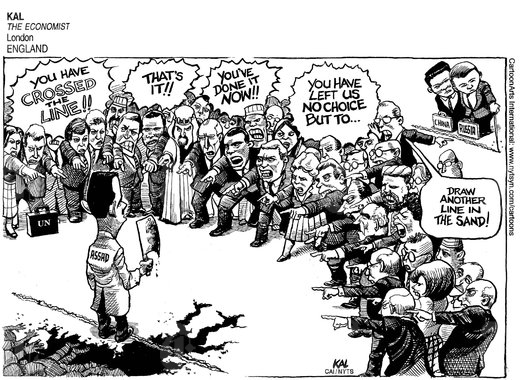
(Cartoon: Kal / The Economist)

It is important to note that the reason that Syria has not been referred to the ICC is not because of the Security Council member states’ ambivalence to the Court itself. As Mark Leon Goldberg reminds us, past cases and practice indicates that “Russia and China are not intrinsically opposed to the ICC.” Thus, if the right political climate and guarantees were in place, it would be possible to get Russia and China on board (or at least abstain) with such a resolution – at least theoretically.

One political guarantee of the hypothetical Security Council resolution could be to make it clear that the ICC’s jurisdiction would be restricted to investigating crimes committed after August 1st, 2012. Crimes committed before this time would thus be beyond the ICC’s jurisdiction. In addition to providing the Assad regime with an incentive to stop committing atrocities, this could also assuage concerns of UN Security Council states that they would be targets of investigation. In particular, Russia would have time to halt its well-documented and dubious material support to the Assad regime without having to worry that it would be investigated by the ICC. For Russia, which seems to be increasingly amenable to the position that Assad needs to step down, the delayed referral could offer a ‘soft landing’. Notably, in Libya, Western states similarly ensured that the ICC could only investigate incidents after February 15, ensuring that their close political, economic and intelligence relations with the Gaddafi regime were outside the Court’s spectre. Continue reading

Posted in International Criminal Court (ICC), Justice, Syria, UN Security Council | Tagged , | 7 Comments

The ICC: Three Remarkable Achievements

(Photo: Robin Utrecht/EPA)

The ICC recently celebrated its tenth anniversary amidst heavy criticism of its international role and impact. Some of the criticism is valid, a lot of it misrepresents the mandate and role of the ICC. Regardless, in this context, after some time mulling over what the ICC has achieved in the first few years of its existence, I’ve come up with a list of three largely neglected achievements of the Court. I have a feeling they won’t be to everyone’s fancy, but while the ICC is very far from perfect, hopefully this post can highlight or bring to the fore a few issues which, in my mind, make the ICC – as an idea, institution and, above all, project – remarkable.

1. It Exists

It is all too easy to forget that it wasn’t a given that, ten years after it was created, the ICC would actually still be around. I remember the Court’s President Judge Sang-Hyun Song declaring that when he was sworn in, he and other judges did privately expressed their skepticism that the Court could survive the political climate of international relations.

There was every chance that states would rip this novel institution apart before it could get a hold on its place on the global stage. But the ICC managed to withstand political forces pulling it in a multitude of directions. Most dramatically, the Court survived the outright and active hostility from the world’s most powerful nation. Throughout the ICC’s formative years, the US creatively and consistently sought to undermine the prospects of the ICC being effective by pressing states into signing Bilateral Immunity Agreements and by passing the ‘Hague Invasion Act‘. Surviving such aggression and trucking on in the face of opponents like John Bolton is a pretty sweet feather in the ICC’s cap.

Somewhat ironically, the demand that the ICC have an impact on [insert pet project here] and have [insert ICTY’s caseload] number of cases concluded is a testament to just how far the Court has come. Today more typical demands courts can be made of the ICC in terms of conviction rates and international influence. It wasn’t always the case. The Court’s most consistent and vehement critics emphatically claim that the ICC needs to have more cases – whether outside Africa or in places it can’t go, like Syria – yet it wasn’t always clear that ICC judges would ever see any cases.

Importantly, I don’t believe reminding observers that the Court’s existence as a functioning international judicial institution wasn’t a foregone conclusion is grasping at straws. It’s a reminder. The Court, as a project, needs to be judged within the context, and against the record, of its lifespan, not in a cross-section of time, ten years on or whatever it may be.


An activist stands outside of the courtroom where former Egyptian President Hosni Mubarak was being tried. Demands for justice and accountability (including from the ICC) swept the Arab world in the ‘Arab Spring’ (Photo: Amr Nabil / AP)

2. It Shapes People’s Demands

Not only does the ICC exist – it appears to be at the vanguard of global and regional human rights and democracy movements. It is not just that demands for justice, human rights and accountability have been particularly pervasive in recent months and years – it’s that these demands are coming from places few imagined they would. I don’t think anyone could have predicted pre-2011 that protesters across the Middle East and North African would take to the streets demanding that their autocratic despots be sent to the The Hague. Yet that’s exactly what’s happened.  Continue reading

Posted in International Criminal Court (ICC) | Tagged | 2 Comments

Melinda Taylor and the ‘ICC4’ Released: Five Pressing Questions

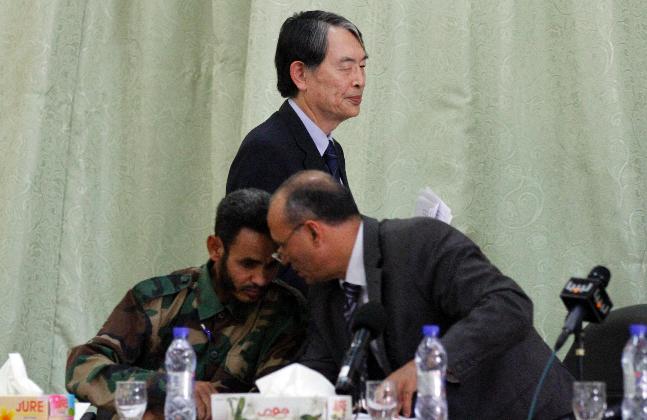
ICC President Song, Zintani Brigade commander Ajmi Ateri and Libya’s Deputy Foreign Minister Mohammed Abdel Aziz shortly before the release of the ICC’s staff in Zintan (Photo: Anis Mili / Reuters)

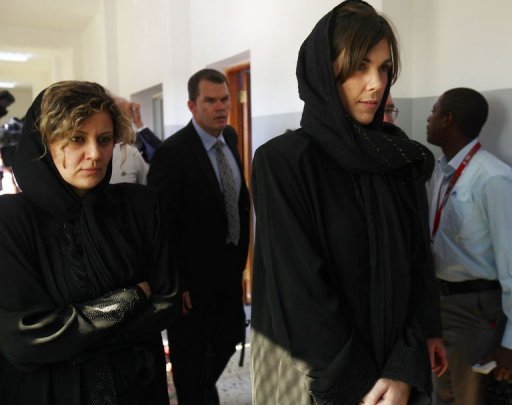
It is a huge relief to be able to write that Melinda Taylor, Helene Assaf, Alexander Khodakov, and Esteban Peralta Losilla were released from Libya on Monday and have returned to be reunited with their families. The four had spent nearly a month in Zintan after being detained following a meeting with Saif al-Islam Gaddafi. Their detention and its consequences have been a focal point of JiC over the past few weeks (see here, here, here, here, here and here – phew!)

While it is likely to be some time before any of the ICC staff members openly discuss their experiences – and rightfully so – there are a number of pressing questions that need to be answered in the coming weeks. Here are five.

1. What led the Zintani and Libyan authorities to agree to Taylor et al’s release?

There were many rounds of negotiations between Libya and the ICC. Assuredly, there were likely as many rounds between Libyan authorities and Zintani militia leaders. But it remains unclear what finally tipped negotiations in favour of releasing the ICC staff?

I, for one, am unconvinced that it was the initial statement of regret or apology from the ICC. Libyan authorities were quick to say that the apology would not result in Taylor’s release, that the statement wasn’t enough.

But the reasons given by Libya for Taylor’s release are contradictory. Libya’s representative to the ICC, Ahmed al-Jehani, maintained that it was because Taylor had diplomatic immunity (see also here). The country’s Prosecutor General, however, declared that Taylor would face a court hearing in Libya in late July but that an in absentia hearing could also take place. These two statements can’t be reconciled unless each is playing to a different constituency – which they likely are. This brings us to question two.

2. Who got and gave what?

A rather large group of actors have vested interests in this saga. Let’s consider the Zintani militia, Libya’s interim government, the ICC and the detained ICC staff themselves. Each played a part in the eventual release of Taylor et al. But, by and large, it remains unclear what was required of and demanded by each party.

For the Zintanis, it is clear that getting a direct apology from the ICC was part of the deal – and they got it. ICC President Song explicitly used the word “apologize” in an address in Zintan prior to Taylor’s release. But did the Zintani militia get anything else? Remember,  they have leveraged their custody of Saif for political gain before. Moreover, there have recently been indications that Libya’s interim Defense Minister Osama Juwaili, who is from Zintan and whose appointment was linked to Zintan’s custody of Saif, was recently livid about his treatment and role. It would not surprise me if improvements in his position were linked into negotiations between Libyan authorities and the Zintani brigade over the ICC staff.

Melinda Taylor (right) and Helene Assaf in Zintan shortly after being released (Photo: AFP)

It is a distinct possibility that Libyan authorities simply wanted this debacle to end. The country’s first-ever free and democratic elections are due to take place within days and having ICC staff members in detention is a distraction any emerging democracy would want to avoid. Nevertheless, the apology and statement of regret from the ICC was surely spurred by Libyan authorities as well. They have consistently voiced disappointment and sought to counter international perceptions of the country as lawless and unstable. Having the Court reaffirm that Libya is a legitimate and lawful government with legitimate grievances fits into these efforts.

The ICC never seemed to have much leverage in this case. Moreover, the Court was largely left hung out to dry by the international community. Statements by the UN Security Council had the political weight of a feather and it appears the Council actually did nothing else to press Libya. Of course, this is unsurprising. The Security Council has generally been disinterested in the ICC’s mandate in Libya (see here and here). The one area of leverage the Court had was with issuing their statement of regret. Over at Opinio Juris, Kevin Jon Heller has opined about the potential consequences of the Court taking the blame for their staff’s predicament. Indeed, the potential consequences seem grim. But with barely a modicum of international support and having been put on the spot by Australian Foreign Minister Bob Carr, I’m not sure the Court had any choice but to issue an apology. Importantly, however, al-Jehani’s statement that Taylor had diplomatic immunity may have been a small victory for, and perhaps even demanded by, the Court. Continue reading
Posted in International Criminal Court (ICC), Libya, Libya and the ICC | Tagged , , , , , | 15 Comments

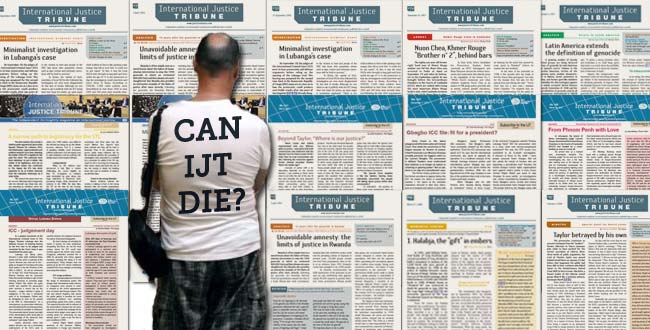
Can International Justice Tribune Die? No!

Answer: No!

Dear readers,

I wanted to alert you to rather sad news. Many of you will already be aware that RNW – International Justice Tribune, an indispensable and widely respected resource for global and transitional justice news will no longer be published at Radio Netherlands Worldwide. According to IJT,

“It is with much regret that we announce that Radio Netherlands Worldwide (RNW) has decided to stop publishing the International Justice Tribune (IJT).

This sad decision was issued in the context of massive budgetary cuts faced by RNW on June 22. All future activities at RNW will be solely focused on young audiences in countries where free speech is under threat.”

The loss of IJT would be monstrous for those of us interested in international justice. In response, IJT has launched a campaign to save the Tribune. I encourage all JiC readers to sign their petition. The campaign is called “Can IJT Die?” The answer is an obvious and emphatic “no!” Here’s more:

We believe this coverage is both essential and complementary to the work of our core readership, composed of researchers, lawyers, journalists, political decision makers and human rights activists at national and international levels. We believe a rigorous and independent specialised newspaper is not only useful, but a condition for the healthy development of international justice. The steady increase in IJT’s readership over the years is proof of the needs it fulfils.

We believe that a free specialised press is essential to the main actors in the area of international justice both here and in the affected countries.

For these reasons we, the IJT’s editors, are now committed to seeking an imminent and sustainable solution for this non-costly project to survive in its present form.

We would like to respectfully ask you to fill in our online petition and send us reasonable suggestions on urgent or long-term financial support.

Sign the petition and help save IJT!

Posted in Advocacy, JiC News | 2 Comments

Can the ICC Deliver Impartial Justice?

My apologies for not blogging much over the last few days. I have just returned from a long-awaited and much-needed vacation but promise to get writing more substantially soon. In any case, I thought readers might be interested in an episode of Al Jazeera’s Inside Story I had the immense honour and pleasure to participate in over the weekend, entitled ‘Can the ICC Deliver Impartial Justice?

There is obviously much more to say about this subject than can be captured in a 25-minute program. Nevertheless, this is a subject that won’t – and shouldn’t – go away. I also believe some of the commentary offered in the episode vividly demonstrates our need to have a more sophisticated conversation about the limits and challenges facing international criminal justice. Particularly, I think some of the comments shed light on how critics effectively string together disparate (and often incorrect or irrelevant facts) and mount them in a campaign to undermine the Court’s very existence. Doing this simply distracts from a much-needed and honest discourse about addressing the real problems and issues with the ICC.

As always, your feedback and comments are very much welcome!

Posted in International Criminal Court (ICC), Interviews, Justice | Leave a comment

Separating Fact from Fiction: Melinda Taylor and the ICC Staff’s Detention in Libya

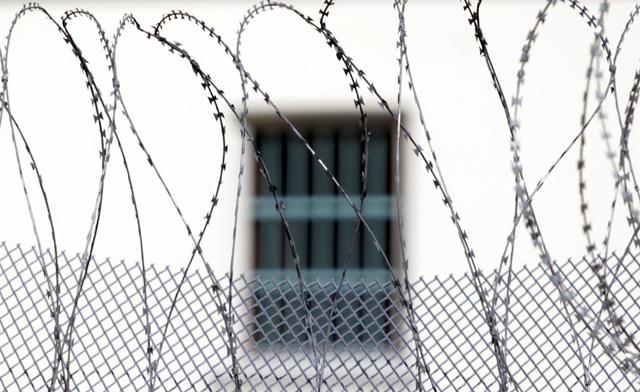
Libya jail

(Photo: Reuters)

In times of crisis or scandal, misunderstandings are an unfortunate but inevitable consequence of not having sufficient information and only getting it in fits and spurts from political actors with competing interests. The continuing controversy surrounding the detention of ICC staff has been no exception. Since their visit to Saif al-Islam Gaddafi in early June, Melinda Taylor, Helene Assaf, Alexander Khodakov, and Esteban Peralta Losilla have been held by a militia from Zintan, Libya, for the most part incommunicado. Libyan and Zintani authorities alleged that they were spying and posed a threat to the country’s national security (for more see here and here).

Admittedly, I was amongst those who believed that after the story broke, it would slowly decline in coverage and be largely ignored by the media. However – and luckily – that has not been the case. Nevertheless, the relatively consistent coverage has not prevented fictions from sprouting and falsehoods from propagating. For this reason, I thought it might be useful to “clear the air” by doing a little exercise in separating fact from fiction.

————————

1. There is evidence that the ICC staff are guilty of breaking Libyan law, undermining Libyan national security, and violating the ICC’s protocols.

Fiction. The claim that the ICC staff must be guilty is unfortunately widespread. Remarkably, commentators acting as both judge and jury have seemingly convicted the ICC staff without trial, indeed without evidence. While there have been proclamations that Melinda Taylor smuggled secret and coded documents as well as a camera pen into her meeting with Saif, absolutely no evidence has been given to date by the Libyan authorities to indicate that this has indeed occurred or that the staff are guilty of any wrongdoing. The closest we have come to actually seeing any evidence came when the arrest of Taylor et al was announced and a Zintani militia leader waived the alleged documents in front of the camera. Importantly, this is not to suggest that the ICC staff haven’t done anything wrong. Some might argue that the ICC’s recent statement of regret regarding the situation implies a concession that something went awry when the staff met Saif. However, we simply do not know what occurred during the meeting between the staff members and Saif. It bears repeating: No evidence of wrongdoing has been brought forward. None.

2. The ICC apologized to Libya.

Fact. There is probably not enough agreement on this to outright declare that it is a fact but I continue to believe the ICC’s statement amounts to an apology, as do others. The ICC’s statement amounted to an apology without saying sorry. It is not an uncommon practice for state or international actors to express an apology for past injustices but avoid using language that they fear may make them liable to subsequent legal action.

In this context, it is worth considering that the ICC’s statement is much closer to an apology than, for instance, former US President Bill Clinton’s “apology” for inaction in the face of the Rwandan Genocide.

Esteban Peralta, one of the ICC staff who has remained in Libya since Melinda Taylor was arrested in order to provide her moral support.

3. Only Melinda Taylor is being held in detention for threatening Libya’s national security.

Fact. Originally, it appeared that both Helene Assaf and Melinda Taylor would be charged in Libya. In a show of remarkable solidarity and integrity, after being told the were free to leave Libya, Alexander Khodakov and Esteban Peralta Losilla chose to stay with Assaf and Taylor for “moral support”. While the circumstances are unclear, it recently became clear that Assaf was also free to leave. All three remain with their colleague but it seems clear that only Taylor is being held in detention. Continue reading

Posted in Defense Counsel, Libya, Libya and the ICC | Tagged , , , , , | 5 Comments

Updates on Melinda Taylor, Helene Assaf and ICC Staff Detained in Libya

Dear readers,

I have decided to create a post dedicated to updates on the ICC staff detained in Libya. Unfortunately, the media is likely to tire of this story quickly and I figured JiC could contribute to creating a space where information and news on the situation could be shared. I had begun culling articles on my previous post, but it would seem to make more sense to simply have one post dedicated to emerging news on the situations facing Melinda Taylor, Helene Assaf, Alexander Khodakov, and Esteban Losilla. 

I will update this page whenever new information comes in. If you have articles or sources to share, please don’t hesitate to do so, either by contacting me or in the comment section. 

Here’s hoping this debacle ends soon.

Mark

(Photo: Suhaib Salem / Reuters)

June 13: A convoy, which included the Ambassadors of Australia, Lebanon, Spain, and Russia as well as ICC officials, was able to visit with Melinda Taylor and the detained staff. However, according to Australia’s Foreign Minister, Bob Carr, it appears unlikely that they will receive an early release. Carr also relayed reports on the conditions in the prison, saying they were “were generally adequate” and that “Taylor appeared to be well and in reasonable spirits given the circumstances.”

For those interested, you can watch an interview with Taylor’s parents here.

The Libyan leadership has been described as “powerless” to release the four ICC staff members.

June 14: NATO Secretary-General Anders Fogh Rasmussen has added his voice behind efforts to release the ICC staff, saying ”I strongly regret that certain groups in Libya have arrest or withheld representatives of the International Criminal Court. I would urge them to release these individuals as soon as possible.” (see also here)

Melinda Taylor’s husband, Geoff Roberts, who, like Taylor, is an international criminal lawyer, has spoken about the ordeal. He has suggested that Libya’s behaviour should be reflected in the country’s admissibility challenge: ”If they can’t protect their own people when they go into these dangerous places, how will it work? Unless they can protect their staff, these courts can’t function.”

Kate and Amanda, of the fantastic blog Wronging Rights, have a salient piece at The Atlantic where they consider what the arrest of the ICC staff will have on the Court’s ability to investigate in fragile conflict and post-conflict contexts.

This piece by Rory Callinan argues that troubles in providing Saif with a fair defense started long before the most recent visit by the ICC staff. He further suggests that pre-existing tensions contributed to the situation Melinda Taylor et al find themselves in.  Senior ICC defense counsel, Xavier-Jean Keita, for whom Taylor worked, has previously been barred from visiting Saif because of fears that his African heritage might put him at risk. Black Africans are often assumed to have been Gaddafi mercenaries. Nick Kaufman, who is currently representing Muammar Gaddafi’s daugher, Aisha, said that the Defense’s filing of sharp critiques of Saif’s captors “contributed to creating a highly flammable atmosphere in Zintan and if you ask me, I believe Melinda has fallen victim of this hostility which is because of the intensity of the litigation…There is no doubt that these filings contributed to cementing the, shall we say, anger of the local authorities holding Saif, against Melinda and her superior.”

Writing in the New York Times, Marlise Simons confirms that  Khodakov and Losilla have been told they are free to leave Zintan but that they have remained in order to provide “moral support” to Melinda Taylor and Helene Assaf. Simons also quotes Ahmed al-Gehani, a Libyan lawyer who was to be the ICC staff’s liaison when meeting Saif. Gehani confirms that the staff are being held in order to leverage their freedom for information: “[Taylor] had not wanted to answer any questions — this has been the problem from the start.”

June 15: Geoff Roberts, Taylor’s husband, fears that the arrest of the ICC staff will put all Court employees at risk.

According to this France24 piece, the four ICC staff members are in good health. The article also quotes the Court as saying:

“The court is very keen to address any regrettable misunderstandings on either side about the delegation’s mandate and activities during its mission in Libya….The ICC expresses its strong hope that the release of the four persons will take place with no delay in the spirit of cooperation that has existed between the court and the Libyan authorities.”

The UN Security Council made a brief statement regarding Melinda Taylor and the four ICC staff members:

The following Security Council press statement was issued today by Council President Li Baodong ( China):

The members of the Security Council express serious concern over the detention in Libya since 7 June 2012 of the International Criminal Court (ICC) staff members, and urge Libyan authorities at all levels and all concerned to work towards immediate release of all the ICC staff members.

The members of the Security Council emphasize that it is the legal obligation of Libya under the Council’s resolution 1970 (2011) to cooperate fully with and provide any necessary assistance to the ICC pursuant to that resolution.

Australia’s Foreign Minister, Bob Carr, welcomed the news, stating that he was “heartened at the strong international support for a swift resolution in this matter.” Carr also reiterated that the Australian government is working to have Talyor’s case expedited but remains cautious and hesitant in commenting on the allegations against the ICC staff members.

Make sure you check out the always insightful Kevin Jon Heller’s take (and the comment section below) on whether or not the ICC staff are entitled to diplomatic immunity. While it is less clear than many (including myself) have made it out to be, Heller concludes that there is a good argument to make that Taylor et al do, in fact, qualify for diplomatic immunity:

I do think there is a persuasive argument in favor of immunity: paragraph 5 of SC Res. 1970, which provides, as part of the Security Council’s referral of the situation in Libya to the ICC, that “the Libyan authorities shall cooperate fully with and provide any necessary assistance to the Court and the Prosecutor pursuant to this resolution.”  The cooperation obligation in paragraph 5, I believe, requires Libya to honor the substantive provisions of the APIC; the argument parallels Dapo Akande’s compelling claim that the Security Council’s referral of the Darfur situation implicitly removed Bashir’s Head-of-State immunity.  Basing immunity on paragraph 5 seems much stronger to me than arguing that all members of international organizations have immunity under customary international law.  Moreover, emphasizing paragraph 5 should serve as a stark reminder to the Security Council that it has a legal — and not simply moral — obligation to do everything in its power to end Taylor and her translator’s indefensible detention. Continue reading

Posted in Defense Counsel, International Criminal Court (ICC), Lebanon, Libya, Libya and the ICC, Russia, Spain | Tagged , , , | 22 Comments