
Dear readers – This marks the first post at JiC by Elke Schwarz. Elke has been JiC’s long-time and faithful editor. Because of her work, we hopefully don’t have too many spelling or grammatical errors! More importantly, Elke is a PhD student at the LSE where her work focuses on the ethics of violence, biopolitics and the work of Hannah Arendt. In this thought-provoking post, Elke addresses target killings and, in particular, the ‘justice’ of using drones. Enjoy!
Is Killing the new ‘Justice’? The Murky Morality of Target Killings
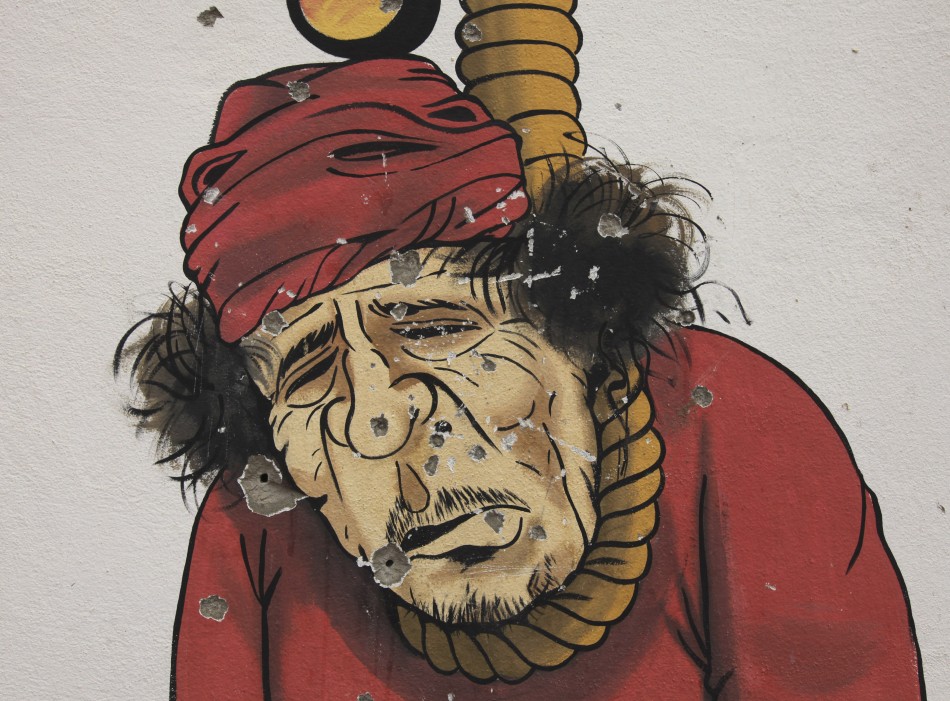
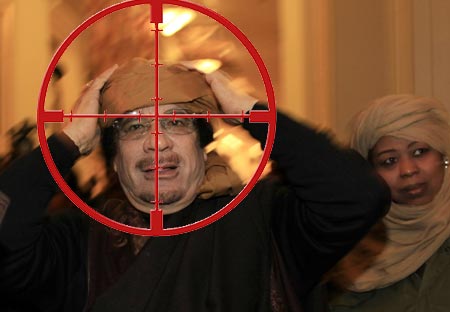
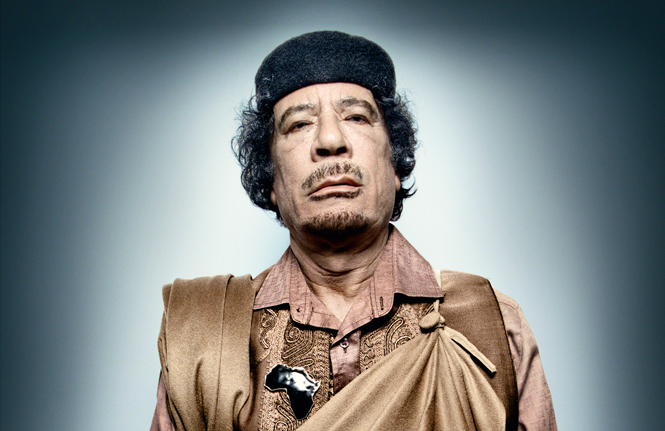
The controversy surrounding Gaddafi’s death has added fuel to the fire in the debate about the legitimacy and ‘justice’ of killing those that are considered particularly evil. Whether the killing takes place directly at the hands of Western forces, as in the case of bin Laden, or whether the grounds are laid to essentially pave the way for a revenge killing, as it appears to have been the case with Gaddafi, the debate on whether killing is the new justice in the foreign policy tool belt of the West is afoot – and rightly so.

MQ-9 Reaper drones are used in Afghanistan and Pakistan. Photo: Wired
Questions of legality, legitimacy and morality ought to be posed when considering the current narrative that shifts the practice of target killing into the space of justice. The post below is an updated and version of an article I had written in the wake of the drone killing of Anwar al-Awlaki last month, but the underlying principles of assassinations as a new norm are worth considering again in the context of Gaddafi’s demise.
The recent news of the killing of US citizen Anwar al-Awlaki by American drones sparked a much overdue flurry of criticism and questions on the ethics and legality of Obama’s death-by-drone programme in the war on terror. Awlaki, al-Qaeda’s alleged ‘chief of external operations’ in Yemen (an upgraded title he received posthumously by officials at the White House and the CIA – previously he was by reputation and status merely a radical Muslim cleric) is the first US citizen to have been assassinated in President Obama’s brand of the fight against terrorism.
The drones programme is by no means a recent tool in the American war chest, nor has it been particularly reserved in its remit of eliminating specified targets in this interminable ‘war’ effort. What is new, however, is that the US has given the green light to eliminating its own citizens, without due process, stripping said citizens of their 5th Amendment rights and rendering them essentially unworthy of living. Awlaki was not the only US citizen targeted and killed by American drones – his 17 year old son was also a recent victim of a US drone strike conducted in Yemen a fortnight after Anwar al-Awlaki’s killing.
The fact that a public outcry against the extra-judicial assassination of a human being becomes audible (aside from the controversial killing of enemy #1 bin Laden of course) only when a US citizen is concerned starkly highlights the normalised extra-judicial status of all foreign drone targets in the perception of the international public. The gloves that came off during the Bush administration are still off and killing as the new justice is beginning to supersede the norm against assassinations.
The norm against political assassinations has been in serious peril since the Bush administration first overtly conceded the strategic use of target killings, framed as a military act to weed out and eliminate high-level Al-Qaeda members, in 2002. This norm continues to deteriorate with Obama at the helm, who has stepped up the drones programme considerably since he took over from Bush junior in 2008.
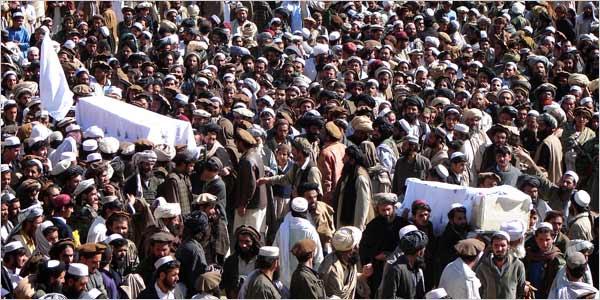
Funeral for victims of drone strikes. Photo: NY Times
Today, there are roughly double the number of drone attacks per week in regions deemed terrorist hotbeds, specifically Pakistan. Since 2004, these drone strikes are reported to have killed between 1,579 and 2,490 individuals, whereby some analyses estimate the civilian casualty rate among these statistics to be as high as 20%. The vast majority of these deaths have occurred in 2010. Since June 2011, the US has expanded its drone programmes in Somalia and it has been reported that some 145 drone strikes have contributed to the capture (and, one might make the case, the killing) of Gaddafi.
While the policy originated as a programme to “capture and kill” a small number of high value terrorist leaders in the G.W. Bush years, the programme has expanded its remit considerably: up to 2,000 killings can hardly be described as a small number, no less if we accept that the total number of military leaders killed was a mere 35 since 2004.










 Justice in Conflict