
Daniela Lai joins JiC for this guest-post. Daniela is a Senior Lecturer in International Relations at London South Bank University. Her forthcoming book with Cambridge University Press, Socioeconomic JusticeInternational Intervention and Transition in Post-war Bosnia and Herzegovina, will be available in June 2020.
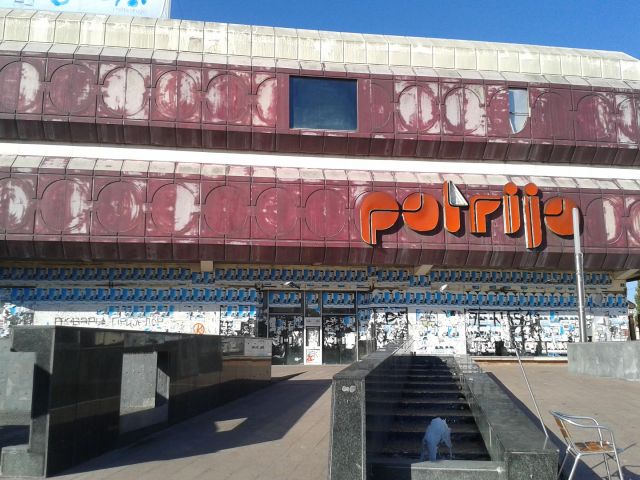
(A former shopping centre in the main square of Prijedor, which is today being torn down. Photo: Daniela Lai)
Socioeconomic issues have moved from the margins of transitional justice to being considered an important part of both scholarly debates and ambitious justice programmes. For too long, justice in the aftermath of conflict and mass violence was understood in strictly legalistic terms, producing a partial view of wartime violence and post-war justice, one that had become increasingly alienated from its local constituencies. A more comprehensive (and overdue) analysis of how people experience socioeconomic violence in war and develop socioeconomic justice claims should be grounded in people’s lived experiences. It should also scrutinise international interventions as they shape both post-war justice and political economy.
The evolution of transitional justice
For a relatively young field of research and practice, transitional justice has undergone a lot of change over the past few decades, with some scholars even arguing it is now in its ‘fourth generation‘. The field has been deeply shaped by its connection to international humanitarian law (IHL) and by the political context within which it emerged (transitions to liberal democracy market economies, as well as liberal peacebuilding). For most of this time, socioeconomic issues have remained at the margins of the field, at best addressed through some form of monetary compensation for violations of IHL or personal rights, at worst overlooked even in the face of their evident relevance.
In the past decade or so, however, practitioners and scholars have started calling for a more explicit engagement with socioeconomic issues, be it in the form of social and economic rights or redress for structural inequalities that have led to or stemmed from political violence and atrocity. These developments have generated academic controversies over what transitional justice really is, whether it is realistic or even desirable to expand its scope beyond established mechanisms, or expect it to produce transformative change.
However, these debates still omit an interdisciplinary and bottom-up analyses of how communities affected by conflict experience violence in its multiple forms (including socioeconomic violence), and how these experiences inform the development of justice claims that go beyond conventional transitional justice approaches. In my book Socioeconomic Justice: International Intervention and Transition in Post-War Bosnia and Herzegovina, I address these questions and look at how international interventions interact with socioeconomic justice claims in the aftermath of war I draw on in-depth qualitative research carried out in Bosnia and Herzegovina (including interviews with people living in the cities of Prijedor and Zenica, with activists from all over BiH, and international officials based in Sarajevo). The arguments and findings of my research demonstrate just how much our field has missed by relegating socioeconomic violence and justice claims to its margins. I understand justice as a social practice characterised by contestation around its meanings and the strategies and claims through which it is pursued, and as the process through which violence and injustice are redressed. Justice is also defined as multidimensional: in my book, I focus on its socioeconomic dimension while also looking at how it intersects with other crimes, including ethnic-based violence.
Socioeconomic justice and political economy
Through this focus on socioeconomic justice, the book also makes visible the link between justice and political economy and consolidates it within academic scholarship, both from a transitional justice and international political economy perspective.
The political economy of the war and transition is not just a backdrop against which to analyse wartime violence and post-war justice: the book shows how justice and political economy are inextricably connected. On the one hand, a political economy approach to justice issues brings to light the pervasive nature of socioeconomic violence and justice claims. On the other, a justice perspective on political economy helps to tease out the effects of internationally-sponsored economic reforms on conflict-affected communities. Continue reading





 Justice in Conflict