The arrest of Gerry Adams, the President of Sinn Féin, on allegations that he was involved in the abduction and killing of Jean McConville in 1972 has caused quite the stir. Many are wondering what the implications of Adams’s arrest will be for Northern Ireland’s peace process. The crux of the debate concerns the relationship and tensions between maintaining peace and achieving justice. I wrote the article below for the Globe and Mail who were gracious enough to allow me to repost it, in its entirety, here.
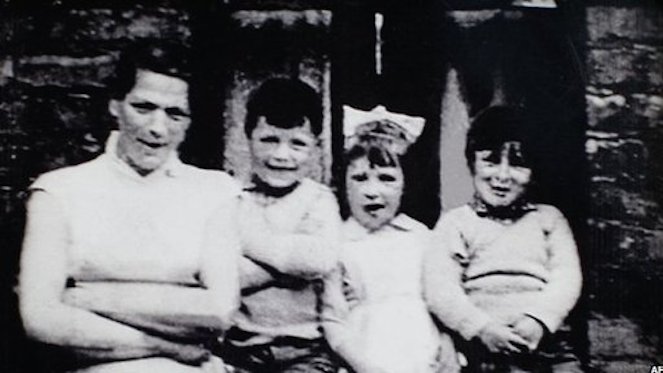
Jean McConville and three of her ten children.
Peace is a process. It takes time and, because it tends to be fragile, it requires careful cultivation. At the same time, communities increasingly expect that peace will allow for mechanisms to achieve justice. Without prosecuting those responsible for human rights violations and atrocities, peace is often seen as somehow incomplete.
This week, the expectations of cultivating peace and pursuing justice came into sharp relief in Northern Ireland. Investigations are ongoing into crimes committed during the Troubles, a period which began in the late 1960s and ended with the Good Friday Agreement of 1998. The period was characterized by incessant sectarian violence, primarily between Protestant groups loyal to the United Kingdom and Catholic republican forces.
Last week investigators honed in on the long-time president of Sinn Féin, Gerry Adams, and his alleged role in the 1972 kidnapping and murder of 38-year old widowed mother of 10, Jean McConville.
Adams has been a stalwart and a chief broker in the tumultuous peace process since the 1980s and has carefully cultivated his image as something of a patron saint of Northern Ireland’s peace process. With his arrest, Northern Ireland now finds itself in a position all too familiar to transitional states: weighing the imperatives of pursuing justice with the prerogatives of maintaining peace.
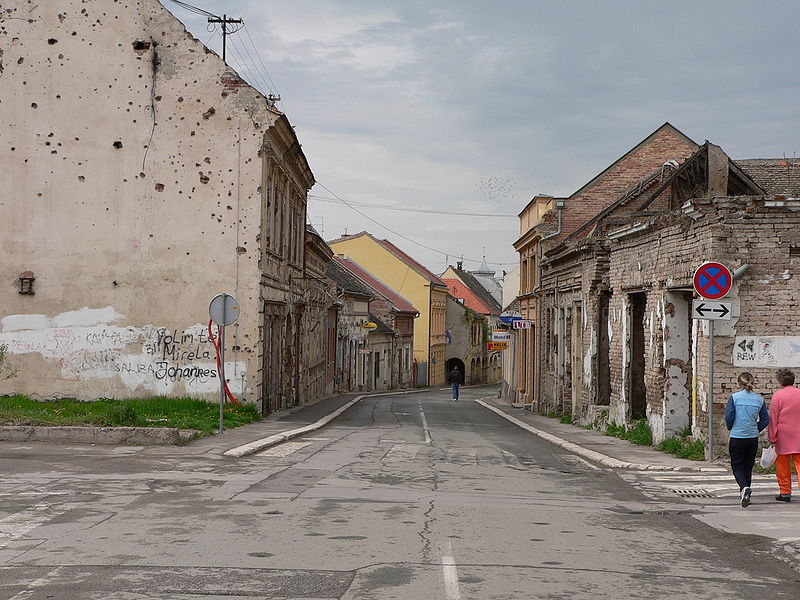
The peace in Northern Ireland remains delicate. Tensions continue to simmer. Dozens of politically inspired murders remain unsolved. Major cities continue to be heavily segregated. Official tour guides pointedly refuse to discuss any recent acts of violence, focusing instead on events from the 1970s and 1980s – periods better protected by the passage of time. A two-story high corrugated iron fence, ironically named “Peace Wall,” carves the capital of Belfast, demarcating Protestant and Catholic neighbourhoods.
While sectarian violence has dramatically diminished, it has not yet been extinguished. Militants continue to be “knee-capped” – often by their own sectarian ’side’. Rather than attempting to avoid such fates, victims voluntarily appear before their perpetrators. As one local Belfast resident explained to this author in 2013, the options are clear: “it’s either a bullet in the knee or a bullet in the head.” Despite a commitment from political figures – by both sides of the sectarian divide – to eliminate political violence and eradicate so-called ’punishment shootings’, knee-capping continues. Today, Northern Ireland has become a leading hub for knee cap reconstruction surgery. What many fear is that it could be worse, that Adams’ arrest and potential prosecution will unravel the peace process and instigate a renewal of paramilitary violence.
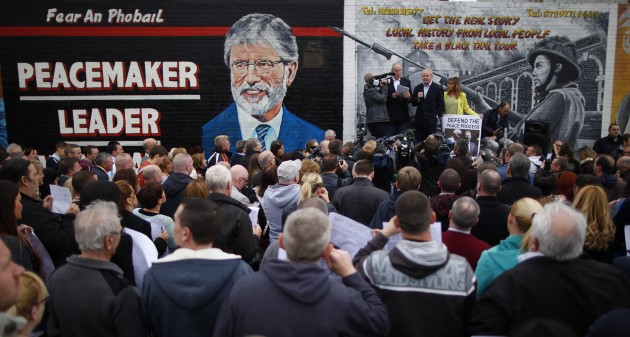
Republican demonstrators gather at a mural depicting and praising Adams’s role in the peace process (Photo: AP)
The McConville case poses two stark and highly related tests for Northern Ireland. First, is the peace secure enough for justice to run its course? And second, can fair and impartial justice be achieved?
Symptomatic of post-conflict justice is the fact that evidence dredged up for prosecutions long after the alleged crimes have been committed is often unreliable. The evidence against Adams comes, literally, from beyond the grave. Starting in 2001, former Republicans and Loyalists agreed to be interviewed for an academic oral history project at Boston College. A number of the Irish Republican Army participants – who also happen to be political adversaries of Adams – pinpoint Adams as being responsible for McConville’s murder. After lengthy legal wrangling, and despite requests not to release the interviews from former Massachusetts Senator and current US Secretary of State John Kerry, documents from the interviews were eventually turned over to authorities in Northern Ireland. However, the evidence may ultimately be unreliable in a court of law, as their allegations cannot be verified and, due to their deaths, the accusers can never be cross-examined. Continue reading