Annie Gell joins us with this guest-post on the impact of the Charles Taylor trial in Sierra Leone and Liberia. Annie is the Leonard H. Sandler fellow in the International Justice Program at Human Rights Watch (HRW). Immediately before joining HRW, Annie lived and worked in Port-au-Prince supporting grassroots women’s groups fighting the epidemic of gender-based violence in post-earthquake Haiti.
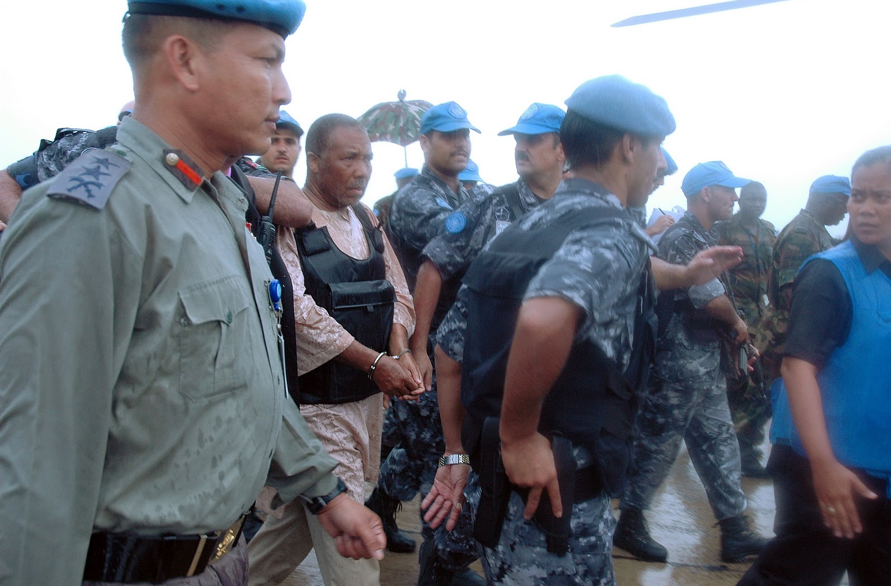
Charles Taylor shortly after being arrested in 2006 (Photo: BBC)
This week, Human Rights Watch released the report “Even a ‘Big Man’ Must Face Justice”: Lessons from the Trial of Charles Taylor. The report is based on interviews in The Hague, London, Washington, DC, Sierra Leone, Liberia, New York, as well as a review of expert commentary, trial transcripts, and daily reports produced by trial observers. This post focuses on Human Rights Watch’s findings regarding the trial’s initial impact in affected communities and provides recommendations for achieving a fuller realization of justice in Sierra Leone and Liberia.
In May 2012, the Special Court for Sierra Leone (SCSL) sentenced Taylor, former president of Liberia, to 50 years in prison for aiding and abetting the 1991-2002 armed conflict in neighboring Sierra Leone. While it has been a long road, the successful conclusion of the trial phase was a landmark for war victims, West Africa, and efforts to ensure perpetrators of the gravest crimes are held to account. However, the trial also highlighted that major accountability gaps remain for serious crimes committed during Sierra Leone and Liberia’s brutal armed conflicts.
Findings on the Impact of the Taylor Trial
The trial’s impact must be understood within the contexts of Sierra Leone and Liberia. After the devastating armed conflicts, both countries have sought to distance themselves from their violent past. Even as neighboring Guinea and Côte d’Ivoire face significant challenges across porous borders, Sierra Leone and Liberia are attempting to build rights-respecting democracies. Yet the institutions that underpin the rule of law—including the police and judiciary—remain extremely weak and other persistent problems, such as corruption, risk undermining hard-won gains.
Consideration of the impact of the trial is constrained by at least three factors: first, the Trial Chamber only handed down its verdict in April 2012 and it could be years before the trial’s full impact is realized; second, there are inherent challenges to isolating the trial’s impact because, though significant, it is one factor of many in a complex social and political landscape; and third, analysis of the trial’s impact in this report is based on information drawn from interviews with civil society members, former combatants, members of government, journalists, and war victims in Monrovia and Freetown. No large-scale or quantitative surveys were conducted.
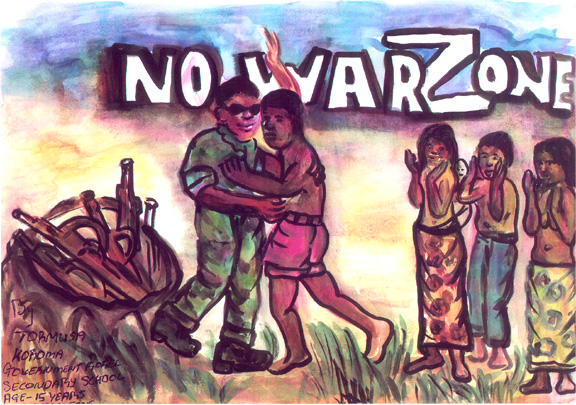
No War Zone (Drawing: Tormusa Koroma, Sierra Leone)
Despite these limitations, several noteworthy observations can be made. First, many people from affected communities are aware of the trial and have reflected on its significance. Since its inception, the Special Court has demonstrated an institutional commitment to conducting outreach within affected communities. Its outreach efforts provide a strong model for other trials, particularly those held far from the location of the crimes, as will typically be the case at the International Criminal Court. Among other activities, court staff created audio and video summaries of the trial in local languages for dissemination in Sierra Leone and Liberia, and facilitated visits to the court in The Hague by civil society members from these countries. Continue reading






 Justice in Conflict