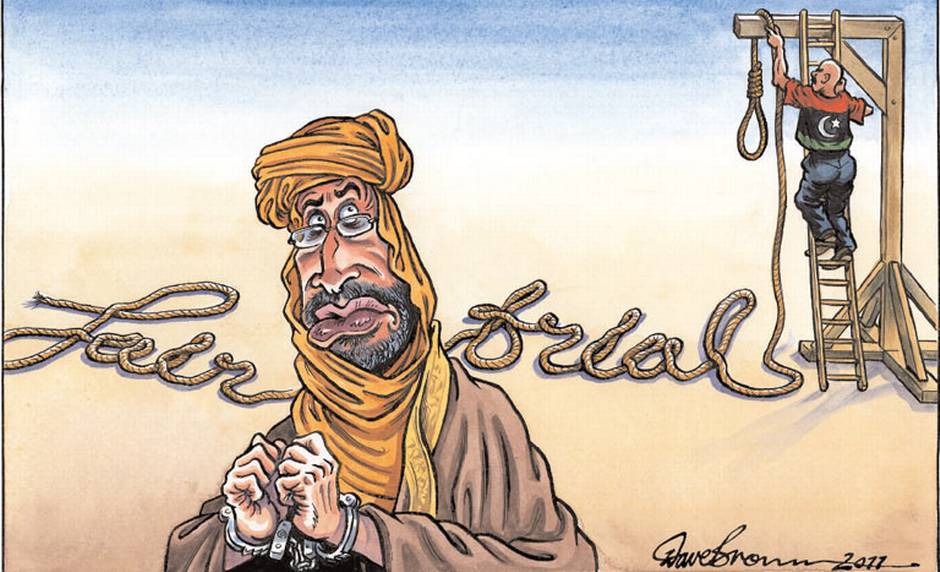
(Cartoon: The Independent / The Daily Cartoon)
Most readers will know by now that the Pre-Trial Chamber of the International Court dismissed Libya’s ruling National Transition Council (NTC)’s application to try Saif al-Islam Gaddafi in Libya. Saif, of course, was indicted by the ICC in June 2011 for his role in crushing the Libyan uprising in February 2011 and has been in detention since mid-November 2011. In this and the next post, I will offer some thoughts on the ruling, and the reactions and controversies it has stirred. This piece focuses on the curious and tumultuous situation on the ground in Libya.
Since being arrested by a group of Zintan rebels, Saif Gaddafi, the formerly gallivanting, ‘playboy’ son of late Libyan leader Muammar Gaddafi, has been held at a secret location in the city of Zintan, home to an impressive Libyan rebel militia which also has Tripoli airport in its prized possession. The circumstances of Saif’s detention is a point that often gets lost in analyses of justice in Libya but is worth stressing: to date, Saif has not been in the hands of the Libyan government. This fact has shaped post-conflict Libya as Saif’s fate has become quite the political asset. Notably Osama al-Juwali, a leader of the Zintani rebels, netted the position of interim defense minister in the NTC.
More troubling, however, has been Saif’s treatment in detention. Saif has become an unlikely cause of human rights groups which have criticized the fact that Saif has been held without legal representation since being arrested, was not informed of the charges against him, has been denied access to lawyers on a number of occasions, and has suffered without proper medical and dental care. More recently, in a letter containing stunning revelations, Xavier-Jean Keïta, principal counsel at the ICC’s Office of Public Counsel for the Defense at the ICC, suggested that Saif had been “physically attacked” while in custody.
Meanwhile, the NTC has been adamant that Saif has been treated fairly and will get a fair trial in Tripoli. To prove it, they’ve built an enormous prison featuring a basketball court, personal chef and satellite TV. One prison guard maintains that “[t]here is not one thing Saif will not have here. This prison is like a castle, a castle fit for a king.” Certainly, for those critics of the ICC who argue that imprisonment in The Hague offers too “cozy” a punishment, the lavish and luxurious nature of Saif’s personal prison palace is food for thought. It is further troubling that the governing authorities are willing to build such an enormous facility for one person, however prized, while thousands of other former combatants remain crammed in make-shift prisons.
But the oddest and most stunning news pertained to Keïta’s description of the charges the NTC originally wanted to levy against Saif:
“Mr. Gaddafi was advised that he was being investigated for trivial allegations concerning the absence of a license for camels, and irregularities concerning fish farms, and that he would not be pursued for serious crimes, such as murder and rape, due to lack of evidence.”
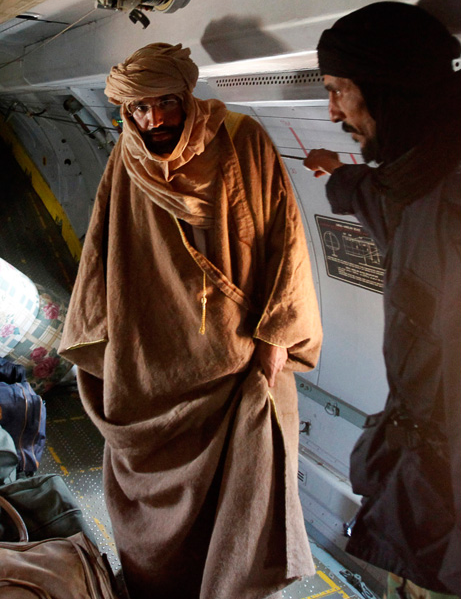
Saif al-Islam Gaddafi on a plane to Zintan shortly after being captured (Photo: Getty Images/AFP)
Keïta added that when the ICC began to put pressure on the NTC to adhere to its international legal obligations, Libyan authorities did an about-face and charged him with more serious crimes, similar to those for which the ICC issued an arrest warrant. But, seriously, camel licences? Irregularities concerning fish farms? Continue reading