Brittany Lyons joins us as a guest-poster to discuss the mixed signals sent by states like the US when they provide military support to authoritarian regimes but decry authoritarian tactics. An aspiring professor of psychology, Brittany is currently working “to help people learn to navigate the academic lifestyle.” Enjoy the post!

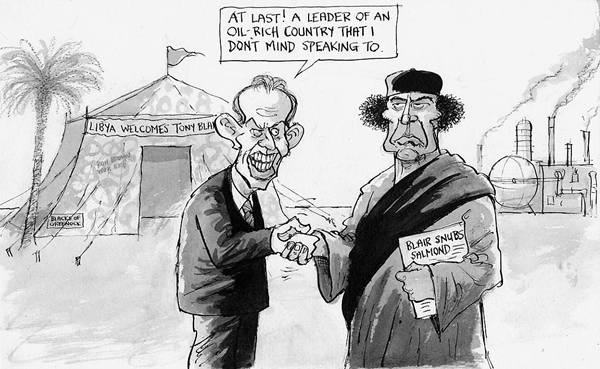
(Cartoon: Steve Bell)
The international human rights organization Amnesty International has expressed concerns about the alleged willingness of Western nations, including the United States, to sell weapons to dictators and terrorist organizations. According to an Amnesty report, the U.S., Russia, and others were major sources of weapons, bullets and military-grade equipment sold to repressive regimes in the Middle East and North Africa. Even though the U.S. claims to be in opposition to dictatorships in these regions, American-made weapons and other military supplies are known to have been used against peaceful protestors in places like Tunisia, Egypt, Syria and Yemen.
The Amnesty International report examines transfers of arms since 2005, and has become the basis for a new push for legislation in the U.S. Congress to block a $53 million arms deal between the United States and Bahrain. The Bahraini government has been condemned by President Obama for its willingness to use violence against unarmed protestors, most of whom are entirely innocent, and many of whom only want rights to equal treatment and education. The weapons will almost certainly be used against those very people, and Amnesty investigators are shining a light on this inconsistency.
Additionally, before the Arab Spring uprisings, the U.S., Great Britain, Russia and other Western nations have actively supplied weaponry and munitions to Yemen, in spite of a belief that they would be used to continue the brutal crackdown on Yemeni citizens.
Amnesty contends, with some real evidence, that there is a generalized failure in arms sales legislation, and an unwillingness to create new arms sales treaty regulations. The U.S. is by no means alone in this failure. Spanish cluster munitions and Soviet-era rockets were found by Amnesty investigators in Misrata, and at least 20 nations are believed to have sold small arms and riot-control agents to Egypt (the U.S. tops the list with sales near $1.3 billion). Since 2005, the brutal regime of Libya has been the beneficiary of arms sales by countries including Belgium, France, Germany, Italy, Russia, Spain and the United Kingdom, even as those same countries were accusing the nation’s dictator Gaddafi of committing of war crimes against his own people.
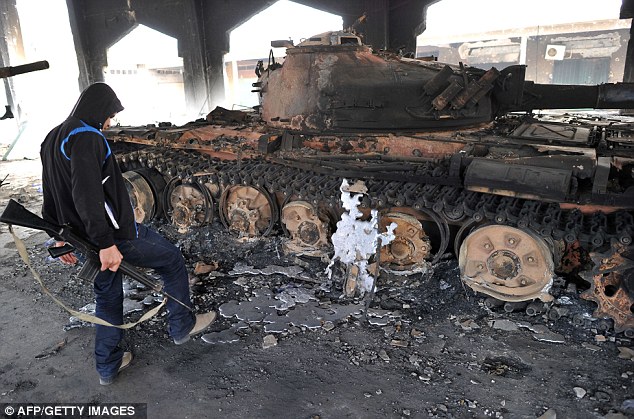
A destroyed tank used by Gaddafi forces. Does it matter if such military weapons were provided by states like the US, Germany, or Russia? (Photo: AFP)
Researchers at Amnesty International continue to argue that only a rigorous, case-by-case examination of proposed arms transfers can begin to address the problems and reduce outside military support for these atrocities. It’s a difficult and touchy situation in some cases, because U.S. allies are often the ones on the Amnesty hot seat. Israel, for example, has been identified as a regular user of U.S.-made weaponry, including hellfire missiles and white phosphorous artillery shells. The use of white phosphorous is considered a war crime when implemented against civilian populations, and although has Israel denied its use, doctors told Amnesty investigators that they had been treating severe burns consistent with white phosphorous injuries. Continue reading