
The following is a post from friend and colleague Andrew Jillions. Andrew is finishing up a PhD in International Relations at LSE. His research looks at the nature of constitutional obligations in international law, focusing how a faith in rules constructs the rule of international law. He also spent a brief stint as an intern at the ICTY. Keep an eye out for more posts at JiC by Andrew!
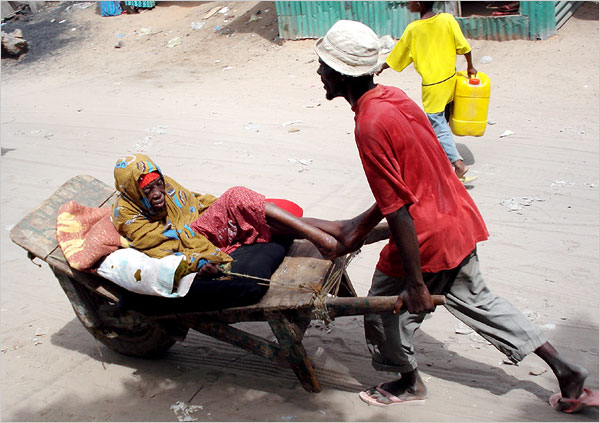
A famine victim is transported in a wheelbarrow (Photo: http://www.newsmania.com)
Is al-Shabaab guilty of a Crime Against Humanity?
As the crisis in Somalia deepens and refugees continue to pour into Dadaab some (also here and here) have begun to raise the question of accountability. There are two considerations in particular: first, is famine a crime against humanity? Second, is al-Shabaab guilty of a crime against humanity?
Before getting to this, it’s worth recapping the genesis of this crisis. The trigger was a below average Deyr rainy season (Oct-Dec 2010) followed by the partial failure of the Gu primary season (April-June). On the back of this, crops failed, livestock died, food prices skyrocketed, the economy crumbled even further and, because of the underlying food insecurity caused by decades of conflict, it hasn’t taken long for the crisis to become a famine.
It is dangerous to oversimplify what factors have helped elevate the crisis into what is now classed as Africa’s worst food security crisis for 20 years, with famine declared in most regions of southern Somalia. Donor states themselves bear some blame for not being quicker to recognize the level of aid needed to address the crisis. Humanitarian organisations can be criticized for giving in too easily to US concerns about funding terrorists and failing to find a way to work within what is admittedly a complex political situation. High food prices weren’t simply due to localized forces but to international speculators jacking up global food prices. Climate change hasn’t helped either.
But it’s local politics that have done the most to turn food insecurity into famine. Al-Shabaab, the rebel group in control of much of the famine afflicted areas, has proved the biggest barrier to improving food security and getting humanitarian relief to the affected communities. In short, the charge is that we wouldn’t be seeing either famine or the resulting internal displacement, at least not on the present scale, if it wasn’t for al-Shabaab.
And so we get to the question of guilt and criminal responsibility, and whether al-Shabaab’s leaders are guilty of a crime against humanity.
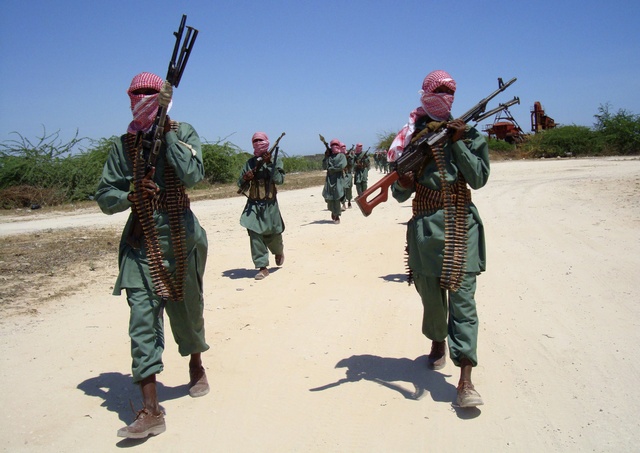
al Shabaab militants training on the outskirts of Mogadishu. Is al Shabaab guilty of a crime against humanity for its role in the famine? (Photo: wehelmedia.com)
Famine as a Crime Against Humanity
In evaluating whether famine can potentially meet the threshold for a crime against humanity, we’re looking at whether it’s part of an action or attack that is widespread or systematic and directed against a civilian population with knowledge and intent. As Alex de Waal points out, in many respects famine is the wrong word to be using here. In the context of criminal responsibility it makes better sense to talk of widespread and systematic starvation. “In famine epidemiology, the verb to starve is transitive – like wounding or murder, it is something that people do to one another.” As Amnesty International have similarly noted, using restrictions on humanitarian aid as a political tool – as Mugabe is accused of doing in Zimbabwe – does provide some grounds for a crime against humanity.
Famine in this sense also contributes to the deportation or forcible transfer of the population (Art. 7.1.d). Famine causes massive internal displacement and forced migration. If there’s any doubt about this, look at how, almost overnight, the refugee camp at Dadaab has been turned into Kenya’s third largest city. What this suggests is that there is a clear-cut case for famine falling under the existing elements of the crime, at least in terms of the action it denotes. There is a prima facie case for al-Shabaab to answer.
The case against Al-Shabaab
The key question, as with all ICL, is whether we can prove intent. Did al-Shabaab engineer the starvation of civilians? There are two possibilities here, the first that they are culpable for creating the famine, the second that their culpability only begins after the famine had been declared.












 Justice in Conflict