Aidan Hehir joins JiC for this critical examination of Kosovo’s war crimes tribunal and the need to pursue accountability for all parties directly and indirectly responsible for mass atrocities in the country. Aidan is a Reader in International Relations at the University of Westminster.
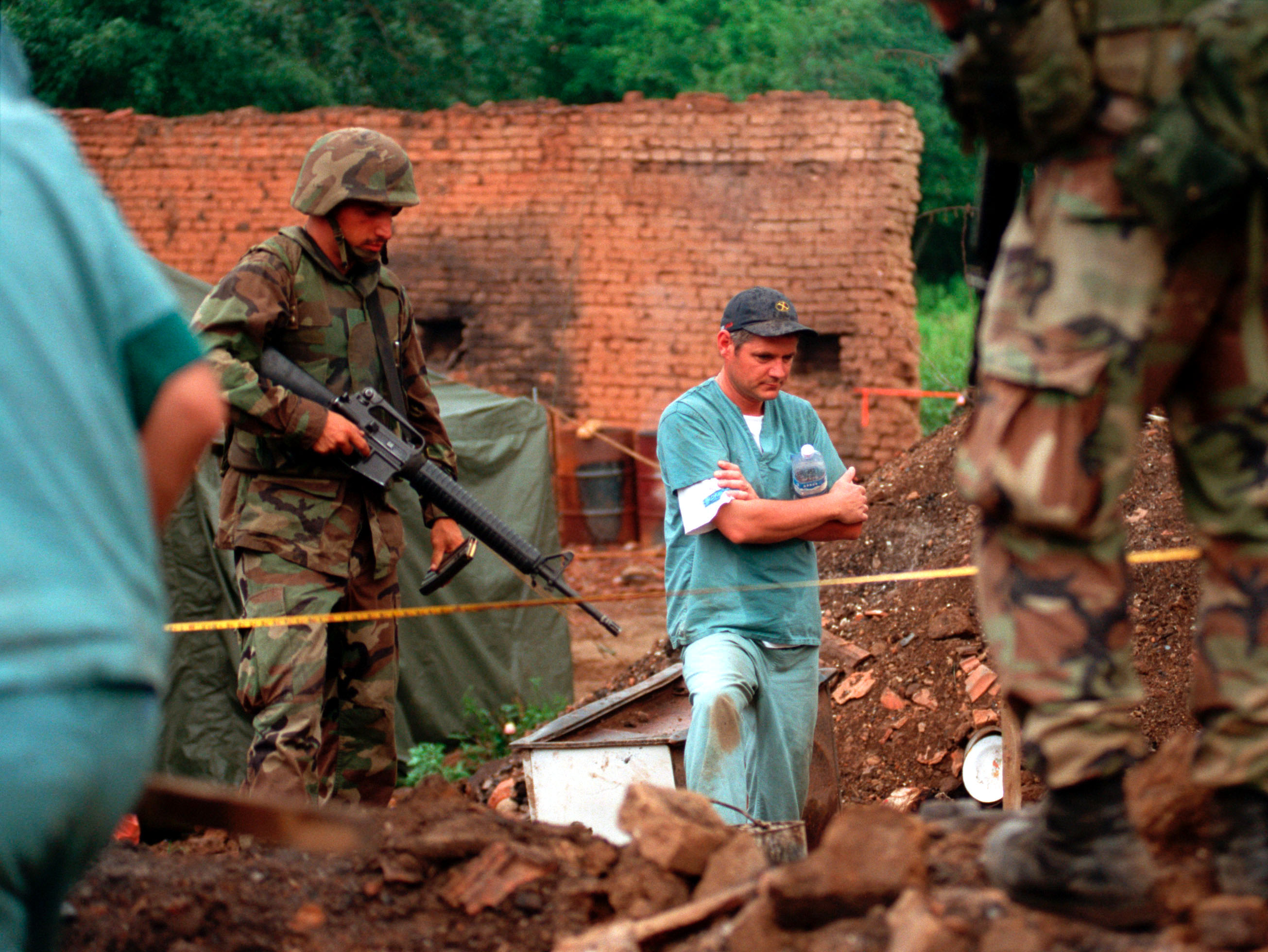
U.S. soldiers provide security as members of the Royal Canadian Mounted Police Forensics Team investigate a grave site in a village in Kosovo in 1999. (Photo: Sgt. Craig J. Shell, U.S. Marine Corps)
On 3 August, the Kosovo parliament voted to alter Kosovo’s constitution to enable the establishment of a Special Court. The court will investigate evidence uncovered by the European Union Special Investigative Task Force of forced detention, torture, murder and, perhaps most shockingly, organ-harvesting allegedly committed by former members of the Kosovo Liberation Army (KLA) from 1 January 1998 to 31 December 2000.
Kosovo’s war crimes court will deal with important and perhaps unique questions about culpability in transitional justice. The offences under its jurisdiction were committed by agents acting with the sometimes overt and sometimes tacit support of external actors, namely NATO and the UN Mission in Kosovo (UNMIK). They are the same actors that assumed executive authority in Kosovo for half of the three-year time period under examination. The extent to which these actors will be held responsible for sponsoring and / or tolerating criminality conducted by the KLA will have a profound effect on perceptions of the Court’s legitimacy and thus societal stability within Kosovo.
“Monsters” and “Victims”
Kosovo Albanians generally see the KLA as freedom fighters who brought about their “liberation”, albeit with the aid of NATO’s military intervention in March 1999. The idea that the KLA, or the Kosovar Albanian community more generally, could be guilty of human rights violations jars with the popular conception of “Serbian aggressors” and “Albanian victims”. Indicatively, Ramush Haradinaj, the former Prime Minister and current leader of the Alliance for the Future of Kosovo, stated: “By approving this court, we are turning ourselves into a monster…we were not monsters; we were victims.”
Kosovo’s declaration of Independence in February 2008 sparked jubilation amongst the majority Albanian population, but this has given way to spiraling anger and dissatisfaction; unemployment remains cripplingly high, wages are low, and corruption is rife. Between December 2014 and February 2015 some 50,000 Albanians left Kosovo in an ill-fated attempt to reach the EU. In March, the UN ranked Kosovo as the fourth largest source of asylum seekers in the world. Amidst this depravation, many naturally take comfort in KLA nostalgia. Unsurprisingly, the prospect of this source of pride being besmirched doesn’t appeal.
The Court’s perceived legitimacy amongst the Albanian community – which clearly has profound implications for peace and stability within Kosovo – will hinge upon the extent to which the actions of the KLA are acknowledged to have been supported – or simply tolerated – by external actors. This external support involved two distinct phases that lie within the Court’s three-year remit: first, the support afforded to the KLA during the struggle against Yugoslav forces from 1 January 1998 until the end of NATO’s intervention on 10 June 1999; and second, the tacit support provided by the international administration established after NATO’s intervention and lasting until 31 December 2000.
Supporting “Terrorists”?
Prior to NATO’s intervention the KLA were known to engage in attacks against Serbian – and also Albanian – civilians; indeed, in February 1998 the US Envoy to the Balkan stated that “[t]he UCK (KLA) is without any question a terrorist organisation” and, a month later, UN Security Council Resolution 1160 condemned “all acts of terrorism by the Kosovo Liberation Army”. Still, evidence now suggests that a number of Western states covertly sent Special Forces into Kosovo in 1998 to train the KLA (James Pettifer (2012) The Kosova Liberation Army, p. 178). More overtly, during Operation Allied Force NATO coordinated militarily with the KLA.
After NATO’s intervention concluded, the Security Council passed Resolution 1244 giving UNMIK administrative powers in Kosovo and charging NATO-led KFOR with maintaining peace and security. Despite the huge international presence, attacks against the Serbian community increased dramatically when NATO’s campaign ended, precipitating a round of “counter-ethnic cleansing”. Reports by Human Rights Watch and the Red Cross recorded that by October 1999 over 200,000 Serbs and thousands of Roma had fled Kosovo in what was described by the then chief prosecutor for the International Criminal Tribunal for the former Yugoslavia Carla Del Pointe as being “…as serious as what happened there before [NATO’s intervention].”
In its initial phase, the international administration made two fateful decisions: one, to tolerate the mass exodus of Serbs and two, to turn a blind eye to the criminality perpetrated by sections of the former KLA. According to a report produced on behalf of the Council of Europe’s Committee on Legal Affairs and Human Rights, the international administration, “favoured a pragmatic political approach taking the view that they needed to promote short-term stability at any price.”
There was some logic to this of course. Tackling the criminal elements of the KLA would have led to confrontations with an armed guerrilla organisation whose support they needed. Additionally, stopping the Serbian exodus, and confronting those who targeted Serbs, would have been costly, dangerous and angered sections of the Albanian population. Ultimately, the continued presence of Serbs in cities such as Pristina, Peja and Prizren would have constituted a persistent source of instability whereas their relocation to enclaves such as Northern Mitrovica and Gračanica removed various inter-ethnic flash points. Continue reading