Chris Tenove is a semi-regular Justice in Conflict blogger, and a Postdoctoral Research Fellow at the University of Toronto. He reported on the Duch trial at the ECCC for Macleans’ magazine and Radio Netherlands.
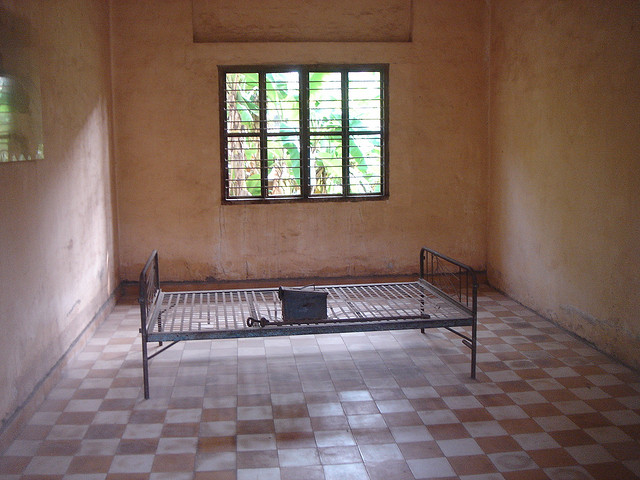
When the Khmer Rouge were driven from Phnom Penh by Vietnamese and Cambodian forces in early 1979, they left behind an institution that has come to illustrate the regime’s cruelty and paranoia. At the S-21 prison, now the Tuol Sleng Genocide Museum, the liberators found 14 recently-executed prisoners as well as rooms full of chains, shackles, a waterboarding apparatus, and other instruments of torture. They also found a vast archive, with thousands of photographs of terrified men and women, along with the confessions that were extracted from them. The documents showed that while the activities were barbaric, the institution operated with bureaucratic discipline. Scrawled across many of the documents were terse orders from the prison’s commandant, Kaing Guek Eav, known as Duch. On one interrogation record he wrote: “Beat [the prisoner] until he tells everything, beat him to get at the deep things.” Beside a list of names: “Kill every last one.”
In 2009, Duch became the first person tried at the Extraordinary Chambers in the Courts of Cambodia (ECCC). Every day of the trial, Thierry Cruvellier came to the courtroom on the outskirts of Phnom Penh and carefully watched Duch, along with the lawyers and judges arrayed around him, and the witnesses who took the stand. Cruvellier has established himself as the preeminent journalist of international criminal justice. He has reported on trials in Arusha, The Hague, Sarajevo and Freetown; edited the International Justice Tribune; and authored the excellent Court of Remorse: Inside the International Criminal Tribunal for Rwanda. He believed that the Duch trial would offer something new, the chance to examine at length the mind and motives of a senior perpetrator of atrocity crimes.
The result is The Master of Confessions: The Making of a Khmer Rouge Torturer (originally released in 2011 as Le maître des aveux). Among its many virtues, Cruvellier’s book is a master-class in how to evoke characters through description, and none are drawn more sharply that Duch himself. The book also shows what gets missed when researchers (like myself) study international criminal justice without attending trials in their entirety. We forget about the many storylines a trial can offer. These include the competing visions of the crimes – and of justice itself – advanced by lawyers, judges and defendants. They also include the dramatic arcs of individual testimonies, as witnesses respond to questions and to their roiling memories and emotions.
I recently spoke with Cruvellier about his book, about the ECCC, and about lessons from the Duch trial that might apply to future international criminal trials.
Chris Tenove: Why did you believe that the Duch trial would be exceptional?
Thierry Cruvellier: I came to Cambodia after covering international tribunals for 10 years, when I was starting to feel like I should move to a new topic. But I realized the Duch trial would be a unique circumstance. Because of the legal system that applied [the ECCC follows France’s civil law system], there would be no plea-bargaining. So even though Duch was essentially pleading guilty, he would have a full trial.
I realized it would be an opportunity to finally hear in detail the voice of the perpetrator. Anyone who covers war crimes tribunals becomes interested in this voice. Only the perpetrator can tell us how that very specific crime – a political crime – actually works. How is it that individuals like Duch, who had not been criminals before this period and would probably never be a criminal after, get involved in a violent machine like S-21?
Did you ever worry that Duch wasn’t worth an entire book? That maybe he wouldn’t reveal enough, or wouldn’t be interesting enough, to warrant such attention?
That was the only real mystery for me. I knew this trial could be exceptional, but I didn’t know if the accused would be ‘up to the task’.’
Duch proved to be a really unusual man. He was intelligent, talkative, and endowed with an exceptional memory. He could be stiff, he could be arrogant, he could be obsequious or irritating. He could also be charming, in a way, and he had a sense of humor. He also had an incredible capacity to protect himself from dangerous emotions, so during the trial he would break down but never break apart.
And he could be sometimes subtle in his thoughts. He was capable of reflecting on himself and on the ideology he had served. So yes, he was a rich character.
In most trials, the defendant rejects the criminal acts that allegedly took place, or tries to justify those acts according to political ideology or circumstances. But Duch admitted to the acts, claimed responsibility and criticized the Khmer Rouge ideology. So what was the trial about?
The trial was so interesting because, through his detailed responses to every bit of evidence, we could get – not a full understanding – but a closer understanding of how “we” might become Duch. And also, once we have become Duch, how we might live with it.
The trial identified some of the steps an individual might go through to become a mass murderer – and that includes the fact that he experienced the social injustice and oppression of the Sihanouk regime, and was imprisoned by it. That’s part of his story. In no way does it make us forgive what he’s done, but it helps show how he got involved in mass murder.
The expert psychologists were also very important. They brought a sort of reasonable and scientific understanding about how human beings function in extreme circumstances. It’s impossible for most people to understand how Duch could kill hundreds of children at S-21 during the very time that two of his own children born. But the psychologists could understand and explain this, and tell us about the kinds of mechanisms that we can develop. Continue reading →






 Justice in Conflict