James P. Rudolph joins us for this fascinating guest-post on the need to respond to the ongoing crisis in Mali. James is an attorney in Washington, D.C. and California where his work focuses on international law. In this post he guides us through the various political, economic and legal responses available to the international community, focusing in particular on the potential for an R2P-response to the violence in Mali.
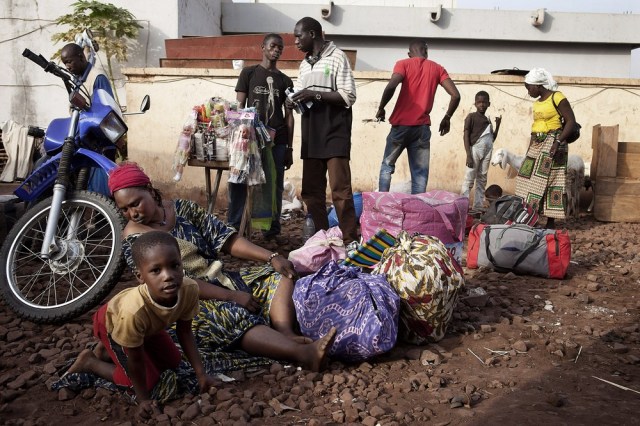
A family in Bamako, escaping violence in Gao (Photo: Joe Penney/Al Jazeera)
Six months ago, a coup d’état toppled President Amadou Toumani Toure (“ATT”), the democratically elected leader of Mali, and soon thereafter ATT went into exile; armed groups in the north, inspired by a strict and austere interpretation of Islam and the desire to impose Sharia law on the entire country, have engaged in jihadism, terrorism and arms trafficking; and many of Mali’s cultural treasures and riches have been destroyed by the same armed groups who consider much of modern civilization – i.e., the West – to be decadent and depraved and thus in need of purification.
Lamentably, most of these developments – marauding and irredentist Islamists linked to al-Qaeda in the Islamic Maghreb, the destruction of cultural relics and objet d’art, threats to World Heritage sites – have been overlooked or ignored. To be sure, some outlets – notably The New York Times and the BBC – have done their part to sound the alarm, and Alain Juppé, the former foreign minister of France, was told in March that if these groups gained control of the north, Mali would be turned into another Afghanistan.
Nevertheless, much of the world’s reaction has been subdued or nonexistent. This is regrettable, for what is happening in Mali has the potential to turn into a full-blown civil war with international peace and security implications. That is, certain regional organizations – namely, the Economic Community of West African States, or Ecowas – have already been sucked into the vortex of violence and armed conflict. Obviously, the situation is more than an internal disturbance, with Mali’s neighbors worried about contagion and France positioning troops in the Sahel. That this is of concern is not doubted. But when it comes time to settling on an appropriate response to this ostensibly internal conflict, the international community seems stuck. In an effort to contribute to a workable solution, this essay proposes that there already is a framework for thinking about the crisis in Mali. It’s called the Responsibility to Protect (R2P), and it offers, at a minimum, a way forward.
R2P entails, interestingly, more than the responsibility to protect. Indeed, the concept has built within it three responsibilities: the responsibility to prevent, the responsibility to react and the responsibility to rebuild. As the situation in Mali seems already to have passed the point where prevention would be effective, the real focus must now be on the responsibility to react. Notwithstanding this conclusion, and to ward off any confusion concerning the use of force, the responsibility to react also has preventive steps to take before coercive, non-consensual force is used. To be sure, military force is part of the responsibility to react, but it is always a last resort and only if it is likely to do more good than harm.
Thus, the focus must first be on the other options within the reaction “toolbox,” and only if these fail can we seriously consider the use of force. These other steps include political and/or diplomatic responses; constitutional and/or legal responses; economic and social responses; and security-sector measures. We will take these in turn.
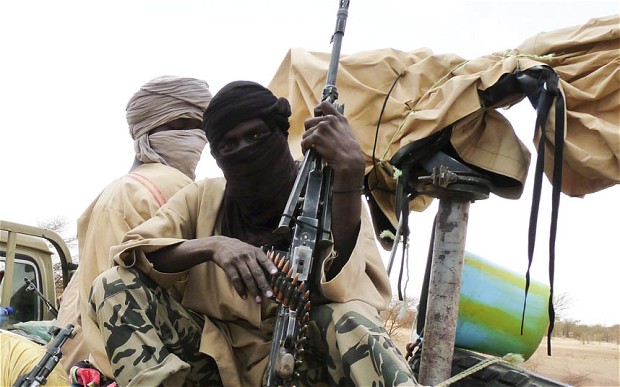
Members of Ansar Dine in Gau, northern Mali (Photo: Reuters)
Political and diplomatic responses are actually divided into political incentives and political sanctions. Incentives include things like diplomatic recognition, membership in international organizations, cancellation of debt, etc. In the case of Mali, we are dealing with a bifurcated country (with two-thirds of the country controlled by Islamists), so these incentives are unlikely to work, because the real issue is how to get the government in Bamako, the capital, back in control of the north. Likewise, political sanctions (things like withdrawal of diplomatic recognition, expulsion from international organizations, travel bans) are, like political incentives, of dubious utility.
The next option, therefore, is the constitutional/legal option, but to be precise, the constitutional option is really about long-term, structural changes tailored to prevent atrocities in the first place, so the focus here is on legal options. In short, this means criminal prosecution. First and foremost, national governments continue to play the primary role in enforcing international law, and this includes prosecution for crimes subject to universal jurisdiction like piracy, genocide, torture, crimes against humanity, etc. It is only when the state is unable or unwilling to prosecute (other than referrals by the Security Council) that institutions like the International Criminal Court (ICC) get involved. Unfortunately, the government in Bamako, which lost control of two-thirds of the country, seems unable to mount an effective prosecution of the crimes being committed in the north. Indeed, Mali is seeking international help by, among other things, asking the ICC to launch an investigation into possible war crimes, signaling its intent to rely on outside help. But launching an investigation and actually apprehending suspects are two different things, as the case of Omar al-Bashir in Sudan so painfully reminds us.
Continue reading →





 Justice in Conflict