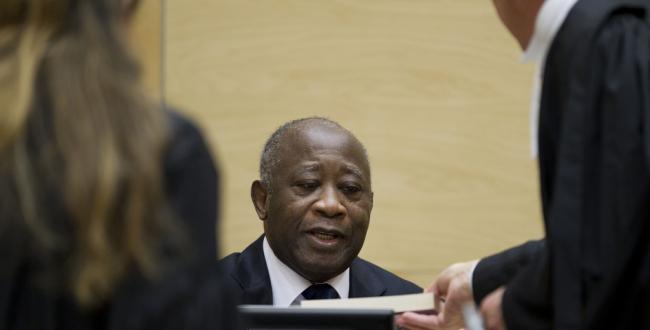
Laurent Gbagbo at the ICC (Photo: RNW)
Few issues have instigated as much controversy in the field of international criminal justice as the question of where International Criminal Court (ICC) indictees should be brought to justice. The majority of attention has been focused on instances when states seek to prosecute ICC indictees domestically and challenge the Court’s jurisdiction. Much less attention has been paid to cases when states choose to ‘outsource’ the trial and prosecution of some individuals to the ICC.
In some cases, where to try ICC indictees seems generally unproblematic. For example, in the Democratic Republic of Congo or the Central African Republic, the virtual lack of anything approximating a functioning and impartial judicial system makes the necessity of trying and prosecuting ICC indictees in The Hague uncontroversial. But other cases, especially states emerging from periods of conflict and which have begun to consolidate democratic and judicial institutions, are another – and much less clear – story altogether. To varying degrees, states like Uganda, Libya and Ivory Coast have emerged from the periods of violence and mass atrocity that instigated ICC intervention. Again, to very varying degrees, they have institutions which may be capable of investigating and prosecuting international crimes. Still, for some individual perpetrators, some states seem to believe that the ICC remains a better option. An important yet seldom asked question thus arises: if a state is able to investigate and prosecute but, for whatever reason, doesn’t want to prosecute particular individuals, should it be able to outsource justice to the ICC?
Complementarity Confusion
The answer to this question rests on the issue of complementarity which, as a principle and practice, is understood as granting the ICC the ability to investigate and prosecute individuals only in those states which are unable and unwilling to do so themselves. Put another way, it is, first and foremost, the responsibility of states to investigate and prosecute individuals allegedly responsible for atrocity crimes. When the state in question fails to do so, then the ICC may be granted or assert its jurisdiction. The brevity of the principle of complementarity, however, betrays its complexity in practice.
It isn’t particularly easy to follow which conception of ‘complementarity’ is being followed at the ICC these days. Take a look across its cases and it is difficult to see a cohesive and consistent application of what “ability” and “willingness” amount to. In some cases, such as Kenya, only the most rigid standard applies, whereby the state must show that it is able and willing to investigate and prosecute the same individuals for the same crimes as those by the ICC. In the Ugandan case, it isn’t clear that the Museveni government was ever unable or unwilling to try LRA commanders. Rather, the government’s problem was that the LRA’s senior command was no longer in Uganda itself and thus couldn’t be arrested. In Libya, the ICC’s Office of the Prosecutor (OTP) has appeared remarkably lenient towards Libya’s demands to try Saif al-Islam Gaddafi and Abdullah al-Senussi, siding with the government’s claim that it is able to investigate and prosecute ICC indictees domestically. It was telling that in the Libyan case, the Court’s defense counsel claimed that the Office of the Prosecutor (OTP) was applying double standards in its use of complementarity. It would come as no surprise if similar arguments are brought up by defense counsel other cases in the future.
But what of this issue of ‘outsourcing’ justice? Let us consider two cases where this seems to be occurring. Continue reading