

Abdullah al-Senussi upon his arrival in Tripoli after being extradited from Mauritania in September, 2012.
As I write this, admissibility hearings at the International Criminal Court (ICC) are ongoing. The hearings will play a major role in whether or not ICC judges ultimately accept Libya’s plans to try Abdullah al-Senussi, Gaddafi’s former spy chief and henchman, and Saif al-Islam Gaddafi, the country’s galavanting former heir apparent, in Libya by Libyan judges. Nevertheless, as most observers familiar with the case freely acknowledge, the hearings aren’t likely to have any bearing on where Saif and Senussi are tried. Without any political backing from the international community, the ICC isn’t exactly in a position to force Libya to surrender either of their prized prisoners to The Hague. In short, there should be no confusion: Saif and Senussi will be tried in Libya.
But what if the ICC could convince the Libyan government that it was in its political interests to surrender Senussi after first putting him on trial in Libya? I think there is a way that the Court can do so – but it requires some political, rather than legal, manoeuvring.
Libya and its citizens desperately want the information locked away in the dark corners of Abdullah al-Senussi’s memory. There is, quite simply, no one with a better understanding – or greater involvement – in the political machinations and violations committed by the Gaddafi regime against Libyans. It is for this reason that he has been called the country’s “black box” and the “crown jewel” of justice in Libya. It is also for this reason that Libya was willing to pay $200 million just to secure Senuss’s extradition from Mauritania. His mind is a repository of truths about what happened in the Abu Salim prison massacre, the Lockerbie bombing, the attack on UTA Flight 772, the torture and execution of countless Libyan citizens, and Libya’s sponsorship of violence and oppression at home and abroad.
So how can Libya get Senussi to confess his secrets? The problem is that Libya has no carrots to offer Senussi for being forthcoming. Indeed, Senussi – like the rest of the world – surely knows that he is unlikely to get a fair trial and is virtually guaranteed an eventual death sentence. If, as it has been rumoured, Senussi is being tortured, that too is unlikely to yield much in terms of truths. Libya likely does not believe it can promise him any less of a sentence. Senussi is, after all, the most wanted man in Libya.
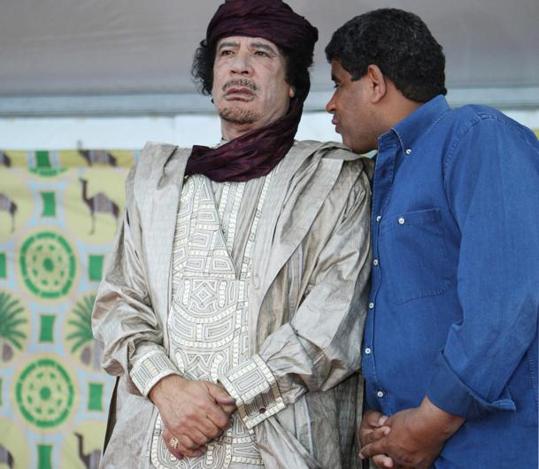
(Photo: AP Photo/Abdel Magid al-Fergany)
So what can Libya do? First of all, it can leverage people that Senussi cares about against him. Senussi’s daughter was arrested this week in Tripoli for allegedly entering Libya illegally. Sadly, it would come as little surprise if her subsequent treatment is being used against Senussi divulging information about Gaddafi-era secrets.
My suggestion, however, is to return to the possibility of sequencing trials in Libya and The Hague. It would go something like this: Libya and the would ICC agree, in principle, that the trial of Senussi would be sequenced. First Senussi would be tried and sentenced in Libya but, rather than carrying out the sentence, he would be tried in The Hague. Libyan authorities would then offer this as an incentive to Senussi in exchange for information about the worst excesses of the Gaddafi regime. It would be tough for Senussi not to accept. It’s either The Hague (a relatively cushy place to spend a few years) or death. Continue reading












 Justice in Conflict