Beyond Famous – Invisible Children’s Follow-up to Kony2012

Invisible Children aired Kony2012 Part II today (Logo: Invisible Children)

One month ago the US based organisation Invisible Children published their Kony 2012 video, campaigning for the arrest of Ugandan rebel leader Joseph Kony. The video went viral to an extent never witnessed before. Many people who had not heard about the LRA and Joseph Kony before started to get engaged with the topic and suddenly took interest in events thousands of miles away. Designed as a 30 minutes advocacy flick, the movie naturally also encountered a lot of criticism for the way in which the video chose to present the situation, for the oversimplification of the LRA conflict in general, as well as the lack of voices from people living in the affected areas. You can find JiC posts that were quite critical with the video here and here. As I have previously described, some of the criticism became as oversimplified as the original movie when internet critics and mass media started picking apart the organisational and financial structures of Invisible Children and people started accusing the organisation of making money off the misery of Africans. Another unfortunate event was the mental breakdown of Invisible Children co-founder and Kony2012 producer Jason Russel that diverted much of the media coverage that should have focused on the LRA conflict and its background.

Today Invisible Children launched part 2 of their Kony2012 video, entitled ‘Beyond Famous’. It puts the organisation’s advocacy approach and Kony2012 into perspective and explains the rest of the strategy that Invisible Children is propagating in order to end the LRA conflict. In doing so it addresses many of the concerns critics have brought forward and gives a lot more space to the voices of people living in areas formerly or currently affected by the LRA violence. With close to 20 minutes it is also a bit shorter than the last video which will hopefully help to ensure that as many people as possible watch it until the end. On a personal note, I still do not like the style of the video. Like the first part it aims at the gut without giving enough food for thought and tries to transport a ‘we can change the world’ attitude that I find naïve and dangerous. The unreflected and self-gratifying mass activism that is promoted in the video goes against my ideal of enlightened and critical citizens, but if that is what is needed to get people interested in the topic, so be it. Still, after having seen some of the old videos Invisible Children is producing with donations, like this High School musical, I would strongly advise you to rather give your money to World Vision, War Child or any other organisation that is doing humanitarian work in the area.
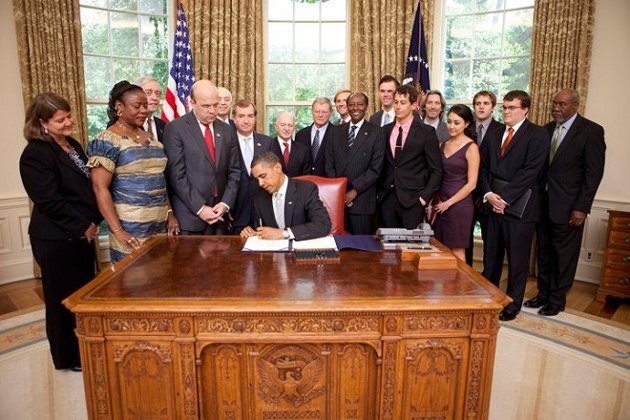
Invisible Children and Resolve staff watching President Obama sign into law the LRA Disarmament and Northern Uganda Recovery Act in May 2010.

There are still some minor issues with the video: It lacks any discussions about the dangers a military approach in the region might harbour, it doesn’t mention the human rights violations the Ugandan government has been acused of, and it is one-sided in not giving screen time to the critics of military approaches in the region who do exist. Yet, this is an advocacy video, and it wouldn’t make a lot of sense to criticize it for not giving the full picture, after all its aim is to mobilize the people in favour of one particular approach – military intervention. The video also implies that Kony2012 helped to coordinate a regional African response to the LRA which is wrong since African Union plans to create a joint brigade have existed for months and the US has been working on facilitating this cooperation for at least as long. Continue reading

Posted in Advocacy, African Union (AU), Central African Republic (CAR), Democratic Republic of Congo, Lord's Resistance Army (LRA), Southern Sudan, Uganda | Tagged , , , , , , , , , , , , | 3 Comments

Justice in Libya? The Senussi Sweepstakes!

Senussi Mauritania

Abdullah al-Senussi (Photo: ANP)

As many readers will already be aware, Abdullah al-Senussi was recently detained in Mauritania in a joint operation between French and Mauritanian intelligence forces. Senussi, variously called Colonel Muammar Gaddafi’s “right hand man”, “eyes and ears” and the Gaddafi regime’s “black box”, was the last free member of the ‘Tripoli Three‘ – the Libyan officials wanted by the International Criminal Court for their roles in the brutal crackdown against Libyans last winter.

There aren’t many Gaddafi-regime atrocities that Senussi isn’t linked to. As I have described elsewhere, Senussi is the ‘crown jewel’ of justice in Libya because of his knowledge of the Gaddafi regime and its vicious secrets. Here’s a brief summary of some of the crimes Senussi has allegedly played a key role in:

  • UTA Flight 772: The September 1989 bombing of a French passenger plane over Niger which killed 170 (all crew and passengers); In 1999, French authorities convicted Senussi in absentia for his role.
  • The Abu Salim Massacre (June 29, 1996): a reported 1,200 inmates who had complained of mistreatment were lured into believing they would receive better treatment, only to be killed; Senussi was said to have played a key role.
  • The Libyan Revolution: Senussi is allegedly responsible for organizing attacks on Benghazi, the same attacks that the UN Security Council reacted to by passing Resolution 1973, authorizing “all necessary means” to prevent the massacre of thousands of Libyan civilians. He may also have been responsible for bringing in the mercenaries who fought with Gaddafi loyalists against the rebels.

Given his position in the Gaddafi regime, Senussi also has an intimate knowledge of other crimes committed against both the Libyan people and against non-Libyan nationals. He holds the key to understanding the Lockerbie tragedy and the Gaddafi regime’s funding of the Irish Republica Army (IRA). He undoubtedly has a deep understanding of  the intimate political and economic relations between Western states and the Gaddafi regime (see herehere and here). Perhaps most importantly, Senussi also knows, to put it bluntly, where the bodies are; he knows where the thousands of victims of Gaddafi’s brutal reign was disposed.

With Senussi’s arrest, the primary question regarding his fate has changed. It used to be “where in the world is Abdullah al-Senussi?” Now it is “where in the world will Abdullah al-Senussi be tried?” Welcome to what David Bosco has aptly termed the “Senussi sweepstakes“!

In this context, this post is an analysis of the main players involved in determining where Senussi will end up facing justice.

The 'Tripoli Three': al-Senussi (L), Muammar Gaddafi (C) and Saif al-Islam (R) (Photo: Die Presse)

Libya: Welcome Home!

Unsurprisingly, Libya’s National Transitional Council wants Senussi delivered to Libya and has promised that if he is extradited to Libya, he will be put on trial before national elections this coming June. Libyan authorities, as in the case of Saif al-Islam Gaddafi (see here and here), have refused to entertain any option other than Senussi and Saif being tried in Libya, by the new Libyan judiciary.

In the wake of Senussi’s arrest, Libya sent a delegation, headed by the Deputy Prime Minister, Mustafa Abu Shagour, to persuade Mauritania to extradite Senussi. The NTC subsequently claimed that the two sides had reached a deal and that a date for Senussi’s surrender to Libya would shortly be announced. However, the delegation left without Senussi, the former intelligence chief remains in the capital, Nouakchott, and a Mauritanian source familiar with the negotiations has said that “[a]t this stage no commitment has been given by the Mauritanian side, it looks like wishful thinking by the Libyans.”

The biggest concern with Libya trying Saif is the very real possibility that he will be convicted quickly – likely for his role in the Abu Salim Massacre – and then sentenced to death. If that were to be the case, many of the truths about the Gaddafi regime would die with Senussi.

France: Bienvenue  à la Justice!

France has said that it wants Senussi surrendered to them and that they should get ‘first dibs’ because of their role in detaining him. As noted above, Senussi was allegedly involved in the bombing of the French UTA Flight 772. France, however, has removed the “allegedly” bit and has actually convicted Senussi in absentia for the crime back in 1999.

Initially, there was confusion about what France would do with Senussi, given that he had already been convicted. I myself wondered why they would request his extradition to France just to put him in jail. However, it is now clear that France would re-open and try Senussi again for his role in the demise of UTA Flight 772.

Importantly, the ICC may claim that if Senussi is sent to France, the French government is under an obligation, under the Rome Statute, to hand him over the Court.

Continue reading

Posted in Complementarity, International Criminal Court (ICC), Libya, Libya and the ICC, The Tripoli Three (Tripoli3) | 4 Comments

Hunting Kony – An Update on the US Deployment in Central Africa

US and Ugandan troops in formation during a training exercise

In May 2010, the United States Government started officially taking more interest in the Lord’s Resistance Army conflict that had ravaged Central Africa, and in particular northern Uganda, for 24 years. President Barack Obama signed into law the ‘Lord’s Resistance Army Disarmament and Northern Uganda Recovery Act’. Nearly one and a half year later, President Obama decided to deploy 100 combat armed military advisors to the areas affected by the LRA in the scope of this act.

JiC has reported about this deployment in the past here and here. The deployment was pushed into the public spotlight with the publication of a hugely popular but also heavily criticised video produced by the NGO Invisible Children that called for the arrest of Joseph Kony in the scope of its KONY2012 Campaign. A couple of months into the US deployment it is of course not possible to really assess its impact comprehensively, but some of its prospects and weaknesses can and should be analysed.

First, let’s get some of the facts straight. One of the reasons for this deployment was the consistent civil society pressure in the US, directed by organisations like Invisible Children. But another important motivation for the deployment was the strategic importance of Uganda to the United States. Oil had been recently discovered in the country and the Ugandan army provides many soldiers for a strategically important Peacekeeping Mission in Somalia. It is often overlooked that many of the military advisors ‘deployed’ were already stationed in the area before the deployment and that the troops are advising the armies in the region, but not taking part in combat operations. Catching Kony thus mainly depends on the capabilities of the local armies, among which the Uganda People’s Defence Force (UPDF) is clearly the most competent one. Furthermore, catching Kony will not be easy. The LRA operates in an area the size of the US State of Arizona or half the size of France. Within this area the LRA moves in small groups of 10-15 persons. UN sources have told me that the LRA groups manage to move up to 50 km per day, an impressive feat considering the dense jungle area.

Military operations have so far failed to stop the LRA. Unfortunately, past operations did not manage to control the LRA threat. Rather, they provoked retaliations and civilian casualties. During the UPDF led offensives to stop the LRA in northern Uganda and southern Sudan (now South Sudan), the LRA managed to outmanoeuvre the UPDF and spread the conflict consecutively to previously peaceful parts of the north and eventually even to eastern Uganda where civilians bore the brunt of the fury of the LRA. Additionally, military attacks on the LRA are likely to kill mainly freshly abducted civilians, among them children. While LRA fighters are experienced enough to disperse quickly into the dense jungle in the case of an attack, the abductees who move with them are often forced to carry looted goods and are tied together with ropes to prevent escape. Those civilians are unlikely to escape in the event of an ambush and are often accidentally killed by soldiers or attack helicopters.

An aerial view of the forests in Garamba National Park in north-eastern DRC. This might give you an idea why it is so difficult to catch Kony (Photo: Finbarr O'Reilly)

Finally, this is not the first attempt that the US made at supporting military efforts to stop the LRA. After the failure of the Juba Peace Talks in 2008, the US provided intelligence and military advisors for the UPDF-led Operation Lightning Thunder, meant to wipe out the LRA in its bases in the Garamba National Park in DRC. The LRA got wind of the attack and dispersed before the ground forces could arrive. A former LRA fighter who I spoke to summarized his deception with the operation:

 ‘[…] I was very surprised when […] Operation [Lightning Thunder] was launched. For me, I thought I would just wake up one morning and hear Joseph Kony was arrested or killed with his senior commanders and that would be the end of the war. But […] to my surprise, I was seeing in the papers that […] they were talking [about having found] maybe a blanket: ‘We got a real blanket of Joseph Kony that he was covering himself with, we [also] brought some bags of [Sesame].’ Now what is that?’

After eluding the UPDF forces, the LRA embarked on a killing spree in north-eastern DRC, killing 865 people in between December 2008 and January 2009. The LRA then killed another 321 civilians in DRC around Christmas 2009. Continue reading

Posted in Advocacy, African Union (AU), Central African Republic (CAR), Democratic Republic of Congo, Lord's Resistance Army (LRA), Southern Sudan, Uganda, United States, War crimes | Tagged , , , , , , , , , , , , , , , , , , , | 3 Comments

Lubanga and the Trouble with ICC Deterrence

This is piece was originally posted at Opinio Juris, which has organized a fascinating and thought-provoking virtual round-table on the Lubanga verdict and its legacy. Check out, inter alia, contributions from Mark Drumbl, Dov Jacobs, Jens Ohlin and Kevin Jon Heller. Drumbl’s masterful work on the subject of child soldiers should be of particular interest to readers of this blog. Big thanks to Jessica Dorsey, who organized the roundtable and offered me the honour to throw in share my two cents! 

(Photo: Pascal Guyot/AFP/Getty Images)

International lawyers will undoubtedly pour over the landmark verdict handed down this week by the International Criminal Court, in which Thomas Lubanga Dyilo was found guilty of conscripting, enlisting and using child soldiers in the long-standing and brutal conflict in the Democratic Republic of Congo. The trial, riddled with well-documented problems from the get-go, is likely to shape the practice of the ICC itself – at least so those disturbed by the conduct of the prosecution hope. But what of the political effects of the Lubanga decision beyond the Court room? Will the trial have a deterrent effect on the use of children in warfare in the DRC?

The widely held argument that international criminal justice can deter the commission of international crimes remains highly problematic. Scholarship on the subject typically, and rather dubiously, ignores the mixed evidence of deterrence in the case of domestic crimes. Studies generally assess international criminal justice’s effects in a vacuum where, for example, the use of military and economic sanctions aren’t taken into account when seeking to establish whether or not there is a deterrent effect. Most problematically, evidence of deterrence is forever slanted against those who claim its existence. As William Schabas has rightly observed, “while we can readily point to those who are not deterred, it is nearly impossible to identify those who are.”

Despite these key issues, deterrence continues to be among the most common arguments proffered in favour of holding perpetrators of international crimes to account. The increased prominence of the deterrence argument reflects a shift, elucidated recently by Leslie Vinjamuri, in the argumentation for international criminal tribunals, away from moral duties and obligations to the positive consequences that these tribunals can bring about. But will the verdict against Lubanga have a deterrent effect on the use of child soldiers?

Firstly, it is my opinion that, despite the issues outlined above, it remains possible to believe that the deterrence achieved through international criminal justice remains a worthy goal without having to prove that it happens or find conclusively that it necessarily does. It may be sufficient to say it is a feasible outcome of international prosecutions – and therefore worthy of support.

In this context, it remains a possibility that the verdict may help to deter the use of child soldiers by signalling that the Court is more than a paper-tiger. The ICC has demonstrated that it can function to punish those who seek to use children as combatants in violent political conflicts. NGOs, such asWar Child, have done a remarkable job in exposing the use of child soldiers in armed forces and groups. Certainly, it is difficult to imagine the Lubanga verdict undermining the progressive decline in the number of conflicts where child soldiers partake, which, according to some has halved since the mid-1990s (although note that there are also less conflicts in general).

Yet, while a general, long-term international deterrence effect seems entirely possible, to claim a specific deterrence effect on the ground in the DRC seems far-fetched – at best.

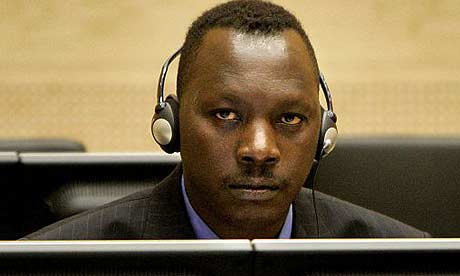
Thomas Lubanga Dyilo at the beginning of his trial at the ICC (Photo: Keystone)

The extent to which local deterrence can be achieved is likely to depend primarily on the sentence, rather than the verdict, handed down to Lubanga. In eastern provinces of the DRC and the epicentres of the conflict, a mixture of fear and anticipation awaited not simply the verdict – which was rather obvious – but the sentence to be handed down. Olivia Bueno has covered the conflict and paints a tense, divisive and complex picture of the situation in the lead-up to the verdict and sentencing:

“On the ground, opinions are divided. Not surprisingly, supporters of Lubanga hope that he will be acquitted or given a short sentence and released….Some are reportedly already planning a homecoming celebration…[But t]hose who do not support Lubanga are deeply concerned about the prospect of his release…For victims of the attacks of the UPC, a decision to acquit or give a light sentence to Thomas Lubanga is likely to result in indignation…Faith in international justice, and in the international community by extension, is likely to be deflated. Victims will feel betrayed by the Court and frustrated with the outcome. Some fear that this frustration could well up into violence…Others fear that the liberation of Thomas Lubanga and his potential return to Ituri might negatively impact the security situation on the ground because he may be a destabilizing figure.” Continue reading

Posted in Child Soldiers, Democratic Republic of Congo, Deterrence, International Criminal Court (ICC), Justice, Outreach | Tagged | 3 Comments

Syria: Appeasement in Disguise?

Andrew Jillions joins JiC for another thought-provoking guest post on responses to the ongoing humanitarian crisis in Syria. Enjoy!

Kofi Annan was in New York yesterday to brief the Security Council on the mess that is Syria. But whatever (limited) hopes there might be of his ability to negotiate an end to the violence, the humanitarian mission also disguises a depressing reality: short of appeasement, the international community has no good strategy for responding to a well-protected regime intent on committing criminal acts.

Debates on what to do about Syria have – on the surface at least – moved on apace since the China/Russia veto last month (which was, in any case, over-hyped). Everyone seems to agree that Bashar al-Assad needs to stop killing and torturing civilians. As Ban Ki Moon put it on the anniversary of the uprising, “the status quo in Syria is indefensible”. In the rarefied domain of international politics, the widespread acceptance of this point counts as a victory. But beyond this limited solidarity, there is scant agreement over what practical steps to take.

The key obstacle to intervention is the fact that al-Assad’s regime is protected, in large part, by the presence of an unconvincing opposition. Even if a unified opposition could be mustered up, potentially through foreign support, the worry remains that this would splinter as soon as their one point of agreement – regime change – was achieved. Getting rid of al-Assad with no viable alternative in place will usher in an era of violent disorder and instability.

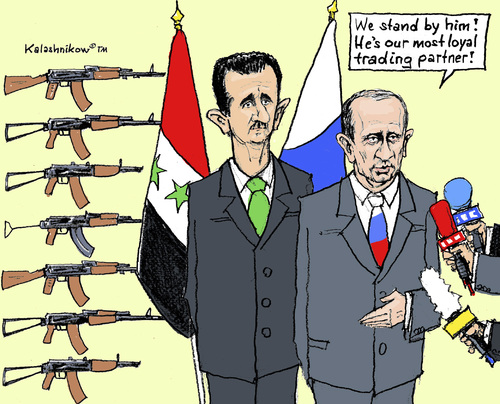
Russia and Syria

(Cartoon: Kalasnikov)

It is possible, as Steven Cook argues, that this chaotic outcome isn’t quite as certain as the anti-interventionists suggest. As I’ve previously argued, there is something devious about discounting intervention on the basis of an imagined and uncertain level of future chaos and bloodshed – using the “unknown unknowns” as good reasons not to act. In the meantime, real people are dying in real time. The footage is there for all to see.

This is all beside the point in the current diplomatic climate. The inscrutable message is that al-Assad must go – as Obama put it, “it’s not a question of if, but when” – but also that military intervention is not a viable option, fomenting a Syrian civil war is not a desirable option. The hope seems to be that al-Assad can be put under enough pressure by rebel forces, by his own government ministers, and by the international community that he can be convinced to willingly step down. Continue reading

Posted in Humanitarian Intervention, Justice, Responsibiltiy to Protect (R2P), Syria, Turkey, UN Security Council, Uncategorized | 3 Comments

Kony 2012 – How 100 Million Clicks Went to Waste

Photo by Invisible Children

The Kony 2012 video produced by Invisible Children has attracted somewhere between 80 and 100 million views by now. No matter what your position on the campaign is, it is undeniable that it managed to tap a huge reservoir of public attention. The viral campaign and reactions to the video quickly spilled over from internet blogs to the classic medias, with basically all big newspapers, TV stations and radio stations running a story on Kony 2012 at least once. And that’s when it all went wrong.

The simplified and – as many rightly point out – to some extent even dangerous message of the video was answered with a global smear campaign that started picking apart not only Kony 2012 but also Invisible Children’s organizational structures and accounting practices. In the end, Kony 2012 has left behind only losers. The current victims of the LRA in the Democratic Republic of Congo, the Central African Republic and South Sudan remain largely ignored, the formerly war affected communities in northern Uganda feel deeply offended by the video, the work of Invisible Children has been discredited, its co-founder and Kony 2012 producer Jason Russel had a mental breakdown in public, and a huge potential of public awareness that could have really made a difference in Central Africa has been squandered.

At the end of the day, the Kony 2012 saga is a very sad story that shows how shallow discussions about complex issues in our mass media still are. Yes, the message of Kony 2012 was oversimplified, yes it painted a wrong picture of what was happening in the LRA conflict, and yes it also offered the wrong answers and sent a dangerous message of militarisation. I adhere to my criticism of the Kony 2012 campaign, and there have been others like Alex de Waal and Mahmood Mamdani who have been much more eloquent and precise in pointing out the real weaknesses in the campaign.

If even a couple of thousand people watched the video and then read the highly informed responses of de Waal, Mamdani and the likes, a lot has been done in terms of awareness rising for the complex issues surrounding the LRA conflict. I also maintain that Invisible Children has not been able to convincingly answer the main points of criticism, especially the warnings that another military intervention along the lines advocated by IC against the LRA is prone to lead to only more civilian casualties. But unfortunately this was not the main thrust of criticism brought forward by the big media outlets. As Adam Finck who currently works with Invisible Children in DRC rightly points out when rebutting some of the less well-founded criticism surrounding Kony 2012, the critics of IC also made an error by oversimplifying the work of Invisible Children.

One of the internet reactions to Kony 2012

As I previously wrote, the work of Invisible Children in the currently war affected areas (mainly DRC and CAR) is of a vital importance. It is one of the few organisations that had the courage of moving into these areas and opening a reception centre for returning LRA abductees/fighters in DRC where it most mattered. It has also helped to build up a high frequency radio early warning system in the area to help civilians to react to LRA attacks in time. The media smear campaign ensuing from the Kony 2012 criticism might have devastating long-term consequences for the work of IC in these areas. Continue reading

Posted in Advocacy, Democratic Republic of Congo, Lord's Resistance Army (LRA), Southern Sudan, Uganda | Tagged , , , , , , , , , , , , , | 23 Comments

Beyond ‘KONY2012’ – Judgement Day and the Lubanga Verdict

Thomas Lubanga verdict

(Photo: AFP)

The ICC’s first-ever verdict is in. Any way you cut it, the guilty verdict issued today against Thomas Lubanga for his use of child soldiers is a landmark ruling. But will it have any effect on the conscription of child soldiers in the future?

The trial, verdict and sentence will undoubtedly (and hopefully) have a deep effect on the practice of the ICC. That being said, many of problems that marred the trial cannot be ascribed to the Court’s “growing pains”. At times the prosecution played a game of fast-and-loose with the law to such an extent that it threatened the possibility of ever getting to today’s verdict.

As many commentators have pointed out, the trial has been riddled with problems from the very get-go. The Office of the Prosecutor has been criticized by a myriad of human rights groups for its myopic approach to the case, focusing only on Lubanga’s use of child soldiers. While the belief is that the narrow focus was chosen to ensure that the trial moved along efficiently, the prosecution hasn’t been particularly forthcoming with its reasoning. As Kevin Jon Heller notes, “for reasons that still have never been adequately explained…[the prosecution] declined to bring more serious charges against [Lubanga], even though he had been facing murder and torture charges in the DRC.” Neither is a five-year trial anyone’s gold standard for efficiency.

The prosecution’s use of ‘intermediaries’ (see also here) to gather evidence on the ground was also widely and vehemently criticized. The ruling judges, in law-speak, agreed that the prosecution had handled ‘intermediaries’ disastrously. Twice (twice!), judges ruled that the prosecution’s behaviour amounted to a denial of a fair trial, suspended proceedings and ordered Lubanga to be released (on both occasions the rulings were reversed on appeal from the prosecution).

Child soldiers in Eastern DRC (Photo: Nicolas Postal/EPA/Corbis)

The trial of Lubanga has been so rife with controversy and problems that it was not clear that a unanimously guilty verdict would be handed down. Many believe that one judge in particular, Adrian Fulford, would issue a dissenting ruling. Richard Walker writes that “A collective sigh of relief was breathed by the ICC Chief Prosecutor Luis Moreno-Ocampo and his successor Fatou Bensouda who sat side by side listening anxiously to Presiding Judge Adrian Fulford” deliver the Chamber’s ruling.

Before anyone pops open a champagne bottle, it is important to remember that it is far too early to call the Lubanga verdict a victory for justice and for the victims and survivors of the conflict. The trial-chamber has not yet issued a sentence and it is anyone’s guess what punishment will be meted out. Importantly, the sentence will have palpable effects on the ground, where fear and anticipation is high while opinions are sharply divided.

Notably, Lubanga has been in detention for seven years. Thus, if he receives a sentence of ten years, he will be a free man in three. Most educated guesses peg the sentencing at 10-15 years. Undoubtedly, the decision by Prosecutor Luis Moreno-Ocampo to restrict the charges to those pertaining to the use of child soldiers will come under heavy fire if the sentence is relatively lenient. Criticism will only intensify if the prosecution’s controversial use of intermediaries is taken into account and it wouldn’t be surprising if it did. Continue reading

Posted in Child Soldiers, Democratic Republic of Congo, Deterrence, ICC Prosecutor, International Criminal Court (ICC), Lord's Resistance Army (LRA) | 5 Comments

What Went Wrong During the Lubanga Trial

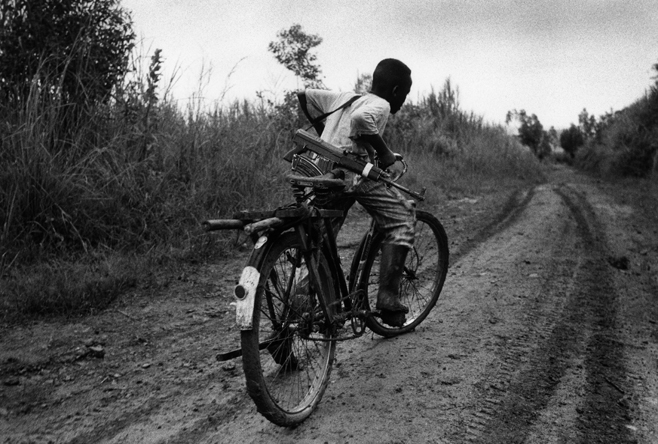
A child soldier rides back to his base in Ituri Province (Marcus Bleasdale/VII)

The International Criminal Court has delivered its first verdict, finding the Congolese warlord Thomas Lubanga guilty on charges of conscripting and enlisting children, and using them to participate in hostilities during the Ituri conflict between 2002 and 2003.

Today’s ruling marks the end of the ICC’s first trial, a trial that has been going on since 2006 and which has been marred with fair trial issues raised by the defence. In fact, the trial chamber ordered Lubanga to be set free twice because the Office of the Prosecutor (OTP) failed to disclose information to the defence and because of general fair trial issues. Only appeals by the OTP that were granted by the Appeals Chamber ensured that the trial went on. At the time of writing the sentence is not yet clear, but we may well see Thomas Lubanga walk free as a result of these delays as he has already served nearly ten years of his sentence if his time in Congolese prisons is taken into consideration. Additionally, the defence still has a right to appeal the sentence.

Regardless, bringing its first trial to an end is a milestone for the ICC and for Chief Prosecutor Luis Moreno-Ocampo who has thus managed to ensure at least one verdict in his 9 year tenure. Nevertheless, the first trial completed at the ICC leaves a bad taste in one’s mouth.

Some of the issues that arose during the first trial are perfectly understandable for a newly established court, especially if one takes into consideration that it operates under quite a unique mixture of Civil Law and Common Law. Lubanga’s trial was nearly stopped twice due to issues of sharing evidence and allegations that Lubanga was not receiving a fair trial connected to these issues. The OTP used so-called intermediaries in the field to collect information and evidence from eyewitnesses in the conflict region. The defence accused one of the intermediaries of having bribed witnesses into delivering false accusations against Lubanga and thus demanded a disclosure of the name of said intermediary. The court ordered the name to be disclosed, but the Chief Prosecutor refused to do so, claiming that he could not guarantee the security of the intermediary if he was not given more time to put protective measures in place.

Lubanga during an ICC hearing (Photo: Ed Oudenaarden/AFP/Getty)

The use of intermediaries is an understandable choice for an office that conducts investigations in conflict areas in which movement is limited and international prosecutors from The Hague are bound to provoke a lot of attention. One of the legacies of the Lubanga trial is the decision of the chamber on the use of intermediaries. Even though the question of intermediaries led to a very long trial and may have violated Lubanga’s right to an expeditious trial, clarifying these issues were necessary steps in the ICC’s development. The chamber’s ruling has been clear in stating that the Prosecutor should not have delegated his responsibility for investigating and that he is to be faulted for some evidence becoming unreliable as a result. This is a welcome development as it will ensure that OTP staff will stay in touch with the region in which they are investigating crimes. The ICC is already accused of being too removed from the realities on the ground and this tendency would be worsened if investigators never saw the field.

But other issues during the Lubanga trial are actually more worrying. Continue reading

Posted in Complementarity, Democratic Republic of Congo, International Criminal Court (ICC), War crimes | 1 Comment

Taking ‘Kony2012’ Down a Notch – Responding to Criticism

LRA combatants

LRA combatants (Photo: AP/File)

Over the past few days, many readers have commented on the blog, Twitter, Facebook and I want to thank you all for that. Thanks to everyone who took the time to read our perspective. We have contributed to an incredibly important debate and have begun the process of refuting the idea that awareness must come at the expense of understanding.

It is in contributing to understanding the issues, and not site hits or blog stats, that I feel that both Patrick’s and my post have been a success. I was also very happy that Invisible Children themselves have responded to the critiques that were levied, although I will leave it to readers to judge whether their responses are adequate.

My position remains the same. I remain opposed to the Kony2012 video and campaign and not because I don’t believe that increasing awareness is wrong. Many have commented to the effect that “you have a point, but knowing about this is success in its own right.” But awareness for awareness’ sake is not only futile but potentially dangerous (see here, here and here). The diagnosis of the ‘LRA question’ that the Kony2012 clip makes is so far from any truth or reality that the prescription it offers – or instills in the minds of those who watch the film with an uncritical eye – may end up doing a disservice to victims and survivors.

Others have suggested that the conclusion I reach is that unless the campaign “has it perfect”, we should do nothing. In other words, I’m unfairly raining on the Kony2012 parade. This could not be further from the truth. I accept that viral campaigns can be useful and that they inevitably must simplify issues as complex as the conflicts in northern Uganda and LRA-affected areas. The question is: at what point does simplifying an issue pass a threshold where it no longer even approximates reality and becomes detrimental to a cause? I continue to believe the film, Kony2012 (again, not Invisible Children as a whole) has passed this threshold – by miles. Continue reading

Posted in Advocacy, Justice, Lord's Resistance Army (LRA), Peace Negotiations, Peace Processes, Uganda | 22 Comments

Kony 2012: The Invisible Children Advocacy Campaign to Catch Kony

The montage used as one of the lead themes for the Kony 2012 campagin, showing Kony with his 'thousands of captured children'. Research says that most of the LRA soldiers are adolescents or young adults. (Photo: Invisible Children)

Yesterday evening, a Youtube video by Invisible Children on Joseph Kony, the Chairman of the Lord’s Resistance Army, started popping up in my Facebook newsfeed. I didn’t think much of it as my newsfeed is usually pretty full with articles and reports from Uganda, as I follow many different organisations working on the LRA. Since I am going through all LRA related news on a daily basis anyway, I watched it during my evening workout, and it left me impressed. It is a superb example of an advocacy video that is very touching while giving you the feeling that you can make a change.

The video describes, in sketchy details, how the Lord’s Resistance Army has been abducting children for the past 26 years in order to fill its ranks and to wage an apparently causeless conflict in which it mutilates civilians (not my opinion but the way the conflict is presented). The narrative is as simple as it is powerful: Kony is the bad guy who has abducted thousands of children and needs to be stopped. Jason Russel, one of the founders of Invisible Children Inc., his little son, and all of us are the good guys whose mission should be to stop Kony. The means: mobilise as many people as possible to lobby influential artists and politicians to stand up for the cause to ‘remove Joseph Kony from the battlefield’. This in turn will make sure that there is enough awareness and civil society pressure surrounding the LRA conflict that the 100 combat equipped US troops deployed by the Obama administration in autumn 2011 stay until their job to help catching Kony is finished.

The hits our blog received so far today demonstrated to me how effective the message has been: we had nearly 9 times the traffic we would have on a normal day around noon. Most people found the site searching for ‘Kony’ or ‘Joseph Kony’, our articles on Uganda being by far the most read ones. It is both assuring and scary how many people can be mobilised within 24 hours by publishing a well-made advocacy/documentary clip.

Don’t get me wrong, I do think a lot of good things can come out of this. It is true that the security interests of the US in engaging the LRA are minimal. It is also true that the troops will be withdrawn from Central Africa if they are not successful relatively soon, and that the public pressure to keep them there is not strong enough.

It is also true that Invisible Children has done some good work in northern Uganda and the Democratic Republic of Congo (DRC). The most recent and maybe most relevant example is that Invisible Children has opened up a reception centre for abducted children and adolescents who escape the LRA in the DRC. It is the only reception centre in the DRC so far, and its opening can be expected to have a real impact since people who fled from the LRA have really nowhere else to turn since the rebel group left northern Uganda with its reception centres. Advocating to keep US troops in Uganda and donating some money to Invisible Children’s ‘TRI’ programme is thus not a bad idea.

One of the child soldiers forcibly recruited into the LRA. They are the main victims in Invisible Children's narrative, waiting to be rescued (The Children of the Nile)

Yet, there are several caveats and points of criticism that arise when having a closer look at the advocacy campaign and the local context in Uganda, DRC, the Central African Republic and Southern Sudan. Let me first just briefly point out the typical ‘tricks’ used in advocacy videos to generate a maximum of indignation and mobilise as many people as possible. The video shows posters apparently printed for the Kony 2012 campaign that display Kony together with Adolf Hitler and Osama bin Laden. It is ridiculous to compare Joseph Kony with the worst mass murderer in history (only Josef Stalin could come close to challenging Hitler for that title) and America’s now defunct public enemy number one. Kony’s relevance is completely blown out of proportion by these comparisons and they only serve to brand him as the pure evil. Continue reading

Posted in Advocacy, Central African Republic (CAR), Democratic Republic of Congo, Lord's Resistance Army (LRA), Osama bin Laden, Uganda | Tagged , , , , , , , , , , , | 119 Comments