Taking ‘Kony 2012’ Down A Notch

The makers of Kony 2012

The makers of Kony 2012. (Photo: Glenna Gordon / Scarlett Lion)

As we speak, one of the most pervasive and successful human rights based viral campaigns in recent memory is underway. Invisible Children’s ‘Kony 2012‘ campaign has taken Twitter, Youtube, Facebook and every other mainstream social media refuge by storm. In many ways, it is quite impressive. But there’s one glaring problem: the campaign reflects neither the realities of northern Ugandan nor the attitudes of its people. In this context, this post examines the explicit and implicit claims made by the ‘Kony 2012’ campaign and tests them against the empirical record on the ground.

Before jumping into the fray, however, I should preface the post by noting that, in many ways, Invisible Children have done a fantastic job in advocating for the rights of northern Ugandans, highlighting the conflict and providing tangible benefits to victims and survivors of LRA brutality. Indeed, this post is not intended to take aim at Invisible Children as an organization but rather to debunk some of the myths its ‘Kony 2012’ campaign is propagating.

The Problem is Popularity? 

Kony 2012 is about making Joseph Kony, the leader of the notorious LRA, famous because, the line of reasoning goes, if everyone knew him, no one would be able to stand idly by as he waged his brutal campaign of terror against the people of East Africa.

I am actually stupefied that any analysis of the ‘LRA question’ results in the identification of the problem being that “Kony isn’t popular enough”. The reality is that few don’t know who Joseph Kony is in East Africa and the Great Lakes Region, making it all-too-apparent that this isn’t about them, their views or their experiences. But even more puzzling is that Joseph Kony is one of the best known alleged war criminals in the world – including in the United States. This is the case in large part because of the advocacy of Western NGOs, including Invisible Children and the Enough Project as well as the ICC arrest warrants issued against Kony and his senior command.

I would understand if this were the 1990s or even the early 2000s when the misery plaguing northern Uganda flew completely under the radar. I would understand if this campaign was about the ongoing conflict in the Democratic Republic of Congo. But a campaign in 2012, premised on Joseph Kony not being famous enough is just folly.

'Kony 2012'

A poster from the 'Kony 2012' campaign. (Poster: Invisible Children)

Umm…what about northern Ugandans?

It is hard to respect any documentary on northern Uganda where a five year-old white boy features more prominently than any northern Ugandan victim or survivor. Incredibly, with the exception of the adolescent northern Ugandan victim, Jacob, the voices of northern Ugandans go almost completely unheard.

It isn’t hard to imagine why the views of northern Ugandans wouldn’t be considered: they don’t fit with the narrative produced and reproduced in the insulated echo chamber that produced the ‘Kony 2012’ film.

‘Kony 2012’, quite dubiously, avoids stepping into the ‘peace-justice’ question in northern Uganda precisely because it is a world of contesting and plural views, eloquently expressed by the northern Ugandans themselves. Some reports suggest that the majority of Acholi people continue to support the amnesty process whereby LRA combatants – including senior officials – return to the country in exchange for amnesty and entering a process of ‘traditional justice’. Many continue to support the Ugandan Amnesty law because of the reality that it is their own children who constitute the LRA. Once again, this issue is barely touched upon in the film. Yet the LRA poses a stark dilemma to the people of northern Uganda: it is now composed primarily of child soldiers, most of whom were abducted and forced to join the rebel ranks and commit atrocities. Labeling them “victims” or “perpetrators” becomes particularly problematic as they are often both.

Furthermore, the crisis in northern Uganda is not seen by its citizens as one that is the result of the LRA. Yes, you read that right. The conflict in the region is viewed as one wherein both the Government of Uganda and the LRA, as well as their regional supporters (primarily South Sudan and Khartoum, respectively) have perpetrated and benefited from nearly twenty-five years of systemic and structural violence and displacement. This pattern is what Chris Dolan has eloquently and persuasively termed ‘social torture‘ wherein both the Ugandan Government and the LRA’s treatment of the population has resulted in symptoms of collective torture and the blurring of the perpetrator-victim binary.

Kony and Egeland

Kony and his former second in command, Vincent Otti, with former UN Undersecretary-General for Humanitarian Affairs and Emergency Relief Coordinator, Jan Egeland (Photo: New York Times)

The Solution?

Given Invisible Children’s problematic identification of the issue, it becomes impossible for them to come up with an appropriate vision of resolving the crisis.

Invisible Children is, perhaps rightly, proud that it put the ‘LRA question’ on the Obama administration’s agenda. In this context, last year’s announcement that the administration would send 100 military ‘advisors’ to Uganda was widely celebrated. But this triumphalism occludes key realities.

The sending of 100 troops was not, in any sense, an altruistic move by the administration. First, it went unreported that many of the troops were already in Uganda. Second, the announcement was, at least in part, a tit-for-tat response for the Government of Uganda’s military engagement in Somalia – where the US refuses to deploy troops. As Matt Brown of the Enough Project conceded:

“The U.S. doesn’t have to fight al-Qaida-linked Shabab in Somalia, so we help Uganda take care of their domestic security problems, freeing them up to fight a more dangerous – or a more pressing, perhaps – issue in Somalia.

It is clear that the ‘Kony 2012’ campaign sees the 100 US troop allotment as inadequate. Here they are right – 100 US troops is not the solution. But their own answer is highly problematic.

We know what the makers of “Kony 2012” believe should happen but they won’t say it explicitly, except to say that Kony must be “stopped”.

Obama’s orders for his 100 troops – presumably supported by those behind ‘Kony 2012’ – is to “kill or capture” Joseph Kony. I don’t think it is a stretch to suggest that many of the same individuals who will form the legion of participants in ‘Kony 2012’ were on the streets celebrating the killing of Osama bin Laden. It thus likely holds that they bought into the belief, proffered by Obama himself, that bin Laden’s killing amounted to justice and if you didn’t agree, you should get your head checked.

The solution then, is something similar: an American-led intervention into at least four countries where the LRA is or has been active (Uganda, the DRC, the Central African Republic and South Sudan) to hunt down Kony. Capturing him, after all, is secondary to “stopping” him.

The idea of “stopping Kony”, of course plays into the narrative created by the ‘Kony 2012’ campaign where what actually happens to Kony and the LRA is irrelevant. The unspecific aim of “stopping” him is sufficient. Who, after all, doesn’t want Kony “stopped”? But then what? If Kony is killed or captured, then what? What happens to the other members of the LRA? ‘Kony 2012’ offers no answers here.

In this context, it is worthwhile remembering that massive regional military solutions (Operations Iron Fist and Lightning Thunder most recently), with support from the US, have thus far failed to dismantle or “stop” the LRA. These failures have created serious and legitimate doubts that the ‘LRA question’ is one that can be resolved by military means.

Incredibly, there is no mention in the film or the campaign that northern Ugandans are currently enjoying the longest period of peace since the conflict began in 1986. Virtually every single northern Ugandan I spoke to during my own field research believes that there is peace in the region. While sporadic violence continues, particularly as a result of bitter land disputes, there have been no LRA attacks in years. In the mid 2000s, the ‘LRA problem’ was exported out of Uganda. The LRA is currently residing in the DRC, CAR, and perhaps parts of South Sudan and even Darfur. Today, land issues and the recent Walk to Work crisis are higher on the agenda than the LRA in northern Uganda.

Lastly, killing Kony cannot resolve the actual sources of the crisis which are far more structural than superficial (to put it lightly) analyses like ‘Kony 2012’ would like to admit. As respected scholars of northern Uganda, Mareike Schomerus, Tim Allen, and Koen Vlassenroot, recently argued,

“Until the underlying problem — the region’s poor governance — is adequately dealt with, there will be no sustainable peace.”

Kony (left) with Otti. (Photo: AFP)

The Need for a Sober Second Thought

In the end, ‘Kony 2012’ falls prey to the obfuscating, simplified and wildly erroneous narrative of a legitimate, terror-fighting, innocent partner of the West (the Government of Uganda) seeking to eliminate a band of lunatic, child-thieving, machine-gun wielding mystics (the LRA). The main beneficiary of this narrative is, once again, the Ugandan Government of Yoweri Museveni, whose legitimacy is bolstered and – if the ‘Kony 2012’ campaign is ‘successful’ – will receive more military funding and support from the US.

Of course, as a viral campaign launched through social media, ‘Kony 2012’ is impressive, if not unprecedented. It will, undoubtedly, mobilize and morph a horde of sincere American youths into proxy war criminal hunters. It will further succeed in increasing the ‘popularity’ of Joseph Kony and the LRA in the United States. But it will do so for many of – if not all – the wrong reasons.

I remember when I was in grade school and a teacher told the students that it was actually difficult to fail. “You have to try to fail,” he said. If ‘Kony 2012’ is to be judged by its reflection of the realities on the ground in northern Uganda and how it measures up against the empirical record, the makers of Kony 2012 tried – and succeeded.

——————————

UPDATE: I’ve now published a response to the main criticisms that this post has inspired. See here: Taking ‘Kony2012′ Down a Notch – Responding to Criticism.

Check out this excellent account by Daniel Solomon over at his blog, Securing Rights.

Also, big thanks to my friend and colleague, Paul Kirby, for his insightful comments on a draft of this post.
Posted in Lord's Resistance Army (LRA), Uganda | 909 Comments

Whither ICC Deterrence in Libya?

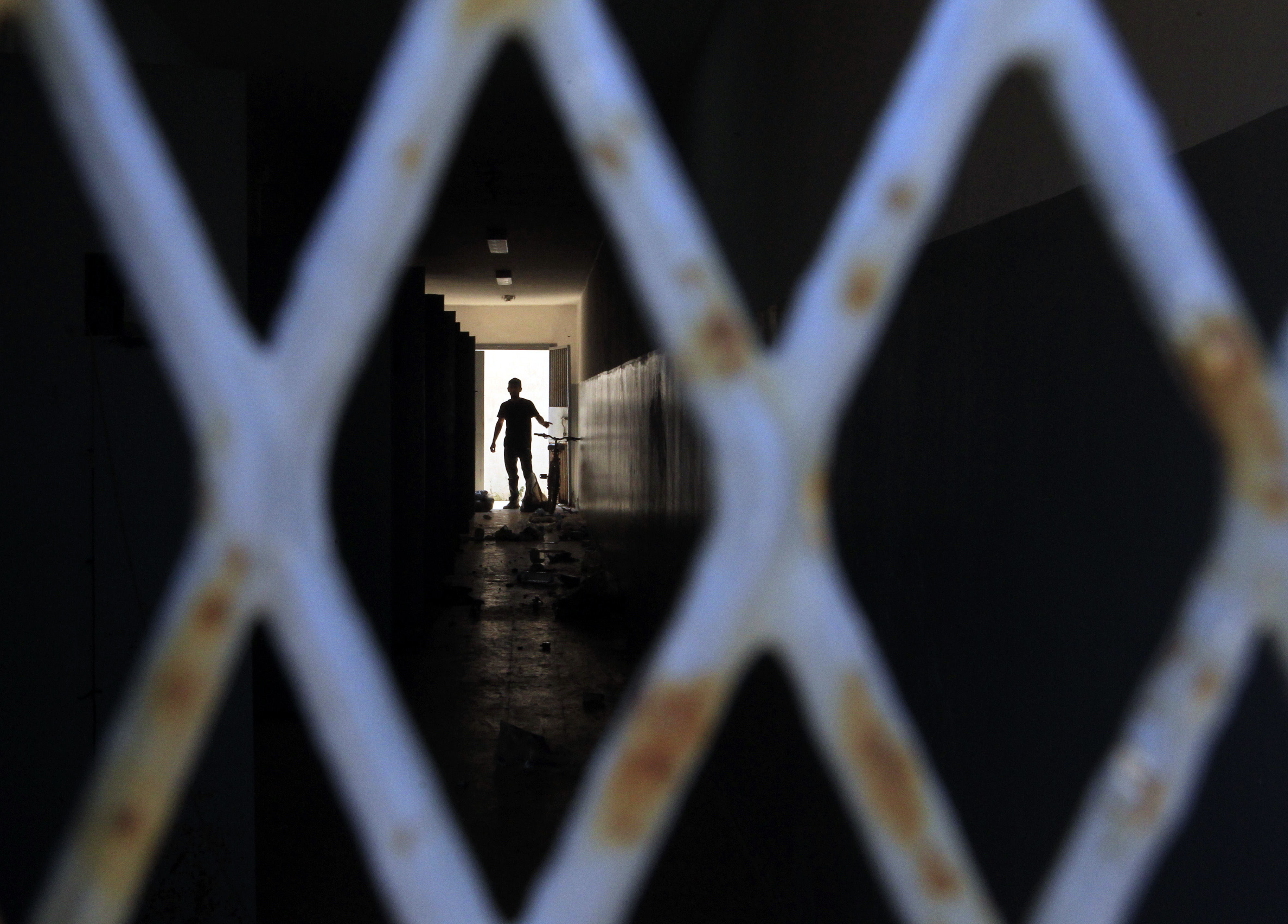
Abu Salim Prison in Libya (Photo: Sergey Ponomarev/AP)

In recent years, advocates of the International Criminal Court have shifted away from justifying international justice through purely moral claims towards arguing for trial justice on the basis of the consequences it can bring about. Leslie Vinjamuri has persuasively demonstrated this consequentialist turn in a recent article. Amongst the oft-proferred arguments put forward is that the pursuit of international criminal justice can deter crimes from occurring.

Broadly speaking, deterrence can occur at two levels. First, and most broadly, international criminal justice is seen by its champions to deter crimes on an international or global level. Anyone thinking of committing crimes against humanity, genocide or war crimes now or in the future will be deterred from doing so because of the mere existence of the ICC which will prosecute and punish those very acts.

Second, deterrence may be more targeted and localized. In this instance, intervention by the ICC in ongoing conflicts is said to deter those actively committing atrocities from continuing to do so. This post is concerned with this second type of ‘targeted deterrence’ in the context of Libya.

Getting Involved at ‘Break-Neck’ Speed

The ICC has never moved more quickly in its work than in the case of Libya. In comparison to other situations under investigation, the speed with which the Office of the Prosecutor (OTP) accepted the UN Security Council’s referral, opened an investigation and requested the issuance of arrest warrants against Colonel Muammar Gaddafi, his son Saif al-Islam Gaddafi and the regime’s head of intelligence, Abdullah al-Senussi, was unprecedented.

I have previously speculated why the ICC chose to move so quickly in the case of Libya. After speaking to some individuals familiar with the Court’s decision-making, however, I am increasingly convinced that the ICC moved so quickly primarily because it wanted to establish itself as ‘a player’ in Libya. In other words, the OTP saw an opportunity to prove its effectiveness and jumped at it, full-throttle. The deterrence factor was part of the calculus: if the ICC intervened in Libya and contributed to the termination of the conflict, the Court could claim it had deterred atrocities and helped establish peace.

Now, it may be that the ICC did help prevent the perpetration of some atrocities in Libya, especially if the defections of senior Gaddafi-regime figures can be linked to fears of being prosecuted by the Court, defections which can, in turn, be linked to the duration of the conflict. As importantly, there is no evidence that the Court contributed to an increase in atrocities by pro-Gaddafi forces or the prolongation of the conflict. But what about the Court’s deterrence effect on the rebels and what about deterrence in post-Gaddafi Libya?

Continue reading

Posted in Deterrence, International Criminal Court (ICC), Libya, Libya and the ICC, NATO | 2 Comments

An Interview with the ICC’s Judge Howard Morrison

Peter Quayle joins JiC for this fascinating glimpse into the views of newly elected ICC Judge, Howard Morrison. In this extract of Peter’s interview, Morrison discusses his career at the ICTY and ICTR, the Karadzic trial (where Morrison is a presiding judge) and the question of ICC bias towards African states. Enjoy!

ICC Judge

Judge Howard Morrison QC, a British barrister, was elected a judge of the International Criminal Court during the Tenth Assembly of State Parties, held in New York, December 2011. Judge Morrison has sat as a judge of the International Criminal Tribunal for the Former Yugoslavia since August 2009. He currently sits in the trial court trying Radovan Karadzic. But, as his questionnaire for the Coalition for the International Criminal Court amply demonstrates, this is only the most recent professional experience and latest judicial office that recommended him to the ICC.

As an advocate, called to the Bar in 1977, his early regional criminal practice included considerable advocacy before Courts Martial. He became a QC in 2001, reflective of his achievements as an advocate, including prosecuting the most serious cases for the Crown Prosecution Service, including sexual violence crimes. From 1998 until 2004, he was also a defence counsel in numerous trials before the ICTY and the International Criminal Tribunal for Rwanda, including the Celebici prison-camp and Nikolic cases. As a judge, Morrison was Resident Chief Magistrate of Fiji and Senior Magistrate of Tuvala, 1986 to 1988. In the courts of England and Wales, he was appointed a Circuit Judge in 2004. In 2008 he was appointed a Senior Judge of the Sovereign Base Areas of Cyprus.

The sixth elections to the ICC, replacing six vacating judges, changed a third of the court’s bench. Each judge is elected for a non-renewable nine year term. Judge Morrison will be sworn in on March 11, 2012 but first complete his cases at the ICTY before assuming his duties at the ICC. Once he does, it is likely that his extraordinary expertise will make him amongst the court’s most authoritative and influential judges.

Peter Quayle (PQ): Were you always interested in an international criminal law career? What has influenced you step by step in your career?

Judge Morrison (JM): When at the Bar I did as much overseas Courts Martial work as I could muster. The idea of international law always fascinated me and I read as much about the Nuremburg and Tokyo trials as possible. After nine years practice as a junior barrister I was able to secure a post as a Resident and then Chief Magistrate in Fiji combined with the post of Senior Magistrate in Tuvalu, followed by a stint in the Caribbean after military coups in Fiji disrupted the judiciary.

Radovan Karadzic

PQ: After your overseas judicial appointments, what led to your being retained as defence counsel at the ICTY/ICTR?

JM: Following those duties there was a decade of prosecuting and defending on the Midland and Oxford Circuit which was interrupted in 1998 when I answered an ad in Counsel [the monthly journal of the Bar in England and Wales] asking for expressions of interest from those who might like to defend at the ICTY in The Hague. A month or so later, a phone call in hesitant German one evening from a Bosnian Croat who wanted me to help conduct his appeal in the Celebici case [the first command/superior responsibility appeal since Nuremburg] gave me the first of three substantial cases at the ICTY and led in turn to a defence case of a Rwandan Cabinet Minister charged with genocide at the ICTR in Arusha, Tanzania.

Continue reading

Posted in ICTY, International Criminal Court (ICC), International Criminal Tribunal for Rwanda (ICTR), Interview, Justice | Leave a comment

The Habré Case at the International Court of Justice – Belgium versus Senegal

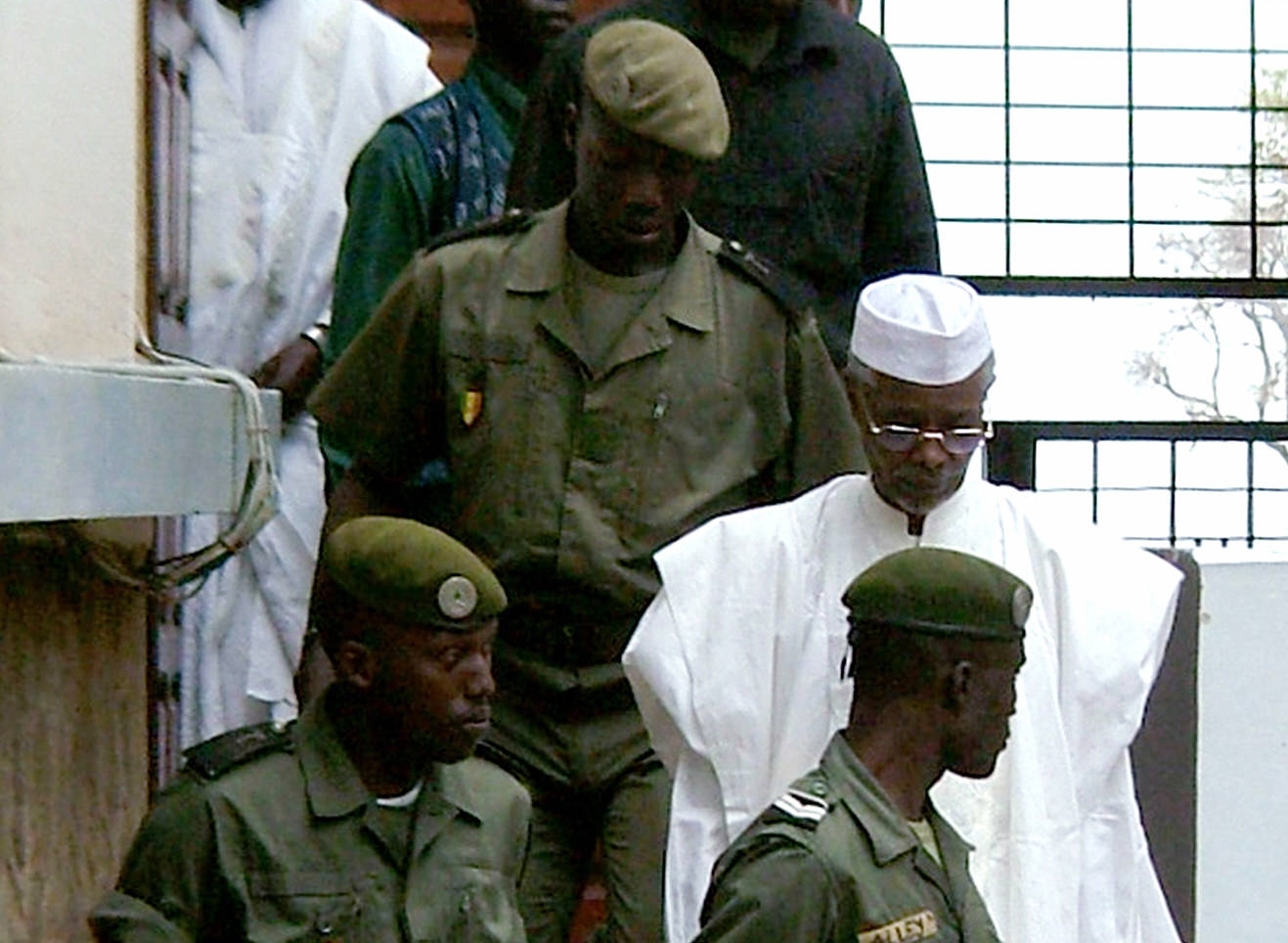
Former Chadian President Habré leaving the Court of Appeal in Dakar after attending a hearing in 2005 (Recup Seyllou, AFP)

A couple of months back I wrote a post on the efforts of international and Chadian human rights advocates to prosecute the former President of Chad, Hissene Habré. Habré is accused of killing and torturing thousands during his stay in power between 1982 and 1990. Two of the main actors who have been fighting for a prosecution of Habré for nearly two decades are the Chadian lawyer Jacqueline Moudeina who received the Alternative Peace Nobel Prize in 2011 for her persistent work to end impunity for Habrés crimes, and Reed Brody from Human Rights Watch.

An interesting twist to the case came up when victims supported by Moudeina and Brody decided to file a case against Habré in Belgium on the principle of universal jurisdiction. Attempts to prosecute Habré in his home country of Chad and his country of exile, Senegal had previously failed. Belgium, however, is one of the countries known for its extensive use of universal jurisdiction.

In short, the idea behind universal jurisdiction is that there are some norms in public international law that are widely accepted to a degree that they have become binding for everyone (jus cogens). Consequently, a violation of these norms is considered a crime against the entire community of states or even humanity as such. These so called erga omnes norms include bans of genocide, slavery, torture and racial discrimination.

In the 2000’s a trend to prosecute foreign government officials in national courts through universal jurisdiction began to emerge. Diplomatic rows stemming from these court cases led to countries like Spain and Belgium limiting the use of universal jurisdiction in their courts. Indeed, the case of Habré was one of the last large-scale universal jurisdiction cases accepted in Belgium, the result of naturalised Belgian citizens who had been victims pursuing the case.

Reed Brody from Human Rights Watch recovering documents connected to Habré's crimes in Chad (Reed Brody)

Belgium has meanwhile filed for the extradition of Habré four times. Three of the requests have been denied while the latest is still pending. Senegalese courts themselves have so far dismissed prosecuting Habré, declaring themselves as not competent in the case, apparently under the pressure of the current Senegalese President Abdoulaye Wade. Continue reading

Posted in African Union (AU), Belgium, Chad, Crimes against humanity, Exile, Justice, Universal Jurisdiction | Tagged , , , , , , , | 9 Comments

The ICC and the Security Council: Just Say No?

Hilary Clinton recently suggested that Syrian President, Bashar Assad, fit the definition of a war criminal. Could the US be inching towards endorsing another UN Security Council referral to the International Criminal Court? Not so fast. Clinton added that, despite the likelihood that Assad was guilty of war crimes and crimes against humanity, any attempt to bring him before the ICC would “complicate a resolution of a difficult, complex situation because it limits options to persuade leaders perhaps to step down from power.” Clearly, the peace-versus-justice debate is alive and well.

A familiar pattern is emerging in Syria. The continuing humanitarian crisis and the lack of a coherent response from the ‘international community’ in Syria has inevitably left many to ponder what possible actions could now be appropriate. Once again, observers are seemingly divided between two camps: one, tired of a lack of action and driven by examples where inaction has led to devastating tolls on human life and which screams “act first, think later”. The other, more calibrated and wary of past experiences in Iraq, Afghanistan and elsewhere urging international actors to “think first, act later.”

There appears to be no coherent response on the horizon to address the acts of atrocity in Syria. While some response is desperately needed, this lull does provide an opportunity for sober reflection on the ever-evolving tools to effectively address and end atrocities.

This essay is based on research I am currently conducting and offers an attempt to grapple with the relationship between the ICC and the UN Security Council. As such, it delves into the ever-shifting sands at the nexus of international politics and international criminal justice in the wake of the Libyan intervention.

Negotiating the ICC’s Independence

The contemporary emergence of international criminal justice and the creation of the ICC can be seen within the context of a particular political ethos, namely liberal cosmopolitanism. Liberal cosmopolitanism seeks to displace the state – or any collective for that matter – as the primary moral and political unit in international relations. It is the individual human’s experience, security and rights that must be, above all, privileged. The end of the Cold War, characterized as it was by realpolitik and stagnation on many human rights questions, provided the elbow room necessary for liberal cosmopolitan projects – previously deemed idealistic or utopian – to institutionalize. Whatever necessary impetus was missing, guilt stemming from the inaction by the international community in the face of the Rwandan Genocide and the Srebrenica massacre fueled the liberal cosmopolitan cause.

Out of this unique historical and political moment emerged a set of concepts, practices and institutions which, students of international politics often argue, constitute the very contours of international politics: international criminal justice; human security; the responsibility to protect; and liberal peacebuilding. All, at their very core, share the view that it is the individual, above all else, who must be ‘protected’ and, when at risk, ‘saved’.

Given this context, it should be unsurprising that, during the Rome Statute negotiations, a key issue of contention was the relationship between the Court and the UN Security Council. Proponents of the ICC sought to guarantee a Court independent of international power politics, one which could transcend the orthodoxy of international relations wherein asymmetries of powers determine whose sovereignty is respected and whose is permeable. ICC advocates were deeply uncomfortable with, suspicious of, and perhaps even feared giving the UN Security Council too much influence over the functioning of the Court. The concern was that if the ICC worked at the behest of the Security Council, it would result in a Court that was an extension of state powers rather than ‘humanity’. 

Moreno-Ocampo in Libya (Photo: Mohammed Salem/Reuters)

Cozying up to the Security Council

To a remarkable extent, fear of the Court being shaped and determined by the Security Council has dissipated.

If there was any discomfort with the ICC’s first UN Security Council referral – that of Darfur in 2005 – little to no concern was voiced when,  in February 2011, Libya became the Court’s second Security Council referral. On the contrary, the Security Council’s action was welcomed by human rights groups without reservation. Richard Dicker, head of Human Rights Watch, heaped praise on the Security Council arguing that it had finally demonstrated that “[t]he United Nations is showing concerted international resolve to pressure Gaddafi and his henchmen to end their murderous attacks on the Libyan population.” Other groups suggested it was a “victory”, “milestone” and “triumph” for international justice.

The Office of the Prosecutor at the ICC was likewise eager and enthusiastic about the Security Council’s referrals. This is most powerfully evidenced by the unprecedented speed with which the Libya referral was accepted and translated into arrest warrants for the Libyan leader, Colonel Muammar Gaddafi, his son and former heir-apparent Saif al-Islam Gaddafi and Libya’s internal and external head of intelligence Abdullah al-Senussi.

For some, like legal scholar, Frédéric Mégret, this proximity is the result of an evolution in the relationship between the ICC and the UN Security Council. In a masterful piece on the subject, Mégret illustrates how “the irresistible attraction of power” leads the ICC to “gravitate towards the Security Council”:

The ICC has had “a tendency to gravitate towards the very power that [it is] supposed to constrain” and finds itself “obsessed with the need to enlist power for [its] cause not only in the sense of needing immediate patrons for the purposes of having certain ideas endorsed, but because [the ICC] depend on power to be implemented in the long term. The irony…,then, is a tremendous tendency to reinforce that which [the ICC claims] to transcend, sovereign states on the one hand, and the Security Council on the other…[T]he ICC’s aspiration to international criminal justice…[is] exposed as ultimately weak and dependent on the very sort of power whose limitations [it] condemn[s]….The Court thus ends up being highly subservient to the Security Council power logic that was supposed to be so lethal to the fundamental justice of international criminal justice…”

It can easily be claimed that this irresistible attraction led the Court to accept Security Council Resolution 1970, a referral which is as much a matter of politics as law or justice. Continue reading

Posted in International Criminal Court (ICC), Justice, Libya, Libya and the ICC, NATO, Peace Processes, Syria, UN Security Council | 10 Comments

Peacekeeping and International Criminal Law: The Abduction of 50 Peacekeepers in Darfur

UNAMID soldiers in Darfur (AFP)

According to several news agencies the Darfurian rebel group Justice and Equality Movement (JEM) has taken about 50 peacekeepers of the joint UN/AU Mission UNAMID hostage in Darfur on Sunday, 19 February 2012. The speaker of the movement, Gibril Adam Bilal, declared that JEM had arrested the peacekeepers for failure of asking for permission to enter a region controlled by the JEM in north-western Darfur. Additionally, he accused the peacekeepers of having travelled with three agents of the Sudanese secret service. Like every peacekeeping mission, UNAMID is neutral. It was originally stationed in Darfur as a purely African Union (AU) mission, AMIS. Its mandate was last renewed for one year through Resolution 2003 in July 2011, under protest by the Government of Sudan that would prefer to solve the Darfur crisis internally. Despite its neutrality UNAMID has been caught between the fronts of the conflict parties several times. It is constantly subjected to ambushes and attacks by bandits, militias affiliated with the Sudanese government, as well as rebel groups. Only recently, two UNAMID soldiers were wounded in an ambush by unknown gunmen. The fact that UNAMID has not been able to effectively monitor the situation in Darfur due to the lack of security and its failure to ensure that the conflict parties respect its mandate and cease their attacks on the mission are part of the reason why the conflict in Darfur has become intractable.

It is no coincidence that it was JEM that abducted the UNAMID peacekeepers, reportedly largely hailing from Senegal. There have been raising tensions between rebel groups like the JEM and internally displaced persons in Darfurian camps on the one side, and the AU and UNAMID on the other side. During his tenure as the UNAMID head of mission Ibrahim Gambari has been personally accused by rebel groups and IDPs that he is lacking neutrality and has been supporting the new Government of Sudan’s approach to achieve ‘peace from within’ in Darfur. Various rebel movements and IDP leaders had repeatedly asked Gambari to step down. Tensions with the IDPs came to a head when Gambari declared that the security situation in Darfur had improved considerably, a statement that caused rage among IDPs still living in camps unable to return to their home villages due to the prevailing insecurity. Partly because of these reasons Ibrahim’s tenure has been criticized in media outlets like Foreign Policy.

Current UNAMID head Ibrahim Gambari

The accusations brought forward by JEM that the UNAMID peacekeepers were moving with Sudanese spies fits into the picture of growing disagreements between UNAMID and the rebels who accuse the mission of not being neutral. Additionally, the Chairman of JEM, Khalil Ibrahim, was killed in an air raid by the Sudanese Air Force in late December 2011. Ibrahim had been one of the faces of the Darfur rebellion, appearing, for example, in a long TV interview with al-Jazeera Arabic. His death was a heavy blow to the JEM and taking the peacekeepers hostage can be seen as an attempt to remind the world of the Darfur issue and show that the JEM remains a relevant force in Sudan. Continue reading

Posted in African Union (AU), Darfur, ICC Prosecutor, International Criminal Court (ICC), Sudan, UN Security Council, War crimes | Tagged , , , , , , , | 2 Comments

Is the ICC Racist?

The International Criminal Court in Africa

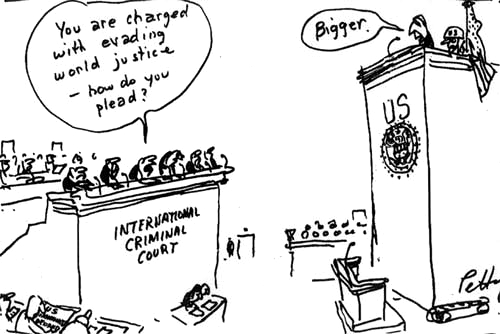
Is the ICC selective? Yes. Is the ICC racist? No. (Cartoon: Cartoon Movement)

I was tempted to answer the above question in JiC’s first-ever one-word post: “No.” However, in the past few weeks a number of individuals, including some whose views I respect greatly, have told me that they believe that the ICC is racist. I thus felt compelled to grapple with the question.

I recently had the opportunity to see a talk by and meet Courtenay Griffiths, the chief defense lawyer for former Liberian President Charles Taylor at the Special Court for Sierra Leone. Griffiths believes that the racism which he sees as pervasive in the domestic adjudication of crimes in Western countries has been transplanted into international criminal law:

“If one goes down to the Old Bailey…on any given day if you troll around the court, you’ll find that roughly ninety percent of all the defendants on trial in that Court are, guess what? Black. …What we’re seeing in terms of international law currently is the replication of that association between criminality and black-ness which one sees at the national level not only here in the United Kingdom but in any significant Western country with a black population.”

It is important to note that levying the charge of racism against the Court does not simply bring into question whether the ICC is biased or selective, two critiques often raised with the Court by its critics and often admitted by its more honest proponents. No, the bludgeon of calling the Court racist takes the matter one step further by suggesting that the ICC targets African contexts because they are African.

No honest, self-reflecting advocate of international criminal justice can say he or she is satisfied with the reach of the ICC. It is selective and that is a problem. Further, some, including myself, are wary that the ICC’s practice of eagerly cozying up to the UN Security Council will only act to entrench the selectivity and bias of international criminal justice further.

But, while problematic, the Court’s selectivity does not mean that the ICC is a racist institution. Defenders against charges of the ICC being a neo-colonialist institution often point to the fact that thirty-three African states are signatories of the Rome Statute and members of the Court. That’s no paltry number.

Africa and the International Criminal CourtFurthermore, African states have engaged, and continue to engage, on a significant level, with the Court. African states lobbied heavily to successfully ensure that an African, Fatou Bensouda, was named the successor to Luis Moreno-Ocampo as the Court’s top prosecutor. Some states have seen cooperation with the Court strategically. The Government of Uganda, for better or worse, viewed its self-referral to the ICC as an opportunity to increase pressure on the Lord’s Resistance Army.

One might now ask, well then why do some African member-states describe the ICC as neo-colonial? There are a few reasons for this. Continue reading

Posted in African Union (AU), International Criminal Court (ICC), UN Security Council | 38 Comments

A Year of Justice in Conflict!

Dear readers,

Today marks JiC’s one-year anniversary! We wanted to take this opportunity to thank you all for your readership and your support. It has been quite the ride so far. Over the last 365 days, JiC has published over 150 posts, on topics ranging from Osama bin Laden’s assassination to the politics of funding the International Criminal Court, from the meaning of transitional justice to the fate of Saif al-Islam Gaddafi.

Over the next 365 days we hope to continue to cover angles rarely considered in other media as well as feature more guest-authors. Remember, if you’re interested in joining JiC for a guest-post or on a more permanent basis, let us know!

We hope you’ve enjoyed reading our posts as much as we’ve enjoyed writing them for you. We could not have done it without your support. A special thanks to Kevin Jon Heller, Radio Netherlands Worldwide, ISN Zurich and IJCentral for cross-posting and promoting our work.

Here’s to another year!

– Mark, Patrick and Elke

PS – here’s a little clip from the youngest ICC advocate I know:

Posted in JiC News | 1 Comment

Syria and the Arab Spring: International Criminal Law after a UN Veto

JiC welcomes Peter Quayle, a solicitor specialising in public international law and litigation and the author of an excellent blog on international law. In this guest-post, Peter considers the international legal parameters in responding to the ongoing crisis in Syria. Enjoy! 

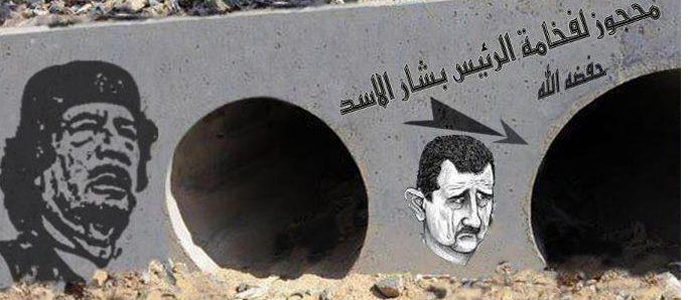
A not-so-subtle and quite grim use of graffiti to suggest that some would like to see Syria's Assad meet a similarly grisly fate as Libya's Gaddafi

During Syria’s scorching summer, visitors to the Souk Al-Hamdiye in central Damascus appreciate the shaded cool. They also remark on the slender beams of sunlight that lance the corrugated iron roof and scatter in the gloom. These are resulting from the profusion of penny-sized holes left by bullets fired in 1925 during an unsuccessful uprising against French colonial rule. It was not until 1945 that Syria gained its independence.

Today’s opposition to President Bashar al-Assad needs be no less protracted. All the more so since the recent veto by Russia and China of a UN Security Council resolution urging adherence to a peace plan proposed by the Arab League. Yet, last year’s interdiction of Libya’s long time leader, Muammar Gaddafi, unsettled the regional presumption of exemption from UN-sanctioned international intervention. Hence the strong supposition that the situation in Syria is surely akin to Libya but the politics in Moscow and Beijing differs. But if we can discern important categorical differences of international criminal law, does this account for apparently inconsistent policy? And if international institutions are inactive, is international law irrelevant?

Five months ago, the UN’s Office of the High Commissioner for Human Rights (OHCHR), reported to the General Assembly on a fact finding mission sent to Syria to investigate breaches of international human rights law. The mission had found “a pattern of human rights violations constituting widespread or systematic attacks against the civilian population, which may amount to crimes against humanity.” It had evidence that murder, disappearances, torture and persecution were all instruments of a policy to brutally suppress political opposition. The OHCHR urged the Security Council to consider referring Syria to the International Criminal Court (ICC).

However, it is noticeable that this categorisation has not cohered before the Security Council. The action taken against Gaddafi’s regime under UNSC 1970 (2011) – arms embargo, travel bans, asset freeze, and referral to the ICC’s jurisdiction – considered that “the widespread and systematic attacks currently taking place in the Libyan Arab Jamahiriya against the civilian population may amount to crimes against humanity.” In contrast, the doomed recent resolution against Syria was confined to the condemnation of “continued widespread and gross violations of human rights and fundamental freedoms.”

A pro-Assad protester in Damascus (Photo: Muzaffar Salman / AP)

Typically, atrocity crimes – crimes against humanity, war crimes and genocide – engage the Security Council’s prerogative to maintain and restore international peace and security. Human rights violations, under the UN Charter, Article 2(7), more often than not, are merely considered to be “essentially within the domestic jurisdiction” of members states. Action against Gaddafi was binding under Chapter VII, “[a]ction with respect to threats to the peace, breaches of the peace, and acts of aggression.” Action as drafted against Syria was under non-compulsory Chapter VI, “Pacific settlement of disputes.” The resolution passed by the General Assembly, adopts the vetoed Security Council version, and is non-binding. Continue reading

Posted in Human Rights, International Criminal Court (ICC), Syria, UN Security Council | 2 Comments

Legacies of Injustice in Liberia: Transitional Justice and Economic Crimes

JiC is thrilled to welcome back Kara Apland for this thoughtful and thought-provoking guest-post. Drawing on the Liberian experience, Kara delves into the oft-neglected subject of economic crimes in the context of transitional justice. Enjoy!

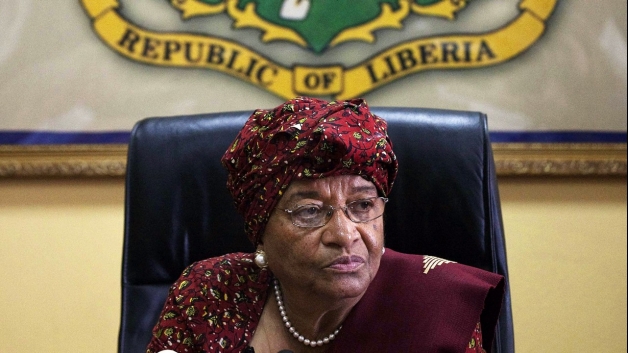
Ellen Johnson Sirleaf, Liberian president, winner of the Nobel Peace Prize and Africa’s first democratically elected female president, has come to be known as a hero of Liberia’s post-conflict recovery. “Liberia’s leading lady” has succeeded in bringing high levels of aid and foreign investment into the country while securing the forgiveness of over a billion dollars in foreign debt. Yet Sirleaf has also been the target of many critical voices within Liberia. In a controversial move that served to delegitimize its work in the eyes of the international community, the Liberian Truth and Reconciliation Commission recommended that Sirleaf be barred from office for her role in supporting war criminal Charles Taylor.

The TRC is by no means Sirleaf’s only critic. Days after Sirleaf was elected for a second term as Liberia’s president, an op-ed by two Liberian land rights campaigners, Silas Siakor and Rachel Knight, appeared in the New York Times. “Mrs. Johnson Sirleaf’s government may now be sowing the seeds of future conflict by handing over huge tracts of land to foreign investors and dispossessing rural Liberians,” they wrote.

While Sirleaf is certainly not the first high-profile Liberian politician to elicit controversy, her disputed reputation in Liberia illustrates the challenge of renegotiating power in political transition, and particularly the question of how to address economic crimes and allocate control of natural resources. Resource control and mismanagement by government and multinational corporations played a major role in the Liberian civil conflict. Not only did control of natural resources (especially rubber, timber, gold and shipping) serve as a motivating factor in the war, those resources ended up funding the armed groups perpetrating the conflict, particularly Charles Taylor’s NPFL. And on a more structural level, corruption, exploitation of natural resources and resulting economic marginalisation and extreme poverty served as underlying causes of the conflict.

Given the intimate role that corruption and resource control played in the Liberian conflict, it would seem that addressing “economic crimes” and securing just, sustainable and democratic policies with regard to natural resources are critical to breaking down norms of impunity and achieving a sustainable transition. But as Siakor and Knight point out, policy in Liberia has been geared toward attracting foreign investment rather than responding to Liberians’ conceptions of economic justice. Between 2006 and 2011, Sirleaf gave the rights to over one-third of Liberian land to logging, mining and agro-industrial industries. Land ownership is a source of conflict in Liberia, as hundreds of millions are being displaced from their homes and farmland to make room for international investment.

Liberian President Ellen Johnson Sirleaf

The flip side of current debates over just policies regarding natural resources in Liberia is impunity with regard to economic crimes of the past. The Liberian Truth and Reconciliation Commission is one of the few transitional justice mechanisms that has been mandated to address economic crimes, having been charged with

“investigating human rights violations and violations of international humanitarian law as well as abuses that occurred, including…economic crimes, recommending measures to be taken for the rehabilitation of victims of such violations.” Continue reading

Posted in Economics of Conflict, Liberia, Transitional Justice, Truth and Reconciliation Commissions, Truth Commission | 1 Comment