
As promised, here is my response to last week’s post on the crime of aggression. I had intended to have it ready earlier, but the dramatic events of last week (see here, here and here) have kept me occupied. I should note that this isn’t my area of expertise and welcome any comments from readers.

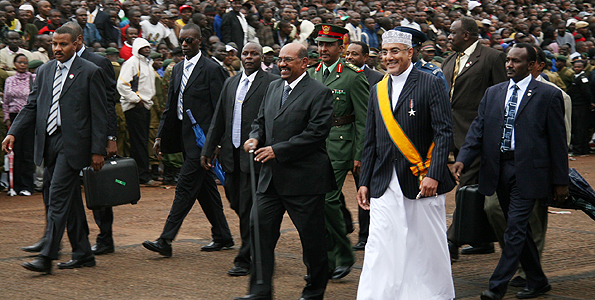
(Photo: Getty Images)
The Crime of Aggression: Why (Not) Care?
In his reflections on the definition of the crime of aggression, agreed to at the ICC’s Kampala Review Conference, legal scholar William Schabas concluded:
“Legal academics like myself will be eternally grateful to the Review Conference for providing us with such complicated and at times incoherent provisions. They will provide us with fodder for journal articles, books and conferences for many years to come.”
Yet, as Teddy suggests, there is something of a winter sleep over the subject and the silence is rather perplexing. It could simply be that, given that this category of crime only becomes operational in 2017, there’s just no rush to talk about it. It is not as if the events of the past year haven’t provided observers with enough to talk, argue and write about. And, as for international criminal lawyers, they’re no doubt busy with other things at the moment!
In his post, however, Teddy suggests that there is something altogether more pervasive that has stunted interest in the crime of aggression:
“I have become increasingly convinced that this is because those who work in or around the Court on a regular basis tend to see the core mission of the ICC as fitting in with a human rights agenda and don’t know how to deal with the crime of aggression.”
Is it possible that the focus on human rights in international criminal justice causes those interested in the ICC to ignore the crime of aggression? My short answer is yes, it is possible. A case could be made that the crime of aggression is ignored because of the narrow focus of human rights on the individual, more generally, and individual responsibility in particular.
Underpinning the human rights regime and the development of international criminal justice has been a myopic focus on the individual. I have previously argued that this is the result of the rise of liberal cosmopolitanism: the belief that all individual humans form part of a global community with the same basic and inalienable rights.
In this context, the crime of aggression sits uncomfortably between individual and collective state accountability. If we accept this to be true, it would be possible to argue that the focus of the human rights regime and the ICC on the individual makes it difficult for human rights and international criminal justice advocates to “deal” with the crime of aggression – a crime that is perpetrated by states and not individuals.
However, it seems unlikely that human rights or international criminal justice advocates would have a problem pursuing individual accountability for crimes that are, to a significant extent, collective in nature. Despite some criticism from scholars, the international criminal justice project has not hesitated to attribute individual responsibility to crimes that are very collective.
 My longer answer, however, as to why the crime of aggression has not received much attention since its codification is because, as it stands, its potential to “revolutionize” the conduct of aggressive war is minimal at best, and hypocritical at worst.
While many celebrate the fact that states have agreed to a definition of the crime of aggression, it was rather telling that, in reaction to the agreement, Christian Wenaweser, president of the assembly of state parties of the International Criminal Court didn’t exactly sound ecstatic: Continue reading












 Justice in Conflict