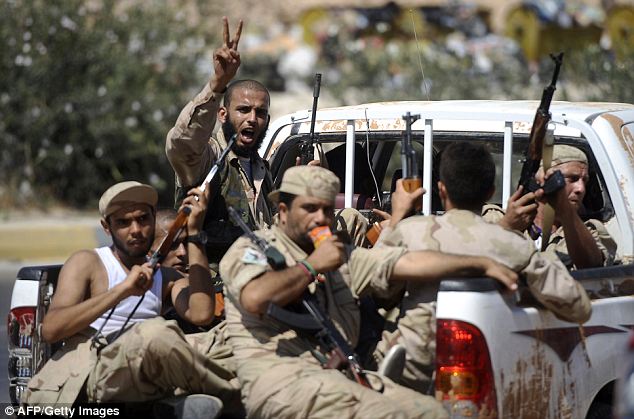
Rebel fighters on their way to Tripoli yesterday (Photo: AFP/Getty Images)
Reports are proliferating that the Libyan capital of Tripoli is on the verge of collapse. The level of resistance in the country has apparently now been withered to “pockets”. While the location of Col. Muammar Gaddafi remains unknown, the BBC has declared that the Libyan rebels have captured his son, a co-ICC-indictee Saif al-Islam. Here are a few thoughts on what this may mean for international criminal justice and the peace process in Libya.
Negotiated Settlement and Negotiated Justice: Dead in the Water?
Orthodox conflict resolution theory suggests that peace negotiations are necessary when no party to a war can ultimately be militarily victorious. Machinations regarding negotiations between the rebel’s National Transitional Council (NTC) and the pro-Gaddafi regime have been rife in previous weeks. Now, however, it is unclear whether such negotiations will indeed be necessary – rarely, if ever, does a victorious party to a conflict feel the need to negotiate with its defeated adversary. With the power and support of “the West” behind it, the NTC may be in a position to dictate rather than negotiate the nature and leadership of post-war Libya. With the fall of Tripoli, Colonel Gaddafi has lost any negotiating leverage or power he may have once had and could have used to shape a post-conflict transition. The idea of a negotiated power-sharing agreement between the NTC and the pro-Gaddafi regime may now be relegated to the dust-bin.
That the dynamics of power in Libya would shift so dramatically with a rebel victory has important implications on the pursuit of international criminal justice. The relationship between conflict resolution processes, especially negotiated peace agreements, and accountability remains more murky than clear. A prevalent fear remains that justice will be sacrificed at the altar of peace, that justice is something to use as a carrot or stick in negotiations rather than be treated as something that must absolutely be done.
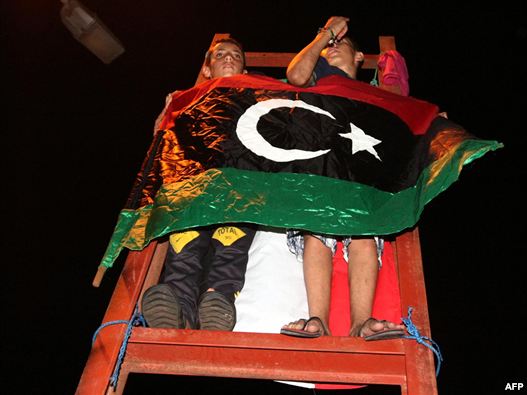
Children celebrate on the outskirts of Tripoli (Photo: AFP)
It remains unclear as to what the NTC views as the appropriate destiny for the Tripoli Three – Gaddafi, his intelligence chief and his son Saif al-Islam. But they are now in a much stronger position to dictate that destiny. Granting amnesty or exile as a part of a negotiated settlement, a real possibility just months ago, now appears very unlikely.
The Amnesty/Exile Question
It remains a possibility, however slight, that the NTC will seek to grant Gaddafi an amnesty as a means to ensure as calm a transition as possible. Of course, this assumes that an amnesty or offer of exile to Gaddafi would, in fact, have a calming effect, something which is not at all clear.
However, the granting of amnesty or exile would seem very unlikely. Trying Gaddafi, whether in the Hague or in Tripoli or Benghazi, would be a remarkable political victory and signal for the NTC and its supporters. While tribal divisions remain strong amongst rebel ranks and some have only increased in intensity during the conflict, what seemingly all of Libya’s tribes fighting with the rebels agreed on was that Gaddafi must go.
The international nature of the conflict also plays into the fate of Gaddafi. There is likely to be significant pressure on the NTC regarding the fate of Colonel Gaddafi and the rest of the Tripoli Three. However, it’s not clear what direction that pressure will actually come from. The “West” has not won a lot of international justice credibility in the past few weeks regarding their positions in Libya, particularly in their suggestion that Gaddafi would be free to stay in the country after the conclusion of the war. Will the interventionary forces in Libya pressure the NTC to send Col. Gaddafi to the ICC? Do some believe that an amnesty for Gaddafi would be a better choice for the country? Will they push for a domestic trial of Gaddafi? What will they demand of the fate of Saif al-Islam?
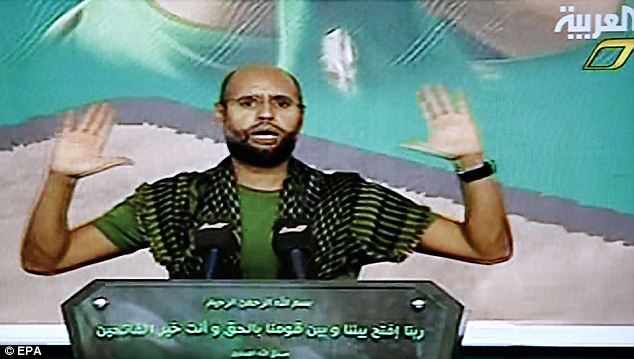
Saif al-Islam on state tv prior to the rebel's attack on Tripoli
Saif: Fate in the Balance
The silence regarding the fate of Saif al-Islam has been, at least to me, deafening. International NGOs and interested states have said virtually nothing about what they believe the appropriate plans are for Saif al-Islam. Despite the ICC warrant against him and the fact that many Western diplomats had been open about giving him a key political role in a Libyan transition, human rights organizations have largely ignored Saif al-Islam.