
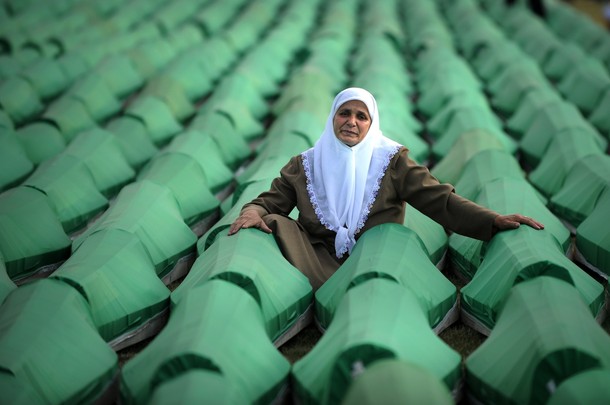
A Bosnian woman mourns over coffins of some of the victims of the 1995 Srebrenica massacre, which has been described as consituting an act of genocide (Photo: srebrenica-genocide.blogspot.com)
In an article on the continued debate about the meaning and use of the term ‘genocide’, The Economist writes:
“Prosecutors, judges, historians and politicians have made huge efforts in recent years to describe the boundaries of genocide: when mere mass murder stops and the ultimate human crime starts. Yet the term is far more than a tool of historical or moral analysis. Its use brings momentous political and legal consequences—and is therefore bound to be highly contested.”
Since the days when Polish lawyer Raphael Lemkin loitered in front of the offices of UN diplomats and pressed the international community to adopt the Convention on the Prevention and Punishment of the Crime of Genocide, few terms have inspired so many words, speeches, books and films as “genocide”. Perhaps only the term “nuclear” has evoked the same passion and interest. Genocide has, for better or worse, become known as the “crime of all crimes” and has seemingly defined the parameters of humanity’s capacity to conduct evil.
According to the Genocide Convention,
genocide means any of the following acts committed with intent to destroy, in whole or in part, a national, ethnical, racial or religious group, as such:
(a) Killing members of the group;
(b) Causing serious bodily or mental harm to members of the group;
(c) Deliberately inflicting on the group conditions of life calculated to bring about its physical destruction in whole or in part;
(d) Imposing measures intended to prevent births within the group;
(e) Forcibly transferring children of the group to another group.
At the center of the genocide debate has been the work of Professor William Schabas. Schabas has written extensively about his discomfort with what he sees as the abuse of the terminology of genocide, declaring that its expanded use and conflation with crimes against humanity has resulted in a “careless and potentially misleading use of precise terminology.” According to the Economist, however, Schabas now argues that the international community should turn its focus away from genocide to crimes against humanity.
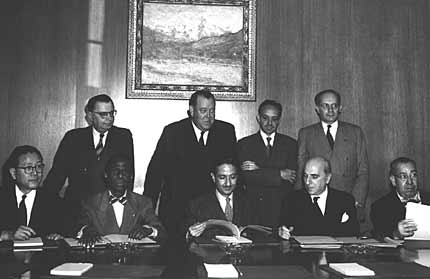
State representatives sign the Genocide Convention. On the far right, standing, is Raphael Lemkin who tirelessly worked to get recogntion of the term "genocide" (Photo: ushmm.org)
A trend towards applying crimes against humanity as a sort of blanket crime, would have significant consequences for the adjudication of international crimes. It would virtually guarantee that most perpetrators of mass atrocities are found guilty. Why? Because, as Dov Jacobs argues, they don’t need the intent to destroy, in total or in part, a particular group of people, as the crime of genocide requires, nor does it require a recognition that crimes were committed in the context of an armed conflict, as war crimes require.
Some may argue that there is something fundamentally positive about a world which sees all crimes which may amount to genocide as crimes against humanity. Because genocide must be done by one group against the “other”, calling crimes genocide implicitly and explicitly reifies the belief that some people are different. Crimes against humanity, on the other hand, is a fundamentally cosmopolitan international crime. Which people are targeted is irrelevant because the crime is one not against any type of people, but a crime against all people, against all of humanity. The architects and perpetrators of the Holocaust, for example, were not charged with genocide at the Nuremberg Tribunal (the term “genocide” did not yet exist). Instead, their acts were considered as crimes against all of humanity.







 Justice in Conflict