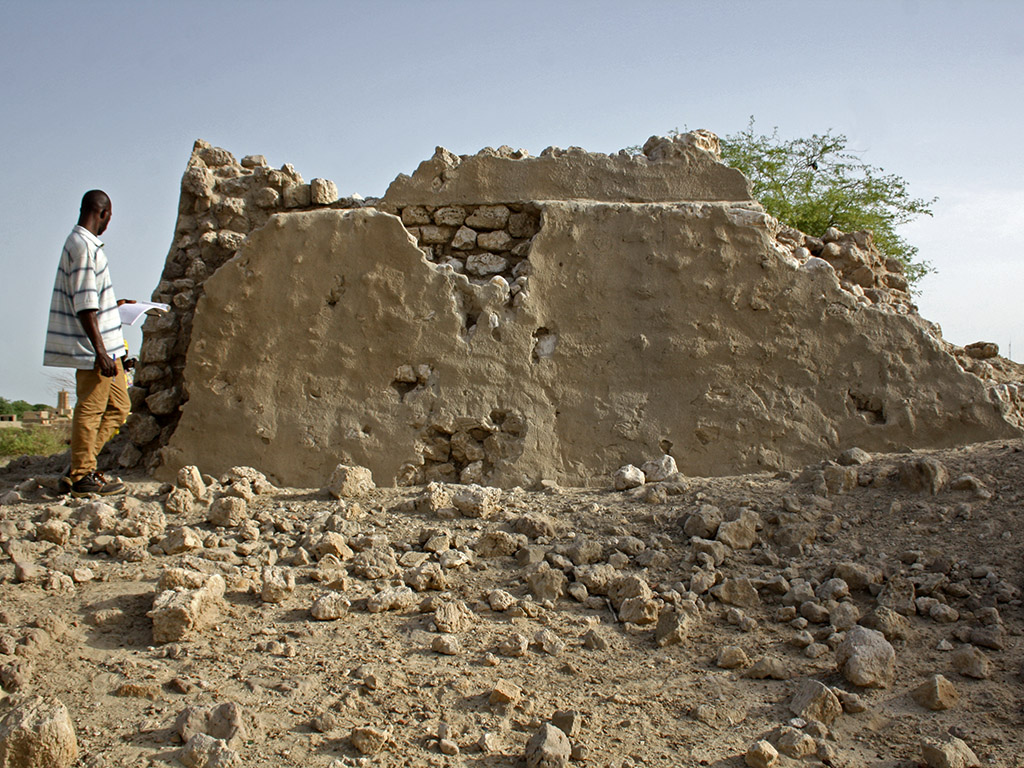
The partially destroyed Alpha Moya mausoleum in Timbuktu in 2013 (Photo: World Monuments Fund)
It is a fool’s game to predict what will happen next at the International Criminal Court (ICC). Today, the world woke up to news that the ICC had gained custody of Ahmad Al Faqi Al Mahdi, a member of the Ansar Dine group allegedly responsible for the brazen destruction of shrines in Timbuktu, Mali.
It wasn’t that long ago that I wrote that the Court had gone virtually silent with regards to its intervention in Mali. In response to that post, a number of sources with intimate knowledge of the investigation insisted that Mali was not a blindspot for the Court and that there would be important developments announced in the near future. It is never easy deciphering when such claims are sincere but in this case they certainly have been – and how.
In its public statement, rather oddly released in the early hours of Saturday morning when public and media attention is low, the Office of the Prosecutor went to great lengths to emphasize that it considered cultural crimes to be as serious as acts of direct physical violence:
Ahmad Al Faqi Al Mahdi, also known as “Abou Tourab”, is accused of allegedly committing the war crime of intentionally directing attacks against ten buildings dedicated to religion and historic monuments in the ancient city of Timbuktu, Mali. A zealous member of an armed group, self-proclaimed “Ansar Dine”, he played a predominant and active role in the functioning of the local structure put in place during the group’s occupation of Timbuktu in 2012, as detailed in my Office’s application for the warrant of arrest which led to his surrender.
The people of Mali deserve justice for the attacks against their cities, their beliefs and their communities. Let there be no mistake: the charges we have brought against Ahmad Al Faqi Al Mahdi involve most serious crimes; they are about the destruction of irreplaceable historic monuments, and they are about a callous assault on the dignity and identity of entire populations, and their religious and historical roots. The inhabitants of Northern Mali, the main victims of these attacks, deserve to see justice done…
…It is rightly said that “cultural heritage is the mirror of humanity.” Such attacks affect humanity as a whole. We must stand up to the destruction and defacing of our common heritage.
In addition to never having prosecuted a member of an extremist Islamic group, the Court, as it noted in its statement, has never prosecuted cultural crimes. But with the destruction of fifteen revered shrines in Timbuktu and the incessant war against cultural sites by the Islamic State in Syria and elsewhere, attacks on such historical monuments have gained unprecedented international attention. The Prosecutor is clearly interested in meeting at least some of growing international demand that those responsible for the wanton destruction of monuments of cultural and historical relevance be held to account. There should thus be no doubt that the Court’s prosecution of Al Mahdi is a test case for future prosecutions of cultural crimes and will expand how the Prosecutor views her mandate.
The arrest and surrender of Al Mahdi also appears to be a pinnacle moment for ICC-state cooperation. It is no secret that the ICC struggles to gain cooperation from relevant states and that, even when it does, states often seek to instrumentals and manipulate the Court for their own benefit. The surrender of Al Mahdi, however, seems to hint at an altogether a different story.