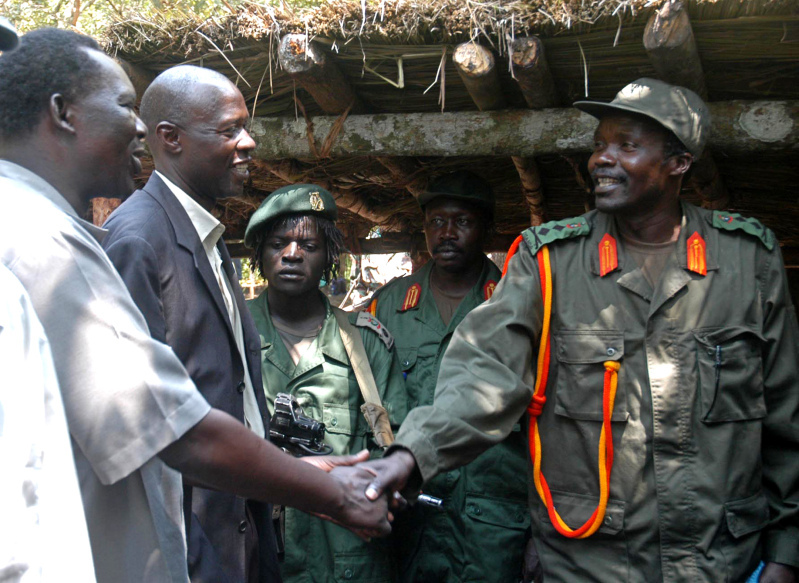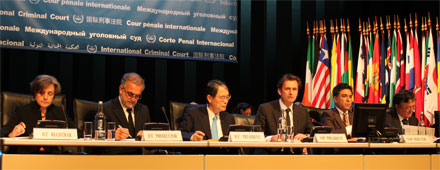
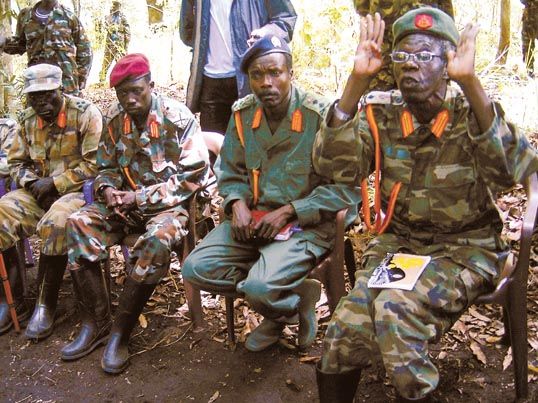
LRA leader Joseph Kony (second from right) and his second-in-command, Vincent Otti (far right), were both indicted by the ICC
Most of the academic and political attention that the International Criminal Court (ICC) receives these days comes from Sudan and Libya. There is little doubt that the investigations of Sudan’s Omar al-Bashir and Libya’s Muammar Gaddafi have captured the imagination of the Court’s fiercest advocates and most vehement critics alike.
It is no secret that the world’s attention can only be split so many ways. When our eyes and ears turn to Libya, we ignore Bahrain and Yemen. When we claim genocide in Darfur, we ignore the horrors of the Democratic Republic of Congo (DRC). Similarly, there is a significant division in the attention that the ICC’s cases get. Generally, the ongoing occurrences of war crimes and crimes against humanity in the DRC and the Central African Republic (CAR) are examined the least. The case of Darfur, thanks in large part to remarkably influential (if not always well-informed) activism of American human rights groups and celebrities as well as the labelling of the Khartoum regime as genocidal, remains a focal point of international political and media attention. Understandably, no case currently receives nearly the attention as Libya where a delirious tyrant, a former London School of Economics grad student and the Intelligence chief are in the cross-hairs of NATO bombs and the ICC’s Prosecutor. Somewhere, in the middle of the pack are the Kenya and Ugandan cases, with Kenya receiving more attention because of its recent nature.
Attention to northern Uganda from scholars, observers and international development community exploded in the early 2000s. A conflict which had long been neglected and seemingly relegated to oblivion, quickly became front-page news and emerged on the agenda of international institutions. This was in large part the result of the ICC’s involvement. In 2003, the situation in northern Uganda became the first case to be referred to the ICC, making Uganda “a litmus test for the much celebrated promise of global justice,” according to scholar Kasaija Phillip Apuuli. Two years later, the Court issued arrest warrants for the four senior members of the Lord’s Resistance Army (LRA): Joseph Kony, Vincent Otti, Okot Odhiambo, Dominic Ongwen and Raska Lukwiya.
Internationally, the ICC’s indictments were hailed as a historic moment symbolizing the end of impunity for violators of the gravest crimes. Locally, however, many viewed the ICC’s timing and intervention as precarious, if not dangerous.

The conflict in northern Uganda resulted in, at times, millions of civilians being forced into internally displaced persons camps (Photo: BBC)
The notoriously brutal LRA, led by Kony, had been at war with the government of Uganda for two decades. Numerous peace initiatives had stalled or failed for various reasons. Then, in 2000, the Government of Uganda passed an Amnesty Act which guaranteed that any LRA combatants who defected from the LRA would be granted reprieve from prosecution and reintegrated into society. Justice would be achieved through context-sensitive traditional reconciliation mechanisms rather than through trials. When the ICC began its investigations and subsequently issued arrest warrants for Kony and the other top officials, many civil society, human rights and religious leaders in northern Uganda strongly criticized the decision. Tim Allen, who wrote a remarkably lucid account of “trial justice” in Uganda quotes one northern Ugandan human rights worker as saying: “There is a balance in the community that cannot be found in the briefcase of the white man.” Others, most thoroughly scholar Adam Branch, maintained that the Ugandan government was in effect using the ICC in order to justify and legitimize a military campaign against the LRA.