Used and Abandoned: Libya, the UN Security Council and the ICC

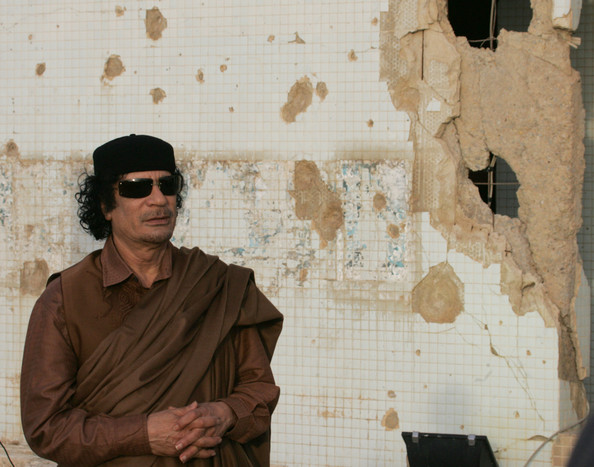
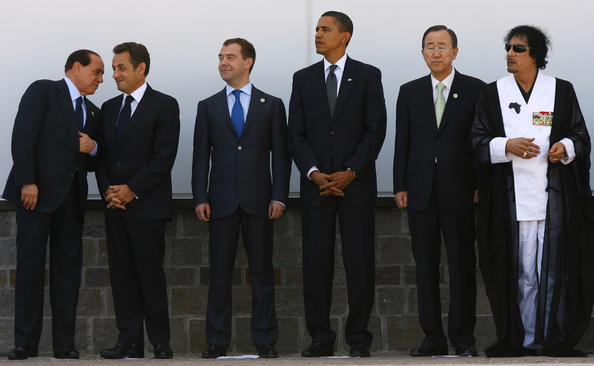
Gaddafi with some of his recent economic, political and military partners (Photo: Oli Scarff/Getty Images)

It hasn’t been a particularly good week for the ICC. First, came the mistaken confirmation by the Office of the Prosecutor (OTP) that Libyan rebels had detained Saif al-Islam. Within hours of the “confirmation” it became clear that Saif was not under arrest. Reports have emerged revealing that the ICC was preparing to enter into negotiations with the rebels’ National Transitional Council (NTC) on transferring Saif, as well as the recent admission that the the OTP had never actually spoken to anyone who could authoritatively confirm Saif’s arrest. Adding insult to injury, Saif even took the time to give journalists a mini-tour of what remains of Gaddafi-loyalist held Tripoli.

Second, the talk of trying the Tripoli Three – Muammar Gaddafi, Saif and the Gaddafi regime’s intelligence chief, Abdullah al-Senussi – by Libyan authorities poses a profound challenge to the Court: If the Gaddafis and al-Senussi can be tried in Libya, by Libyan officials, despite the lack of a functioning, legitimate and independent judiciary for over forty years, then what was the point of getting the ICC involved in Libya in the first place?

The short answer, it would appear, is that the international community used the Court for political ends.
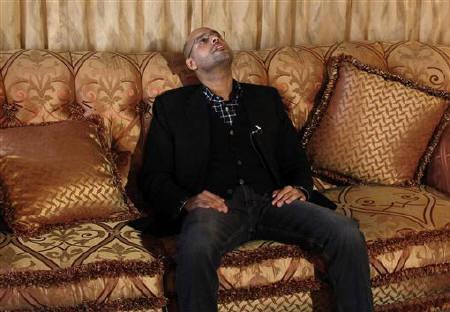
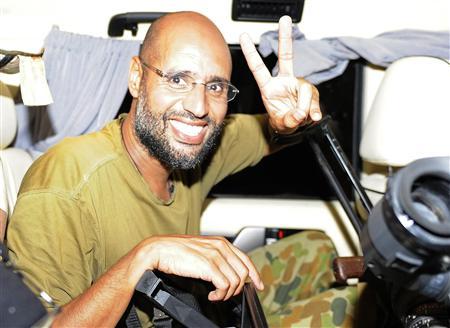
It wasn't a great week for the ICC which confirmed that Saif al-Islam Gaddafi had been detained by rebels only to watch him on TV, giving tours of Tripoli to journalists

Back in February when the UN Security Council decided to refer the situation in Libya to the ICC under Resolution 1970, the sensible conclusion many observers drew was that the Court would be in charge of bringing those most responsible for the crackdown on peaceful protesters in Libya to account. But even back in those early, hazy days of the Arab Spring, there were hints that the ICC was being instrumentalized for political purposes by the Council. The referral disallowed the investigation of any citizens of states not party to the ICC and imposed a jurisdictional wall for the Court by barring it from investigating events prior to February 15 2011.

Shortly after the UN Security Council referral, I wrote a piece in which I considered whether the Council had “outsourced” responsibility for peace in Libya to the ICC, happily watching as the Court was deflecting blame for ongoing violence. The case of Darfur made this a palpable possibility. Now that some form of peace appears inevitable in the comings weeks and months in Libya, it may not be possible to say that the Council did, in fact, outsource responsibility for peace to the Court. But, in a similar vein, the Court may have been used by the international community for interests which had very little, if anything, to do with justice and everything to do with politics.

The international community, and in particular an embarrassed set of Western states who had literally and figuratively propped up and cozied up to Colonel Gaddafi’s regime by becoming economic, military and political partners with him, capitalized on an unprecedentedly widespread support for intervention in Libya. In the span of just days even the most starry-eyed internationalists watched, stunned, as the UN Security Council passed two resolutions – one which imposed a no-fly zone over Libya, citing the Gaddafi regime’s failure in their “responsibility to protect” their citizens, and another which referred the situation to the ICC. Not even China and Russia, the most pesky stalwarts against any possible withering of the principle of sovereign non-intervention stood against the tides of international justice. The Arab League and the African Union jumped on board too, something which would have been preposterous to propose just a few months prior.

Susan Rice Libya

According to some, a rift has emerged between Susan Rice and the ICC over where the Tripoli Three should be tried.

Of course, the cohesiveness and unity amongst international actors has not weathered the turbulent nature of the conflict particularly well. Regardless, while some commentators were quick to argue that the largely unanimous international support for the ICC’s intervention in Libya suggested a new era for the Court, it would appear instead that the Court may have been supported because it served the political interests of the parties involved. In other words, UN Security Council states understood that the Court could help or, at least not hurt, in isolating Gaddafi and removing him from power. Recent developments indicate that whether or not Gaddafi would end up in The Hague was, at best, an afterthought and, at worst, irrelevant.
Continue reading

Posted in Human Rights, International Criminal Court (ICC), Justice, Libya, Libya and the ICC, UN Security Council, United Kingdom, United States | 6 Comments

Having Cake and Eating it Too: An ICC Trial in Libya?

Could Gaddafi face an ICC trial in Libya? (Photo: AFP)

The past few days has seen an interesting shift in the debates regarding international justice in Libya. While many commentators, especially those who argue that justice can only hinder peace, were once happy to question whether Muammar Gaddafi, his son and his intelligence chief should be tried, the primary debate emerging now is where they should be tried.

At the center of the debate on where the Tripoli Three should be tried is a deceivingly complex paradox, outlined brilliantly in Gerry Simpsons’ book, Law, War and Crime, in the chapter “Law’s Place”. While international criminal law adjudicates crimes on the international level, justice remains most effectively pursued and achieved locally, where witnesses, victims, survivors and evidence actually are. The International Criminal Court’s complementarity regime is intended to mitigate this contradiction by guaranteeing that the ICC could only ever prosecute individuals in a state that was either unable or unwilling to do so itself. States, by extension, have primacy over pursuing justice and can only be replaced by the ICC if they don’t want to or can’t effectively and legitimately prosecute human rights violators.

Numerous commentators have grappled with the issue of trying the Tripoli Three in either Libya or The Hague. Andrew Jillions wrote a piece here at JiC on the subject, questioning whether it should be considered only as a legal issue. David Bosco also has an interesting post on the subject at his blog, The Multilateralist. The Guardian did a survey on where Gaddafi should be tried with the results overwhelmingly in favour of local trials. Stewart Patrick has detailed five possible options that the international community has with regards to trying the Tripoli Three and any others who may be indicted by the Court (remember, the first three indictments related to crimes committed only in the very early stages of the conflict).

Saif al-Islam Gaddafi ICC

Could Saif al-Islam Gaddafi be put on trial by the ICC in Libya? (Photo: Reuters)

Yet in promoting stark ‘either-or’ scenarios most assessments miss another possibility which could, at least theoretically, put this whole debate to rest and leave all sides satisfied: an ICC trial of Gaddafi in Libya.

It seems this option has yet to filter through the imaginations of most commentators, but it is not as absurd as one might be led to believe. Earlier this year, judges at the ICC considered holding hearings in Kenya for confirmation charges against those responsible for the 2007 post-election violence in the country. The judges eventually decided against holding the hearings in Kenya, but it marked the first time the Court had seriously contemplated the idea of taking the ICC out of The Hague.

In Libya, the possibility of political intrusion and attempts to influence judicial proceedings by allies of the indicted Gaddafis would appear far less unlikely than in the Kenyan case where some of the ICC’s targets remain closely tethered to the ruling political class. Victim and witness protection would undoubtedly be a challenge, arguably a more significant challenge than if the case was heard in The Hague. There is also a legitimate fear that by trying the Tripoli Three in Libya or the Ocampo Six in Kenya, the ICC could become a traveling political circus. But the benefits of holding an ICC trial in Libya are palpable – for the Court, for Libya and for justice.

(Photo: Reuters/Mohammed Salem)

Holding hearings and a trial in Libya would allow the Court to retain control over the proceedings and thus guarantee international legal standards, maintain its political salience in Libya and in the region, all the while illustrating that the ICC isn’t simply interested in extracting leaders from the very context in which the victims and survivors it purports to work for live. The Court would also be able to leave a tangible legacy in Libya with offices, a court, and so forth, in place.

Importantly, the inflexibility of trials having to take place in The Hague makes very little sense to victims. In a context where it isn’t enough for justice to be done, but also needing to be seen to be done, what better way to strengthen the Court’s reputation and credibility while directly enhancing the capacity of Libya to try its own leaders?

Libya and the National Transitional Council would be able to continue its critical relationship with the international community, demonstrate to the world and to Libyans that it is committed to achieving justice and embracing rule of law, while skipping out on the financial burden of what will surely be a long and arduous trial. They would be able to satisfy both the desire of its people to have the Tripoli Three tried in Libya as well as pressure from the Court and human rights groups to guarantee a judicial process of the highest standard.

Continue reading

Posted in Complementarity, International Criminal Court (ICC), Justice, Kenya, Libya, Libya and the ICC, The Tripoli Three (Tripoli3) | 4 Comments

Trying the Tripoli Three: Justice at Home or Away?

Gaddafi trial

Photo by Getty Images Europe

Andrew Jillions joins JiC once again to discuss where the Tripoli Three should be tried: in Libya or The Hague?

With rebels storming Tripoli and Saif al-Islam reported captured, it seemed appropriate to consider the question of where those indicted by the ICC should face trial, in Libya or the Hague. Things are less clear today, with the fog of war being blamed for the mistaken reports of Saif’s capture, and discussions about the location of his trial looking somewhat premature. Nevertheless, the writing is on the wall and, hopefully sooner rather than later, where the trial will take place is a question that will eventually need to be answered.

But there is more than one way to frame this question. David Bosco for example frames it as a question of whether Gaddafi or his fellow accused can face justice at home, the implication being that the ICC currently has ownership of the issue. The question asked yesterday in a poll for the Guardian is the more appropriate open-ended one: Should Gaddafi face justice at home?’, the implication being that there are broader considerations than what Moreno-Ocampo thinks.

My view is that it is a mistake to think of this as a fundamentally legal question, just as it is a mistake to think that resolving the question requires a fundamentally legal judgement. To attempt to make it so will weaken international criminal justice, giving fodder to those waiting to cry legalism at any sign of prosecutorial excess (here’s looking at you John Bolton!). Contrary to Alison Cole’s argument, the danger to international justice is not that it appears hollow if the ICC wimps out of the full execution of the arrest warrants. Rather, the danger is that by demanding the transfer of “the Tripoli Three” the ICC shows an inability to exercise discretionary judgement, and to recognise that this is a genuinely different situation from any that have come before the Court previously. We’re looking at a new set of actors in the National Transitional Council, actors that haven’t yet had the opportunity to show either an ability or willingness to try those accused of international crimes, let alone sign Libya up to the ICC.

Siege of Tripoli

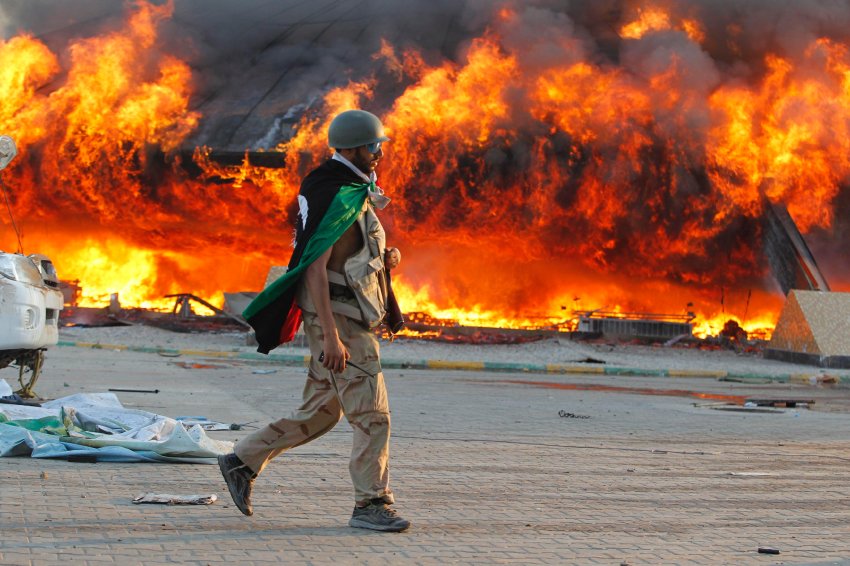
A rebel walks past burning debris in Tripoli (Photo: Spiegel)

All the signs are that the National Transitional Council will want to try Gaddafi and his fellow accused themselves. As Mark Kersten notes, they are in an increasingly strong position when it comes to dictating post-conflict events. Reflecting the view that this is a fundamentally political judgement for the NTC, Andrew Mitchell, the UK International Development Secretary, has stated unequivocally that if the Libyans want to try Gaddafi, they will be allowed to.

There are some conditions that will need to be satisfied first, however. Bosco suggests the possibility that “the unenviable task of assessing whether the new Libya is capable of conducting credible trials” would fall, eventually, to an ICC judge, but I think this is a standard that will more likely be adjudicated by those countries involved in the intervention and currently advising the NTC. At some point, in order to claim jurisdiction, the NTC, or whatever this becomes in the new Libya, will need to be able to show that they have the necessary judicial institutions in place to try the accused and that those institutions can be trusted to give the accused a fair trial, in line with international standards. Given that none of these institutions currently exist, there is some work to be done here.

Continue reading

Posted in Complementarity, Crimes against humanity, Human Rights, International Criminal Court (ICC), Justice, Libya, Libya and the ICC, The Tripoli Three (Tripoli3) | Leave a comment

Peace and Justice in Libya – Tripoli Falling, Justice Rising?

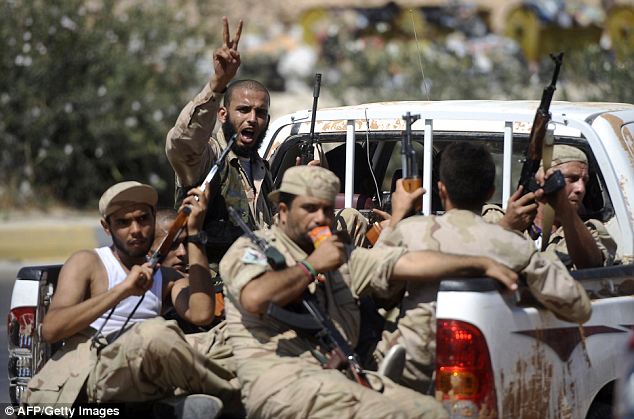
Rebel fighters on their way to Tripoli yesterday (Photo: AFP/Getty Images)

Reports are proliferating that the Libyan capital of Tripoli is on the verge of collapse. The level of resistance in the country has apparently now been withered to “pockets”. While the location of Col. Muammar Gaddafi remains unknown, the BBC has declared that the Libyan rebels have captured his son, a co-ICC-indictee Saif al-Islam. Here are a few thoughts on what this may mean for international criminal justice and the peace process in Libya.

Negotiated Settlement and Negotiated Justice: Dead in the Water?

Orthodox conflict resolution theory suggests that peace negotiations are necessary when no party to a war can ultimately be militarily victorious. Machinations regarding negotiations between the rebel’s National Transitional Council (NTC) and the pro-Gaddafi regime have been rife in previous weeks. Now, however, it is unclear whether such negotiations will indeed be necessary – rarely, if ever, does a victorious party to a conflict feel the need to negotiate with its defeated adversary. With the power and support of “the West” behind it, the NTC may be in a position to dictate rather than negotiate the nature and leadership of post-war Libya. With the fall of Tripoli, Colonel Gaddafi has lost any negotiating leverage or power he may have once had and could have used to shape a post-conflict transition. The idea of a negotiated power-sharing agreement between the NTC and the pro-Gaddafi regime may now be relegated to the dust-bin.

That the dynamics of power in Libya would shift so dramatically with a rebel victory has important implications on the pursuit of international criminal justice. The relationship between conflict resolution processes, especially negotiated peace agreements, and accountability remains more murky than clear. A prevalent fear remains that justice will be sacrificed at the altar of peace, that justice is something to use as a carrot or stick in negotiations rather than be treated as something that must absolutely be done.

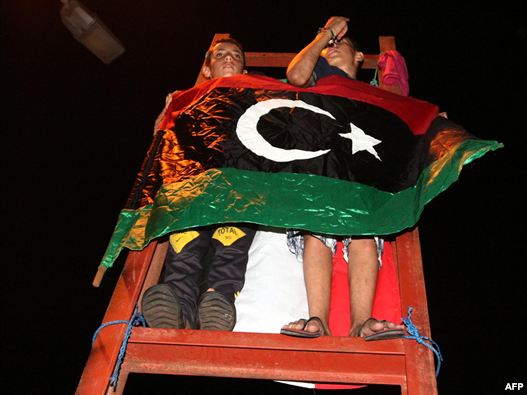
Children celebrate on the outskirts of Tripoli (Photo: AFP)

It remains unclear as to what the NTC views as the appropriate destiny for the Tripoli Three – Gaddafi, his intelligence chief and his son Saif al-Islam. But they are now in a much stronger position to dictate that destiny. Granting amnesty or exile as a part of a negotiated settlement, a real possibility just months ago, now appears very unlikely.

The Amnesty/Exile Question

It remains a possibility, however slight, that the NTC will seek to grant Gaddafi an amnesty as a means to ensure as calm a transition as possible. Of course, this assumes that an amnesty or offer of exile to Gaddafi would, in fact, have a calming effect, something which is not at all clear.

However, the granting of amnesty or exile would seem very unlikely. Trying Gaddafi, whether in the Hague or in Tripoli or Benghazi, would be a remarkable political victory and signal for the NTC and its supporters. While tribal divisions remain strong amongst rebel ranks and some have only increased in intensity during the conflict, what seemingly all of Libya’s tribes fighting with the rebels agreed on was that Gaddafi must go.

The international nature of the conflict also plays into the fate of Gaddafi. There is likely to be significant pressure on the NTC regarding the fate of Colonel Gaddafi and the rest of the Tripoli Three. However, it’s not clear what direction that pressure will actually come from. The “West” has not won a lot of international justice credibility in the past few weeks regarding their positions in Libya, particularly in their suggestion that Gaddafi would be free to stay in the country after the conclusion of the war. Will the interventionary forces in Libya pressure the NTC to send Col. Gaddafi to the ICC? Do some believe that an amnesty for Gaddafi would be a better choice for the country? Will they push for a domestic trial of Gaddafi? What will they demand of the fate of Saif al-Islam?

Saif al-Islam ICC

Saif al-Islam on state tv prior to the rebel's attack on Tripoli

Saif: Fate in the Balance

The silence regarding the fate of Saif al-Islam has been, at least to me, deafening. International NGOs and interested states have said virtually nothing about what they believe the appropriate plans are for Saif al-Islam. Despite the ICC warrant against him and the fact that many Western diplomats had been open about giving him a key political role in a Libyan transition, human rights organizations have largely ignored Saif al-Islam.

Continue reading

Posted in Amnesty, International Criminal Court (ICC), Justice, Libya, Libya and the ICC, Peace Negotiations, The Tripoli Three (Tripoli3) | 3 Comments

The Middle Man: The Intermediaries of International Criminal Justice

Dear JiC Readers: We continue this week with a new guest-poster at JiC, Holly DranginisHolly is a law student at Berkeley Law School and a researcher at the Berkeley Human Rights Center. She was a consultant for the International Criminal Court in 2008 and led capacity building initiatives in Northern Uganda with intermediaries and international nongovernmental organizations in 2009-2010. Most recently she interned on the prosecution team for the Charles Taylor case in The Hague. We hope to have Holly become a contributor and to share her experience and knowledge at JiC on a regular basis.

Holly interviewing intermediary staff in Lira, Uganda in 2010

The Middle Man: The Intermediaries of International Criminal Justice

Dr. Paul Farmer recently wrote for Foreign Affairs with a fresh perspective on the great challenge of aid in impoverished, disaster-affected and war-torn countries. To improve the quality and longevity of initiatives, he says, “Foreign contractors and international nongovernmental organizations (NGOs) need to find a better way of accompanying development partners.” This is as true for public international law as it is for public health. For the International Criminal Court (ICC), one barometer of good accompaniment and therefore in some ways, success in the overall mission, are intermediaries.

There is quite a rich debate in whether it is appropriate to place justice in conflict among the health and development initiatives that are Farmer’s area of expertise. But for a moment, let’s imagine that delivering rule of law, whether on an international, hybrid, domestic or community level is a form of aid alongside medicine and poverty-eradication that share glaring achievement gaps. Failure to do so may be precisely part of the problem we face in effective implementation.

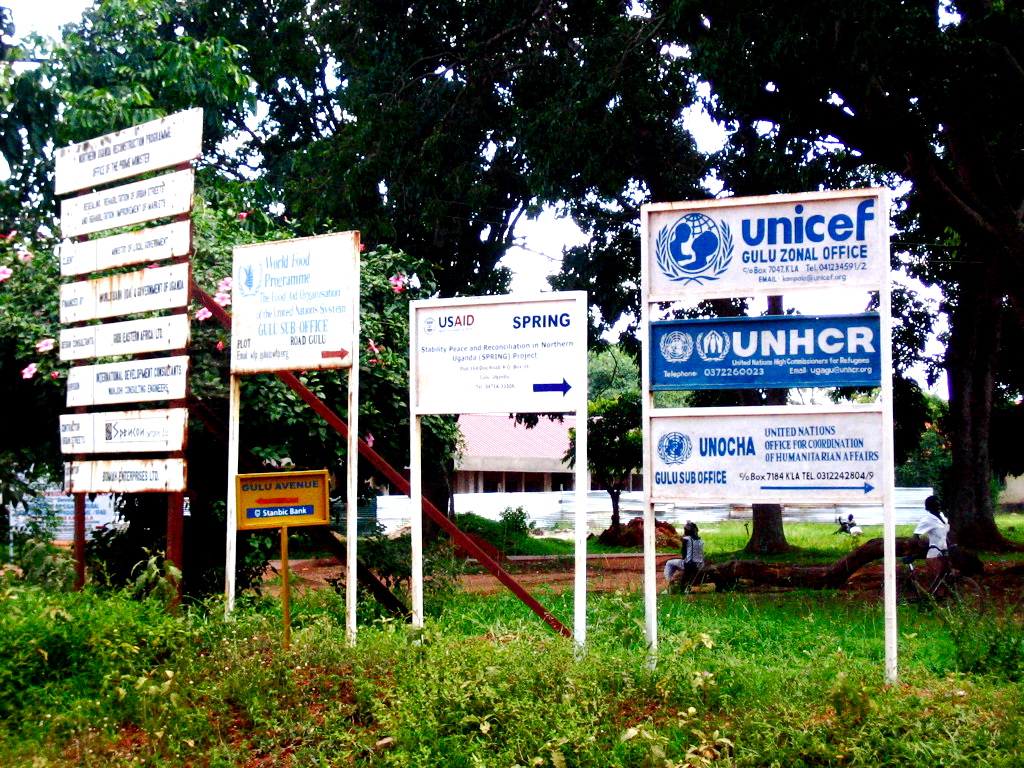
Signs in Gulu, illustrating the onslaught of international nongovernmental organization offices in the small town (Photo: Holly Dranginis)

The Accompaniers

The term “intermediary” in ICC parlance is quite elusive, appearing nowhere in either the Rome Statute or the ICC’s Rules of Procedure and Evidence. A definition offered in a recent report by the Victims’ Rights Working Group (VRWG) says, “[An intermediary is] someone who comes between one person and another; facilitates contact…between one of the organs or units of the Court or Counsel on the one hand, and victims, witnesses…or affected communities…on the other.” With some exceptions including United Nations personnel, intermediaries are typically local nongovernmental organizations who do the investigating, liaising and translating that ICC personnel may be unable to do for lack of time, money and importantly, cultural familiarity. Intermediaries find key witnesses and crime sites, help interview and gather witness statements and navigate state political postures toward the Court. They also help witnesses and victims fill out forms on everything from reparations to protective measures and perform community outreach where ICC field offices are ill-equipped to cover their often vast geographic mandates.

The VRWG definition dovetails with Farmer’s explanation of accompagnateur, that is, someone who is “present on a journey” with the beneficiary and who says, “I’ll go with you and support you on your journey wherever it leads; I’ll share your fate for a while.” An intermediary staffer I met in Lira, Uganda last year who I’ll call Grace, explained her role in a similar way: “We as intermediaries know much about the victims. [The Court] must come down to the grassroots–not just come to get information from the RDC (local government minister), the district and so-forth. Those people don’t have the actual knowledge that we have.”

Value Added

Grace’s comment evokes Farmer’s reference to Roberto Goizueta’s warning against removed administration: “The tendency to ‘minister from safe enclosures’ rather than from the place itself,” causes significant problems in implementing successful initiatives and, as in ICC situation countries, gaining the trust and respect of your most important partners. The fact is, ICC personnel flying down from The Hague for a few days at a time rarely have the sensitivity, historical background, or cultural intuition to liaise with witnesses and victims effectively without the help of intermediaries.

Paicho IDP camp, Northern Uganda (Photo: Holly Dranginis)

Lawyers, like doctors, travel in the field to glean data, contextual understanding and the needs of their beneficiaries. Before writing indictments, they speak to the people about identifying those most responsible; before creating evidence charts they search for the best informants in rural villages; and before advocating for certain sentences, they find out how crimes impacted both individual witnesses and communities.

Intermediaries provide scalpels for these tasks where the Court may otherwise approach the situation with a hatchet. Intermediaries know the political and environmental elements essential for more effective implementation of witness protection. They know the code words for rape that informants use in communities where the original terms are taboo. They keep good track of who has given statements to whom, how consistent the stories are and the possible explanations for inconsistencies. They know who has gone for psychosocial treatment and who has not. They know which informants are sick with malaria and which informants are taking care of children sick with malaria. They know where, how and why NGO money flows within situation countries. They know where to find the bones of individual victims when court investigators may only have taken note of mass graves. We need these people. And importantly, they need support.

The Support Gap

In spite of performing a unique and critical duty, intermediaries are not without their flaws and there is healthy skepticism surrounding their continued role in cases before the ICC. In the aftermath of controversy in the Lubanga trial last summer surrounding the risk of intermediaries bribing and coaching witnesses, IntLawGrrls provided an excellent comment on the pros and cons of the involvement of intermediaries. Just as with witnesses, investigators, attorneys and anyone else critical to the process, intermediaries must be thoroughly vetted and monitored. There are high risks involved along the communication chain from village to courtroom. Intermediaries are capable of abusing their roles and tainting the legal process if they lie, use bribery, disclose confidential information, or falsify or exaggerate paperwork.

Continue reading

Posted in Human Rights, International Criminal Court (ICC), Justice, Uganda | Leave a comment

The (In)Justice of Famine (2): The Limitations of International Justice

Photo taken during the 1984 famine in Ethiopia

There has been an ongoing and interesting discussion about whether the famine in Somalia constitutes a crime against humanity. Andrew Jillions, here at JiC, recently wrote a thought-provoking piece which examined whether famine could be considered a crime against humanity and, if it could, whether there was a case against al-Shabaab. Alana Tiemessen, at Duck of Minerva, has also written a great piece on the subject. This post is an attempt to take a step back from the particular case of the famine in Somalia by asking whether international criminal justice can and should prosecute structural violence.

My argument is simple: contemporary international criminal justice is limited by its inability to adjudicate structural violence, such as famine. Whether instruments of international criminal law, such as the ICC, can or should cover structural crimes is unclear. However, that international justice privileges direct violence over structural violence is a reality that should be challenged. It is surely unsatisfactory, and even unjust, that only some atrocities are provided recourse to justice while others are not.

For as long as humanity has struggled with the concept of peace, the term has primarily been defined as the absence of violence. So long as there were no direct forms of violence – inflicting physical harm upon another individual or group of individuals – then peace was said to exist. Johan Galtung famously termed this conception of peace as “negative peace”. Galtung also expanded the concept of peace in his elucidation of “positive peace” which is achieved only when structural violence, especially social injustices, is eliminated.

Since Galtung’s prescient work, the concept of peace has been picked apart and theorized more so than any other concept, the only exception, perhaps, being ‘justice’. Nevertheless, most still conceive of and accept peace in its negative variant.

It may be that the International Criminal Court is part of an attempt to expand the notion of peace where justice itself is a requirement, where “there is no peace without justice”. However, the Court was created in the context of the continued dominance of negative peace. Crimes against humanity, genocide, and war crimes are generally considered to constitute physical, rather than structural acts perpetrated against victims. The Court’s “holy trinity” of international crimes is seldom applied to structural realities – the conditions in which victims live and which define their ability to live in dignity.

In recent years, however, some cases have emerged which have challenged international criminal justice’s privileging of direct forms of violence, to varying degrees of success.

Two survivors of the conflict in northern Uganda (Photo: Heather McClintock)

In northern Uganda, some, including Chris Dolan, have suggested the often squalid internally displaced persons (IDP) camps which were created by the government and were allegedly terrorized by both rebel and government troops, could feasibly constitute a crime against humanity.

In Darfur, a debate has emerged as to whether the regime in Khartoum is guilty of “genocide by attrition” as put forward most forcefully by Eric Reeves:

“[w]hat Khartoum was unable to accomplish with the massive violence of 2003-04, entailing wholesale destruction of African villages, will be achieved through a ‘genocide by attrition.’ Civilians displaced into camps or surviving precariously in rural areas will face unprecedented shortfalls in humanitarian assistance, primarily food and potable water.”

I have previously argued that the lack of international criminal justice attention on North Korea is suspect and that the structural conditions, including regular famines and widespread malnourishment, into which the Pyongyang regime forces citizens, may be considered under the rubric of international crimes. Continue reading

Posted in al-Shabaab, Crimes against humanity, Darfur, Famine, Genocide, IDP, International Criminal Court (ICC), Justice, North Korea, Somalia, Sudan, Ukraine | 1 Comment

The (in)Justice of Famine: Is al-Shabaab guilty of a Crime Against Humanity?

The following is a post from friend and colleague Andrew Jillions. Andrew is finishing up a PhD in International Relations at LSE. His research looks at the nature of constitutional obligations in international law, focusing how a faith in rules constructs the rule of international law. He also spent a brief stint as an intern at the ICTY. Keep an eye out for more posts at JiC by Andrew!

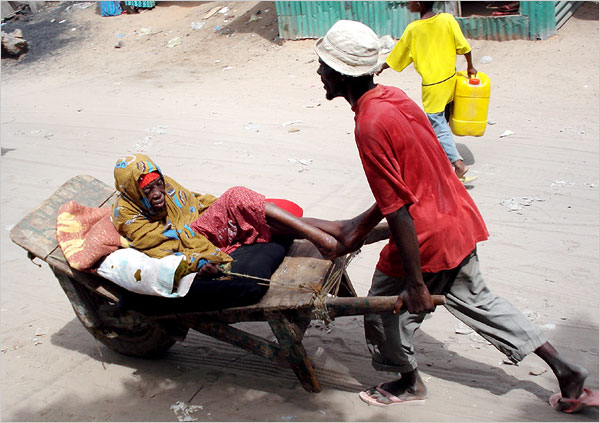
A famine victim is transported in a wheelbarrow (Photo: http://www.newsmania.com)

Is al-Shabaab guilty of a Crime Against Humanity?

As the crisis in Somalia deepens and refugees continue to pour into Dadaab some (also here and here) have begun to raise the question of accountability. There are two considerations in particular: first, is famine a crime against humanity? Second, is al-Shabaab guilty of a crime against humanity?

Before getting to this, it’s worth recapping the genesis of this crisis. The trigger was a below average Deyr rainy season (Oct-Dec 2010) followed by the partial failure of the Gu primary season (April-June). On the back of this, crops failed, livestock died, food prices skyrocketed, the economy crumbled even further and, because of the underlying food insecurity caused by decades of conflict, it hasn’t taken long for the crisis to become a famine.

It is dangerous to oversimplify what factors have helped elevate the crisis into what is now classed as Africa’s worst food security crisis for 20 years, with famine declared in most regions of southern Somalia. Donor states themselves bear some blame for not being quicker to recognize the level of aid needed to address the crisis. Humanitarian organisations can be criticized for giving in too easily to US concerns about funding terrorists and failing to find a way to work within what is admittedly a complex political situation. High food prices weren’t simply due to localized forces but to international speculators jacking up global food prices. Climate change hasn’t helped either.

But it’s local politics that have done the most to turn food insecurity into famine. Al-Shabaab, the rebel group in control of much of the famine afflicted areas, has proved the biggest barrier to improving food security and getting humanitarian relief to the affected communities. In short, the charge is that we wouldn’t be seeing either famine or the resulting internal displacement, at least not on the present scale, if it wasn’t for al-Shabaab.

And so we get to the question of guilt and criminal responsibility, and whether al-Shabaab’s leaders are guilty of a crime against humanity.

crimes in Somalia

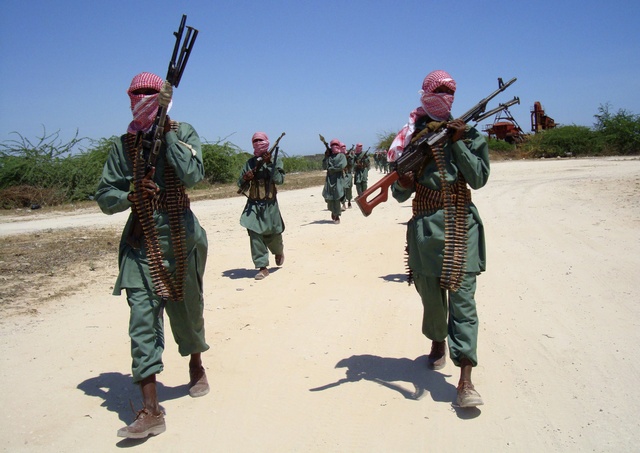
al Shabaab militants training on the outskirts of Mogadishu. Is al Shabaab guilty of a crime against humanity for its role in the famine? (Photo: wehelmedia.com)

Famine as a Crime Against Humanity

In evaluating whether famine can potentially meet the threshold for a crime against humanity, we’re looking at whether it’s part of an action or attack that is widespread or systematic and directed against a civilian population with knowledge and intent. As Alex de Waal points out, in many respects famine is the wrong word to be using here. In the context of criminal responsibility it makes better sense to talk of widespread and systematic starvation. “In famine epidemiology, the verb to starve is transitive – like wounding or murder, it is something that people do to one another.” As Amnesty International have similarly noted, using restrictions on humanitarian aid as a political tool – as Mugabe is accused of doing in Zimbabwe – does provide some grounds for a crime against humanity.

Famine in this sense also contributes to the deportation or forcible transfer of the population (Art. 7.1.d). Famine causes massive internal displacement and forced migration. If there’s any doubt about this, look at how, almost overnight, the refugee camp at Dadaab has been turned into Kenya’s third largest city. What this suggests is that there is a clear-cut case for famine falling under the existing elements of the crime, at least in terms of the action it denotes. There is a prima facie case for al-Shabaab to answer.

The case against Al-Shabaab

The key question, as with all ICL, is whether we can prove intent. Did al-Shabaab engineer the starvation of civilians?  There are two possibilities here, the first that they are culpable for creating the famine, the second that their culpability only begins after the famine had been declared.

Continue reading

Posted in al-Shabaab, Crimes against humanity, Famine, Justice, Somalia | 3 Comments

Justice in Syria: Underground Funding of the ICC

Brothers in arms, and crimes? (Photo: http://www.presidentassad.net)

According to Borzou Daragahi of the LA Times, at least one unnamed Western government is funding a fact-finding operation in Syria in order to gather evidence which may eventually be used against Syrian President Bashar Assad in a case before the International Criminal Court.

When considering why Libya and not Syria was referred to the ICC, it is hard not to be stumped. There is no good answer. After all, if we are to believe what human rights groups say – that a crime against humanity is a crime against humanity, regardless of where it takes place –  then surely the treatment of international crimes across contexts should be similar. Does the divergent treatment of the gravest of crimes, with only a chosen few subjected to international justice, not demonstrate the uncomfortable reality that some forms of suffering and violence are more important and worthy of attention than others? In the wake of indictments issued by the ICC against the Tripoli Three, even the Gaddafi regime appeared to have noticed this uneven application of justice.

There has been no shortage of speculation on the reasons for the divergent (some would simply describe it as hypocritical) international responses to the alleged atrocities being committed in Libya and Syria: the Western powers have spent their political capital on intervening in Libya; there is little support from regional organizations for an intervention in Libya; perhaps the ICC is experiencing “judicial overstretch” with its ever-expanding case-load; and the ICC simply doesn’t have enough money to investigate crimes, particularly in the wake of new investigations in Libya and Ivory Coast.

Syria ICC

(Photo: © Sham News Network)

It is in this context of a general lack of international political will and a lack of funds that reports regarding a clandestine funding of a fact-finding mission in Syria have emerged:

“At least one Western government is bankrolling a project to gather evidence that could be used to indict Syria’s President Bashar Assad at an international tribunal over his crackdown on the country’s democracy movement, said a jurist leading the effort and a diplomat whose government is sponsoring it.

The fact-finding mission mostly involves assembling testimony from Syrian refugees that conforms to standards of international law necessary to sustain a war crimes trial at the International Criminal Court

Continue reading

Posted in Funding, Human Rights, ICC Prosecutor, International Criminal Court (ICC), Libya, Libya and the ICC, Syria | 8 Comments

JiC News: Looking for Guest Bloggers; Help Choose JiC’s Logo

Dear friends,

Just a quick notice that JiC is looking for guest posters and guest bloggers. Plans are underway to introduce a few new writers who will hopefully become regular contributors. If you are interested in writing a single post or become a more regular contributor, send an e-mail to: mark.s.kersten[at]gmail[dot]com and please copy JiC’s editor, Elke Schwarz on the e-mail at: elkeschwarz[at]mac[dot]com

Your proposal should include a little bit about your background and details regarding your experience with issues concerning conflict resolution, international justice or related areas and at least one suggested topic you would like to write a post about. We look forward to reading your submissions!

On another note, I have designed a few possible logos for JiC (see photos, below). I would be grateful if you could share your feedback on them and which you think should be selected. You can vote on the logos below. Also, if you would like to follow JiC on Facebook, now you can (click here)!

JiC Logo 1

JiC Logo 2

JiC Logo 3

JiC Logo 4

Posted in JiC News | 1 Comment

An Argentinean Judge Judy: Moreno-Ocampo’s Retirement Plans?

Judge Judy Judge Ocampo?As many readers will know, this coming December the International Criminal Court’s Assembly of States Parties (ASP) will come together to elect a new Prosecutor. Posts here at JiC have considered the criteria of the next Prosecutor and some potential candidates.

But while many, including myself, are asking: who will be the next ICC Prosecutor, few are asking what the current Prosecutor, Luis Moreno-Ocampo, will do next.

Remarkably, the following clip has escaped my knowledge for the few years that I have been following the ICC. Prior to becoming the ICC’s Prosecutor, Luis Moreno-Ocampo was many things. He was a deputy prosecutor on one of the biggest war crimes trials in history in his native Argentina. He was also a professor at Harvard. For a time he was even legendary soccer player/footballer/diva Diego Maradona’s lawyer. However, as this clip attests, perhaps the best and most widely known and high-profile international prosecutor in all of time, was once the Argentinean version of Judge Judy, which – if I understand correctly – is titled “Forum: The People’s Court” (Thanks Mariana!):

This is just a little mid-week humour. I promise something more serious soon!

Posted in Argentina, Humour, ICC Prosecutor, International Criminal Court (ICC), Next ICC Prosecutor | 4 Comments