
I’m happy to announce that Patrick Wegner is joining JiC as a regular blogger! Patrick is currently doing research in Uganda on the effects of the ICC on the conflict in the north of the country and has a wealth of knowledge and experience to share with readers. His first post considers an issue that I spoke to him at length about when we met in Uganda: the ICC’s need to assess the impact of its work.
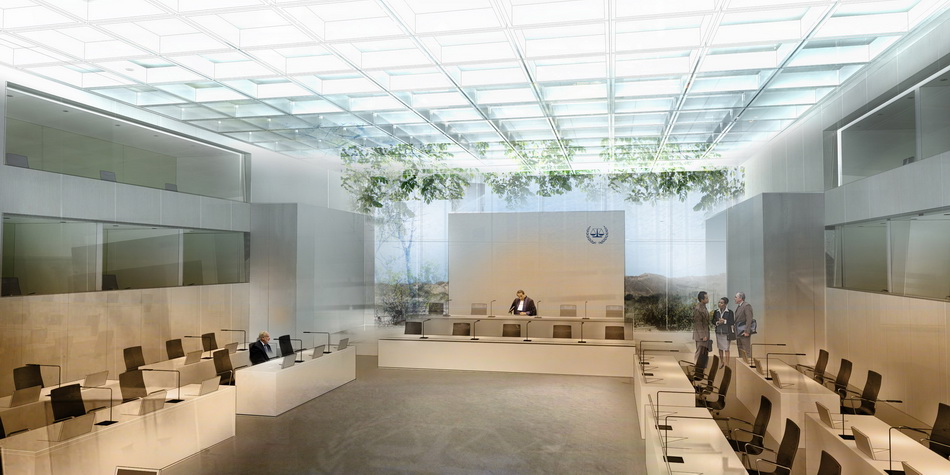
Court Room design in the new ICC premises ©schmidt/hammer/lassen architects
The work of the International Criminal Court, especially with regards to its involvement in ongoing conflicts, has been extremely polemic. In northern Uganda, the ICC warrants for LRA leaders have sparked a discussion about whether the Court is incapacitating those affected by the conflict that supposedly prefer traditional justice mechanism to ‘Western’ retributive justice. Many northern Ugandans also criticise the ICC for not investigating both sides of the conflict. They point out a history of National Resistance Army and Uganda People’s Defence Force crimes reaching back into the late 1980’s for which no accountability has been ensured to date.
In Darfur, humanitarian organizations have criticized the ICC for making their already difficult work even harder by indicting President al-Bashir. Within hours of the warrant, al-Bashir expelled 13 humanitarian organizations working in Darfur. The arrest warrant for President al-Bashir has also been criticized in general by the African Union and the Arab League for destabilizing the region and hindering peace.
Authors like Chris Dolan, William Schabas and Eric Leonard have pointed out errors of judgement committed by the Office of the Prosecutor or have accused the Prosecutor of not understanding the political implications of his decisions. Some of this criticism is justified. Two examples that come to mind are the joint announcement of investigations in northern Uganda by Chief Prosecutor Luis Moreno Ocampo and Uganda’s President, and the decision to issue a public arrest warrant for President al-Bashir in Sudan. Both decisions have been criticized heavily in retrospect and both have had consequences for the situation countries and the cases.
Due to the announcement of investigations in northern Uganda by President Yoweri Museveni, people in northern Uganda saw the court intervention as biased from the beginning. Repeated surveys have found that those affected by the conflict want to see both the LRA and the government held accountable for the crimes they have committed during the conflict. Seeing the Prosecutor and the President side by side made many locals think that the ICC is an instrument of the government that would only investigate the LRA. A later clarification by the Office of the Prosecutor that all sides of the conflict would be investigated was too little to effectively contravene the powerful iconography of the joint declaration. This miscalculation was one important reason for the strong initial hostility that the ICC met among the northern population and local civil society organizations.
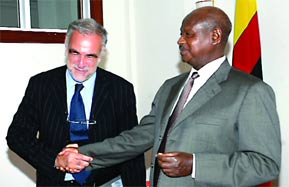
President Museveni and Chief Prosecutor Moreno Ocampo, photo by Independent Photo
The decision to publicly apply for an arrest warrant against President al-Bashir of Sudan has also had negative repercussions for the situation in Darfur. It would be unfair to ascribe the eviction of aid agencies to the ICC, as the Sudanese government had been expelling agencies and their officials in the past. The direct reaction to the warrants was actually an attempt to blackmail the international community into withdrawing the warrants and should be seen as solely President al-Bashir’s responsibility. Yet, pursuing a sealed warrant would have avoided such an immediate backlash and would not have come at the expense of the ICC’s mission to guarantee justice. Additionally, the public arrest warrant was perfect propaganda material for the Darfuri rebel movements. It provided the rebels with another reason to reject negotiations with the government and strengthened their resolve to find a military solution as the pressure on the government could be expected to grow. At the same time, the ICC became part of the conflict as the investigations were exploited for propaganda reasons on both sides. Al-Bashir used them to claim a Western conspiracy to bring Sudan to its knees, thus rallying support even among Sudanese opposition parties. The rebels, on the other hand, emphasized that they were fighting against a criminal regime, with an indicted war criminal at its lead.
Arguably, these strategic mistakes could have been avoided with better knowledge of the situation on the ground. Nobody familiar with the situation in northern Uganda would have ever made an initial declaration at the side of President Museveni. And arguably, having followed the Darfur conflict and the failed negotiations up to that point, it was also pretty clear that the ICC would be drawn into the dynamics of the conflict upon publicly indicting President al-Bashir. Yet, the Office of the Prosecutor had not even tried to investigate the situation on the ground in Darfur due to security reasons.







 Justice in Conflict