
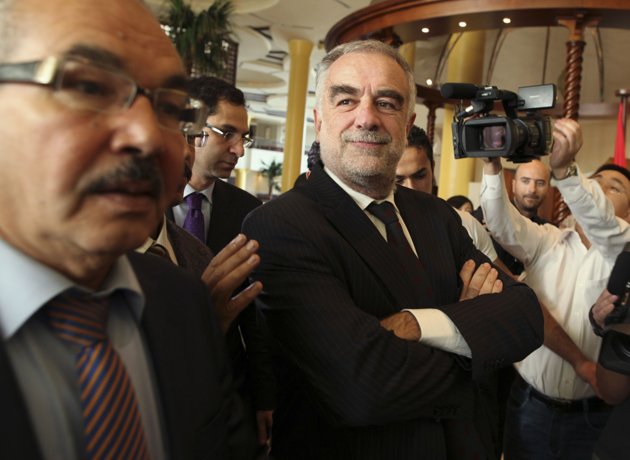
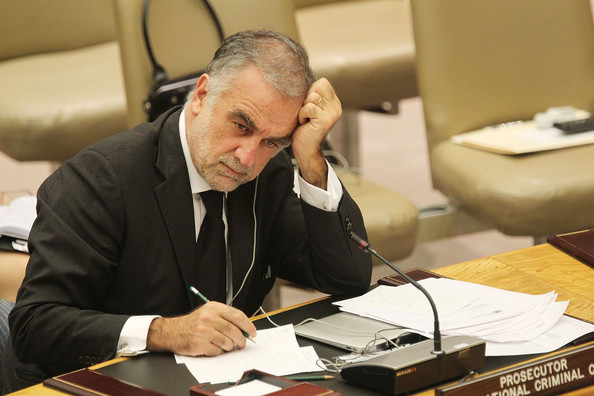
ICC Prosecutor Luis Moreno-Ocampo in Tripoli (Photo: Mohammed Salem / Reuters)
I recently had the opportunity to attend a seminar on the International Criminal Court and complementarity in Libya, held by Leiden’s esteemed professor of international law, Carsten Stahn. The seminar was organized by Jens Meierhenrich and was also attended by international relations and international criminal justice scholar Kirsten Ainley. Once the (excellent) presentation was over, we got into a conversation about ICC Prosecutor Luis Moreno-Ocampo’s leniency towards Libya’s insistence on trying Saif al-Islam Gaddafi and Abdullah al-Senussi. This post is an attempt to think through some of the possible explanations for Moreno-Ocampo’s complacent attitude.
The Background
Following the arrest of Saif al-Islam Gaddafi and (false?) reports that al-Senussi had been detained, there was an impassioned debate about where they would be put on trial: in Libya or at the ICC. A third option, supported by the Office of the Prosecutor and number of observers, was for the ICC to hold an ‘in situ’ trial in Libya, but this was apparently nixed by Libyan authorities. It quickly became clear that Saif would be tried in Libya, by Libyans.
During a visit to Tripoli to talk with the Libyan National Transitional Council, Moreno-Ocampo conceded that Libya could and would try Saif:
“The standard of the ICC is that it has to be a judicial process that is not organised to shield the suspect… and I respect that it’s important for the cases to be tried in Libya… and I am not competing for the case.”
It was an odd and, for some, frustrating statement for a number of reasons. One, it isn’t in the powers of the Prosecutor to decide. As many commentators have noted – and as the ICC’s Pre-Trial Chamber I has clarified – if Saif was to be tried domestically, Libya would have to file a complementarity challenge with the Court. Once the ICC’s Pre-Trial Chamber has approved the opening of an investigation, let alone issued arrest warrants, it isn’t the prerogative of the Prosecutor to decide where and when a trial can take place.
Second, the statement was quite out of character for Moreno-Ocampo. He has never so publicly – and obviously – expressed a desire to “return” a case. It would be unthinkable for Moreno-Ocampo to even entertain the possibility of having Sudanese President, Omar al-Bashir, against whom Moreno-Ocampo has had something of a personal crusade, put on trial in Sudan. Moreno-Ocampo also didn’t express much, if any interest, in having hearings in Kenya for the ‘Ocampo Six’. In sharp contrast, this is exactly what Moreno-Ocampo did in the case of Saif’s trial – much to the chagrin of those skeptical that Libya’s judiciary is sufficiently developed to take on the case, and wary of Saif meeting a fate similar to that of his father.
Here are a four possible reasons why Moreno-Ocampo chose to throw his support, at least nominally, behind a Libyan trial. Of course, some may be more persuasive than others and they are in no particular order.
1. Playing its Part in History: The ICC and the Arab Spring
It could be that Moreno-Ocampo sees himself and the ICC as having a starring role in Libya’s transition and consequently the Arab Spring more broadly. Who wouldn’t want a little bit of that star-dust?
As a result, it is possible that Moreno-Ocampo sees it in his purview to constantly and consistently support the aims of democratic, transitional forces in Libya – in this case, quite clearly, a domestic trial. Given that he will be vacating his office at the ICC within months, it is also possible that Moreno-Ocampo sees justice served in Libya as part of his legacy and believes that trying Saif in Libya is simply the right thing to do. Continue reading










 Justice in Conflict